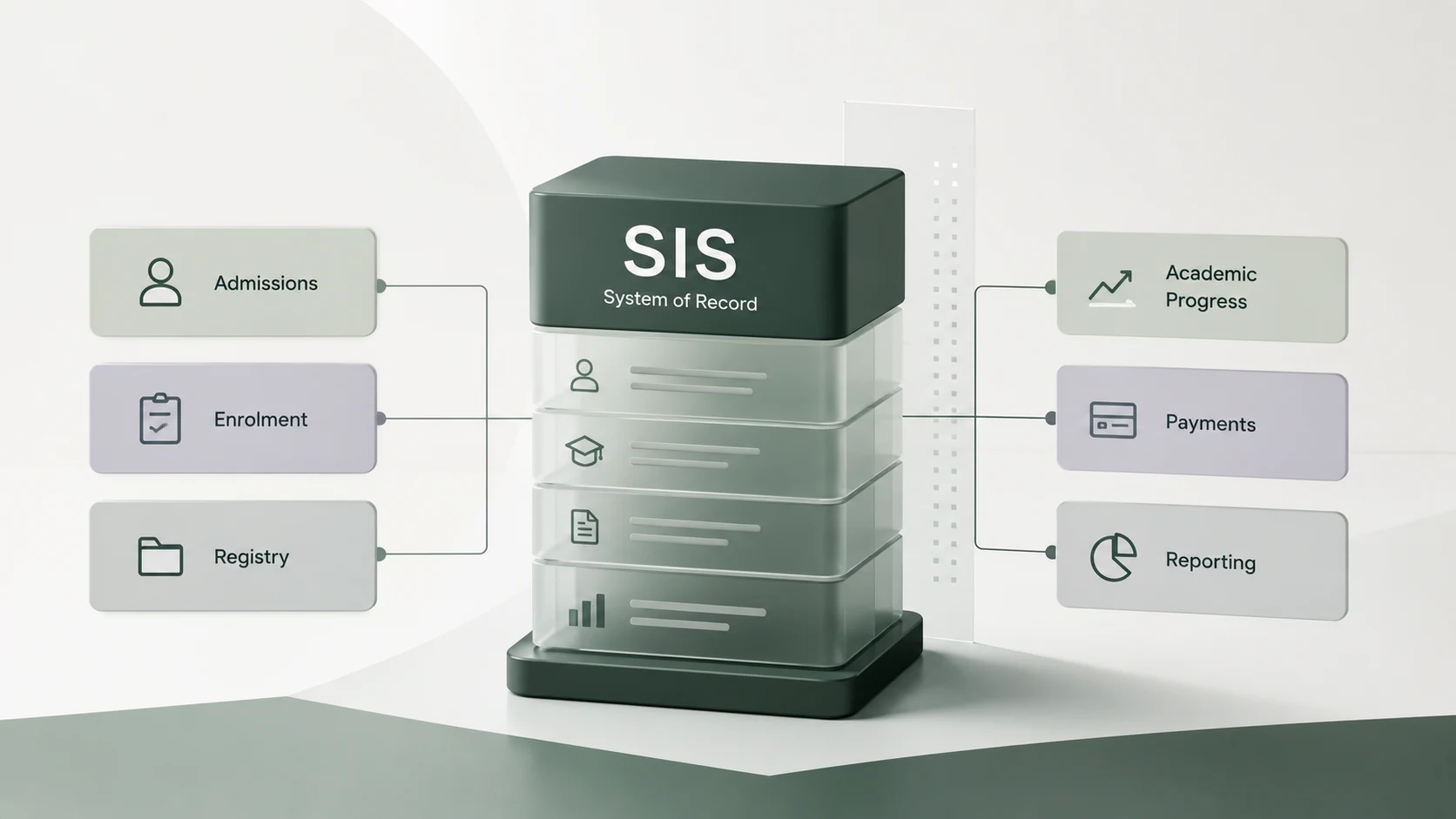
Choosing an ERP system for a university used to be a finance and HR decision. In 2026 it is a strategic one. The system that runs your general ledger, payroll, procurement and grants now sits at the centre of institutional reporting, data governance, cybersecurity posture, cloud strategy and AI readiness. It shapes how quickly finance teams can model an enrolment shortfall, how cleanly student data flows between systems, and how much of your IT capacity is spent maintaining ageing infrastructure rather than improving services.
This guide compares the ERP systems and ERP-adjacent administrative platforms that higher education institutions are most likely to evaluate in 2026. It is written for the people who actually own these decisions and live with the consequences: CIOs and IT directors, CFOs and finance leaders, registrars and student systems leaders, HR and procurement teams, data and reporting leaders, and the institutional leadership teams who sign the business case.
The short answer, stated plainly and then unpacked in detail: the best ERP systems for higher education in 2026 include Workday, Oracle Fusion Cloud ERP, Ellucian, SAP, Unit4, Jenzabar and TechnologyOne, alongside several SIS-led administrative platforms that institutions often assess in the same process. Which one is right for you depends on institution size, geography, public or private status, finance and HR complexity, student lifecycle needs, integration strategy and appetite for transformation. There is no single best ERP for every institution, and any ranking that claims otherwise should be treated with caution.
One boundary matters throughout this article, and it is the reason it is not a generic ERP listicle. An ERP is not a CRM, and it is not an admissions or student engagement platform. Some vendors cover finance, HR and student systems in one suite. Others are much stronger in finance and HR than in the student lifecycle. A few of the platforms institutions evaluate alongside ERP are more accurately described as student information systems (SIS) rather than full ERPs. We flag this clearly for every entry, because buyers who blur these categories tend to end up forcing recruitment, admissions and learner communications into systems that were never designed for them.
The development and maintenance of an in-house system is a complex and time-consuming task. Full Fabric lets you turn your full attention to maximizing growth and performance.

An ERP (enterprise resource planning) system is the software that runs an institution's core administrative and financial operations. In a higher education context, an ERP typically covers some or all of the following:
The important point for buyers is that "ERP" in higher education does not map cleanly onto a single product category. Several distinct system types are often grouped together, and keeping them separate makes selection far easier.
Vendors have strong commercial reasons to blur these categories. Buyers should not. The distinction between what an ERP does well and what a purpose-built student information system for higher education or a higher education CRM does well is precisely where most architecture decisions are won or lost. For a fuller treatment of where these systems overlap and diverge, see Full Fabric's guide on how SIS and CRM systems compare.
Several pressures have converged to make ERP modernisation a board-level topic rather than an IT housekeeping task.
Legacy architecture is the starting point. A significant share of institutions still run finance, HR and student systems that were procured a decade or more ago, often on-premise, heavily customised and expensive to change. Every workaround adds operational drag and technical debt, and each custom modification makes the eventual migration harder.
Financial pressure is intensifying. The 2026 EDUCAUSE Top 10 opens on a notably sober note, describing a sector where the financial stability of many institutions, and of Minority Serving Institutions in particular, is increasingly strained by reductions in federal support. Against that backdrop, EDUCAUSE places data analytics for operational and financial insights, using analytics to reveal spending patterns, enrolment trends and areas for cost savings, among its highest priorities for the year. Finance and IT leaders are being asked to model scenarios and find efficiencies at a speed that fragmented legacy systems simply cannot support.
Cybersecurity now sits at the very top of the agenda. EDUCAUSE ranks collaborative cybersecurity, building a culture of shared responsibility, end-user awareness and improved access to security services, as its number one issue for 2026. Ageing administrative systems are a material part of the exposure, and the security posture of a core ERP is now a first-order selection criterion rather than a technical footnote.
AI readiness has become part of the ERP conversation, though EDUCAUSE frames it carefully. Its second-ranked issue, "The Human Edge of AI," is about empowering students, faculty and staff to engage with AI tools critically, creatively and safely, rather than about buying AI features for their own sake. The EDUCAUSE panel is explicit that it will not be a silver-bullet solution, or even artificial intelligence, that carries institutions through the present moment. For ERP buyers, the practical question is whether a vendor's AI roadmap is genuinely useful and well-governed, not whether it exists.
Cloud migration, integration complexity and the demographic pressures behind the enrolment cliff round out the picture. Institutions are being asked to do more with constrained resources, on systems that need to be more secure, more connected and easier to report from. That combination is why ERP selection in 2026 is best understood as a decision about the institutional operating model, not just a procurement exercise. For a practical view of the AI dimension specifically, Full Fabric's guide to navigating AI in higher education is a useful companion.
No ERP should be chosen from a ranking alone. A ranking is a shortlist and an evaluation guide. The real work is scoring candidate systems against criteria that reflect your institution's actual context. The following framework covers the areas that matter most.
This list is a shortlist and evaluation guide, not a definitive league table. Popularity alone does not determine the order. Entries are assessed on higher education fit, breadth and depth across finance, HR, procurement, grants, planning and reporting, cloud maturity, integration ecosystem, security posture, regional relevance and suitability for different institution types.
The ranking deliberately mixes full ERPs with ERP-adjacent and SIS-led platforms, because institutions frequently evaluate them in the same process. Where an entry is not a full finance, HR and procurement ERP, we say so explicitly. We do not repeat vendor marketing claims as independent facts, and every numerical claim is attributed to a named source. Full Fabric does not appear in the ranking, because Full Fabric is not an ERP. Its place in the wider architecture is covered in a dedicated section below.
| Rank | ERP system | Best for | Strongest areas | Key considerations |
|---|---|---|---|---|
| 1 | Workday | Cloud-first institutions modernising finance, HR and student together | Finance, HCM, planning, unified data model | Scale of change; cost; admissions and CRM depth |
| 2 | Oracle Fusion Cloud ERP | Large, complex institutions wanting a broad cloud suite | Finance, procurement, HCM, analytics | Implementation effort; breadth can exceed need |
| 3 | Ellucian | Institutions wanting a vendor solely focused on higher education | Purpose-built SIS and ERP, SaaS migration path | Legacy-to-SaaS migration is not simple |
| 4 | SAP S/4HANA | Large research universities in the SAP ecosystem | Finance, procurement, grants, research | Complexity; strong partner dependency |
| 5 | Unit4 ERPx | People-centric mid-to-large institutions, strong in Europe | Finance, HR, FP&A, procurement | Less suited to very large US research universities |
| 6 | Jenzabar One | Small and mid-sized institutions wanting integrated campus admin | Higher-education-native suite, student and finance | Best fit for its target segment; less for very large universities |
| 7 | TechnologyOne | Education and public sector in Australia, New Zealand and the UK | SaaS ERP, single platform, operations | Strongest in specific regions |
| 8 | Anthology (now part of Ellucian) | Existing Anthology customers seeking continuity | Student, finance and HCM continuity | Now maintained by Ellucian; roadmap evolving |
| 9 | Tribal SITS | UK and regional institutions needing deep student administration | Student records and student finance | SIS-led, not a full finance and HR ERP |
| 10 | Thesis | Institutions modernising student records on a cloud SIS | Cloud SIS, student management, migration | SIS-led, not a full ERP |
Best for: cloud-first institutions modernising finance, HR and, increasingly, student operations on a single platform.
Workday built its reputation on cloud human capital management and financial management, and it has extended into higher education with a suite spanning finance, HCM, planning and student capabilities. Workday describes its education offering as a single system designed to bring together finance, HR, planning and student data, which is the core of its pitch: one data model rather than a set of integrated products. This is genuinely attractive for institutions that want to retire multiple legacy systems and report from a unified dataset.
Why it stands out. The unified data model is the differentiator. When finance, HR and planning share the same underlying data, cross-domain reporting and scenario modelling become materially easier, which speaks directly to the financial and analytics pressures EDUCAUSE has highlighted for 2026. Workday's planning capability is well regarded, and its cloud-native architecture avoids the hosted-legacy ambiguity that affects some competitors.
Strengths. Deep finance and HCM; strong planning, budgeting and forecasting; a mature cloud platform; a large enterprise customer base outside education that underpins investment in the product.
Limitations and fit considerations. Workday is an enterprise-scale commitment. Implementations are substantial change programmes, not configuration exercises, and total cost of ownership is at the higher end. Its student capabilities, while expanding, are newer than its finance and HCM heritage, and institutions should evaluate them on current evidence rather than assumption. It is best suited to larger universities and institutions with the capacity to run a significant transformation.
Where it may need complementary systems. Workday is a finance, HR and planning platform first. Recruitment, admissions engagement, enquiry management and applicant communications are not its centre of gravity, and many institutions pair it with a purpose-built admissions and enrolment platform or CRM for the front-office student lifecycle.
Best for: large or complex institutions that want a broad, integrated cloud suite from a single major vendor.
Oracle offers higher education institutions its Fusion Cloud applications, spanning ERP (finance and procurement), enterprise performance management (planning), HCM and analytics, alongside Oracle's student offerings and a wider set of education and research solutions. The breadth is the headline: few vendors can match Oracle's coverage across finance, procurement, planning, HR and analytics within one cloud family.
Why it stands out. Suite breadth and depth. For institutions that value consolidating on a single major cloud vendor, Oracle Fusion Cloud can cover a very large share of the administrative estate, with strong procurement and spend management and a mature analytics layer.
Strengths. Comprehensive finance and procurement; capable planning and analytics; extensive cloud infrastructure; a global vendor with deep resources.
Limitations and fit considerations. Breadth can exceed what smaller institutions need, and implementation is a significant undertaking that usually depends on an experienced systems integrator. Oracle's marketing frequently draws direct comparisons against competitors; buyers should test claims against their own requirements rather than accepting positioning statements. As with any large suite, the risk is buying more platform than the institution can absorb.
Where it may need complementary systems. Oracle's strengths are administrative and financial. Institutions with sophisticated recruitment and admissions needs often find that a specialised CRM and admissions layer, connected to Oracle for finance and records, serves applicants and staff better than the ERP alone.
Best for: institutions that want a technology partner focused solely on higher education, with a clear SaaS migration path.
Ellucian is the most higher-education-specific vendor on this list, and 2025 to 2026 has significantly expanded its position. Its portfolio spans the long-established Banner and Colleague platforms and its newer SaaS-native Ellucian Student, HCM and Finance, which Ellucian describes as powered by Banner and Colleague and purpose-built for higher education. Ellucian states that it partners with approximately 3,000 customers across 50 countries, serving more than 21 million students.
Two recent developments matter for buyers. First, Ellucian reported a record first quarter of 2026, with 26 institutions going live on its SaaS SIS and ERP solutions, the highest number in a single quarter, a signal that its cloud migration is gaining pace. Second, and more consequentially, Ellucian completed its acquisition of Anthology's Student Information Systems and Enterprise Resource Planning business on 31 December 2025, following its successful bid in Anthology's Chapter 11 process, bringing more than 260 Anthology SIS and ERP customers into Ellucian. This makes Ellucian a substantially larger presence in the SIS and ERP market than it was a year earlier.
Why it stands out. Singular focus on higher education, a purpose-built product set covering both student and administrative systems, and a large, well-established customer community.
Strengths. Deep sector expertise; broad coverage across SIS, HCM and finance; an active SaaS migration path; a large user community that provides reference customers and shared practice.
Limitations and fit considerations. The Banner and Colleague heritage is both a strength and a challenge. Many institutions run older on-premise deployments, and the move to SaaS-native Ellucian is a real migration project rather than an upgrade. Ellucian's own materials acknowledge that modernisation is a strategic choice rather than simply an IT project, and can be time-consuming, requiring significant institutional resources and change management. Institutions should distinguish clearly between legacy Banner or Colleague and the newer cloud offerings when scoping any project, and should not assume migration is simple for every institution.
Where it may need complementary systems. Even with broad coverage, some institutions layer a specialised CRM and admissions platform over Ellucian for recruitment marketing, enquiry nurture and applicant experience. Full Fabric maintains a detailed Ellucian alternative and comparison resource for institutions weighing the front-office layer specifically.
Best for: large, complex institutions and research-intensive universities already invested in the SAP ecosystem.
SAP serves education and research institutions through its S/4HANA platform and wider industry solutions, covering finance, HR, procurement, research administration, grants and analytics. SAP's strength is enterprise-grade financial and operational management at scale, backed by one of the deepest partner ecosystems in enterprise software.
Why it stands out. Enterprise depth. For large universities with complex finance structures, significant research funding to administer, and a need for rigorous procurement and grants management, SAP offers proven capability and a mature ecosystem.
Strengths. Robust finance and procurement; strong grants and research administration; powerful analytics; extensive partner network for implementation and support.
Limitations and fit considerations. SAP implementations are complex and partner-dependent, and the platform is generally overkill for smaller institutions. Success depends heavily on the quality of the implementation partner and on disciplined scoping. The investment is justified where scale and complexity demand it, and hard to justify where they do not.
Where it may need complementary student lifecycle systems. SAP's centre of gravity is finance, HR, procurement and research administration. It is not primarily a student recruitment, admissions or lifecycle engagement platform, and research universities commonly connect it to dedicated SIS and CRM systems for the student-facing layer.
Best for: people-centric mid-to-large institutions, with particularly strong adoption across parts of Europe.
Unit4 positions ERPx as an ERP built for people-centric, service-oriented organisations, a category into which higher education fits well. Its higher education offering spans finance, HR, financial planning and analysis, procurement and, in relevant contexts, research funding administration. Unit4 has a notable base among universities and colleges, especially in the UK, the Nordics and other European markets.
Why it stands out. Unit4's "people-centric" framing reflects a genuine design emphasis on organisations where staff, projects and funding, rather than physical products, are the core. Its FP&A and reporting capabilities are well regarded, and it is often more proportionate for mid-sized institutions than the very largest enterprise suites.
Strengths. Strong finance and HR; capable financial planning and analysis; good procurement; a design orientation that suits service organisations; solid regional fit in Europe.
Limitations and fit considerations. Unit4 is less commonly the default choice for the very largest US research universities, where Workday, Oracle and SAP dominate the conversation. Institutions should confirm the depth of any research and grants functionality they specifically need, and check regional payroll and statutory coverage.
Where it may need complementary systems. As a finance and HR ERP, Unit4 typically pairs with a dedicated SIS and a purpose-built CRM and admissions platform for the full student lifecycle.
Best for: small and mid-sized institutions that want an integrated, higher-education-native campus administration suite.
Jenzabar One is a higher-education-specific platform bringing together student, finance and HCM capabilities. Jenzabar is an active voice in the sector, and contributed a corporate perspective to the 2026 EDUCAUSE Top 10 alongside other vendors. Its proposition centres on integrated campus administration designed specifically for colleges and universities, with a strong presence among small and mid-sized institutions.
Why it stands out. Higher education focus combined with a scale of solution that fits smaller institutions well. Where the largest suites can overwhelm a modest IT team, Jenzabar aims to provide integrated student, finance and HR administration proportionate to the institution.
Strengths. Purpose-built for higher education; integrated student and administrative functions; a focus on the small and mid-sized segment that larger vendors sometimes underserve; an engaged customer community.
Limitations and fit considerations. Jenzabar is strongest in its target segment. Very large or highly complex universities may find they need the breadth of an enterprise suite. As with any vendor, marketing superlatives should be verified against current, sourced evidence rather than taken at face value.
Where it may need complementary systems. Depending on the modules an institution adopts, a specialised CRM and admissions layer can strengthen recruitment and applicant engagement alongside Jenzabar's administrative core.
Best for: education and public-sector institutions in Australia, New Zealand and the UK seeking a single SaaS ERP.
TechnologyOne is an enterprise SaaS provider with a strong education and public-sector focus, particularly in Australia and New Zealand and, increasingly, the UK. Its proposition is a single, integrated SaaS ERP spanning finance and operations, with education-sector solutions layered on top, aimed at simplifying the administrative estate and improving the staff and student experience.
Why it stands out. A genuinely single-platform SaaS approach and deep familiarity with the public-sector and education context in its core regions. For institutions in those markets, TechnologyOne's regional fit, including statutory and operational alignment, is a real advantage.
Strengths. Modern SaaS architecture; integrated finance and operations; strong regional presence and sector understanding; a focus on operational simplification.
Limitations and fit considerations. TechnologyOne is strongest where it is most established. Institutions outside Australia, New Zealand and the UK should weigh the size of the local customer base and support presence. As always, confirm the depth of any specific module the institution depends on.
Geographic fit. Australia, New Zealand and the UK are the natural markets; the value proposition is weaker where the regional footprint is thinner.
Best for: existing Anthology customers seeking continuity, rather than greenfield buyers evaluating from scratch.
Anthology's SIS and ERP products, including Anthology Student and its finance and HCM capabilities, served a substantial base of institutions. Their status changed materially at the end of 2025. Following Anthology's Chapter 11 restructuring, Ellucian completed its acquisition of Anthology's SIS and ERP business on 31 December 2025, transferring more than 260 customers to Ellucian, which said it will continue to support and maintain the existing systems. Separately, Encoura acquired Anthology's Lifecycle Engagement and Student Success solutions on 2 February 2026. The Anthology SIS and ERP business now sits with Ellucian, while Anthology's remaining focus and product structure should be assessed through current Anthology and buyer communications rather than assumed from pre-close materials.
For institutions currently on Anthology's SIS or ERP, Ellucian's guidance emphasises continuity. Ellucian states that institutions will continue operating as they do today, with systems, support channels, login processes and day-to-day workflows unchanged, and existing integrations, APIs, configurations and customisations continuing to operate, and that Anthology employees who support those institutions have joined Ellucian.
Why it appears here. These products still run critical operations at hundreds of institutions, and continuity is the operative concern. This entry is about the installed base, not a recommendation to select Anthology-branded products as a new greenfield choice.
Strengths. Established student, finance and HCM functionality; a defined continuity commitment from Ellucian; retained support teams.
Limitations and fit considerations. Longer-term integration plans across the combined Ellucian and Anthology portfolios have not been fully detailed publicly, and Ellucian has said any longer-term integration will be guided by institutional needs with continuity as the foundation. New buyers evaluating the market afresh should assess Ellucian's broader SaaS-native roadmap directly rather than the Anthology brand in isolation, and should treat product-roadmap questions as something to confirm with the vendor.
Where it may need complementary systems. As with other administrative suites, front-office recruitment, admissions engagement and lifecycle communications are candidates for a specialised CRM and admissions platform.
Best for: UK and regional institutions that need deep student administration and student finance.
Tribal's SITS:Vision is a well-established student information and management platform, widely used across UK higher education. It is important to be clear about what it is: SITS is primarily a student management or SIS platform, not a full finance, HR and procurement ERP. It is included here because student records, enrolment and student finance are core parts of the higher education administrative stack, and many institutions evaluate SIS-led systems alongside ERP rather than treating them as entirely separate decisions.
Why it appears here. For UK and regionally focused institutions, the SIS is often the most consequential administrative system they own, and SITS has deep functionality in exactly that domain.
Strengths. Mature student records and enrolment; student finance handling; strong UK and regional fit; long track record in the sector.
Limitations as a full ERP. SITS is not a substitute for a finance and HR ERP. Institutions using it typically run separate finance, HR, payroll and procurement systems, and should plan integration between the SIS and those systems deliberately. It should not be described as a complete finance, HR and procurement ERP.
Where it fits. SITS commonly sits alongside a finance and HR ERP and, where recruitment and admissions engagement matter, a purpose-built CRM and admissions layer.
Best for: institutions modernising student records on a cloud-native SIS.
Thesis is a cloud-based student information and management platform. As with SITS, the important framing is that Thesis is primarily an SIS or student management platform, not a full ERP. It earns a place on this list as an ERP-adjacent administrative system that institutions evaluate when they are specifically modernising student records, rather than as a finance, HR and procurement suite.
Why it appears here. Cloud-native SIS platforms are a live consideration for institutions replacing ageing student systems, and Thesis is positioned in that modernisation conversation.
Strengths. Cloud-native architecture; a focus on student management and records; relevance to institutions prioritising SIS modernisation and data migration.
Limitations versus a full ERP. Thesis does not provide the finance, HR, payroll, procurement and grants breadth of a core ERP, and it should not be evaluated as though it does. Institutions adopting it will still need finance and HR systems, and clean integration between them.
Where it fits. As a student-records-focused platform, Thesis typically complements, rather than replaces, an institution's finance and HR ERP.
Depending on institutional context, several other systems may deserve a place on a shortlist. Microsoft Dynamics 365 is configurable ERP infrastructure that higher education partners implement, though it is better understood as a platform to be configured than as a higher-education-native ERP. Oracle NetSuite is a capable cloud ERP where a credible education fit can be established, more often for smaller or non-traditional providers. Blackbaud Financial Edge NXT is relevant specifically as finance and fund accounting software for the sector rather than as a full ERP. If any of these is a stronger fit for a given institution than an entry above, it belongs on that institution's shortlist, provided its category (full ERP, finance-led, SIS-led or configurable platform) is stated clearly.
The honest answer to "which is best" is "best for what, and for whom." The following guidance maps common situations to the systems most worth evaluating first. None of these is a guarantee of fit; each is a sensible starting point.
This is the distinction that most often determines whether an implementation succeeds or disappoints, and it is central to understanding where a platform like Full Fabric fits.
An ERP is not the best place to manage recruitment and admissions engagement. Finance and HR systems are designed around transactions, records and controls, not around nurturing a prospective student across months of enquiries, events, open days and application steps. Forcing recruitment marketing and applicant communication into an ERP tends to produce clunky workarounds and frustrated teams.
An SIS is not the best place to manage marketing, enquiries and nurture either. The student information system is authoritative for the academic record once someone becomes a student. It is not built for the pre-application relationship, the enquiry pipeline or the campaign and communication workflows that recruitment teams live in.
A CRM is not the same as an ERP. A higher education CRM manages relationships, outreach and the admissions pipeline; an ERP manages finance, HR and administration. Confusing the two leads institutions either to over-extend an ERP into work it does badly, or to expect a CRM to do administrative jobs it was never designed for.
Admissions teams sit in the gap. They need workflow, communications and applicant context that lives between the CRM relationship layer and the SIS record. Application evaluation, offers, conditions, document collection and the transition to enrolment are their own distinct problem. This is precisely the space a dedicated admissions and enrolment platform occupies. Full Fabric's guidance on choosing the right CRM for higher education and on what universities use CRM systems for explores these boundaries in more depth.
The practical conclusion is that most institutions do not choose between ERP and CRM and SIS. They run all three, and the architecture question is which system owns which data and process, and how cleanly they connect.
To be unambiguous: Full Fabric is not an ERP, and it is not ranked as one in this article. It does not replace Oracle, Workday, SAP, Ellucian, Unit4, Jenzabar or any core finance and HR ERP, and it does not replace payroll, procurement, grants or research management systems. Where an institution runs an ERP, that ERP typically remains the source of truth for finance, HR, payroll, procurement and grants.
What Full Fabric does is provide the higher education front-office and student lifecycle layer that ERPs are not designed to own. It is a purpose-built platform for higher education, connecting relationship management and CRM, recruitment, admissions and enrolment, student information and records, communications, payments where relevant, reporting and contextual AI around a single learner record that runs from first enquiry to alumni status.
In an architecture where an ERP owns the general ledger and workforce, Full Fabric can serve as the operational platform for the CRM, admissions and student lifecycle workflows that need to sit close to learners, applicants and the teams who serve them. It integrates with existing institutional systems rather than trying to replace them, which lets institutions avoid forcing recruitment, admissions and learner communications into systems that were never built for those tasks. Data protection is treated as a foundational requirement, supported by Full Fabric's security and GDPR resources and its Trust Center, and any compliance posture should be assessed against your own institution's regulatory obligations.
This is useful in practice where an institution needs stronger CRM, enquiry management, applicant experience, student records continuity, lifecycle communications and operational visibility than its ERP alone provides. It is particularly relevant for business schools, public universities, executive education providers and lifelong learning teams, and it is a common consideration for IT teams mapping which system should own which part of the estate. Fit always depends on the institution's existing architecture; the point is complementarity, not replacement.
ERP implementations fail more often through avoidable process and governance problems than through software defects. The recurring risks are worth naming plainly.
Unclear scope is the first. Institutions that start without a firm answer to "what are we replacing, and what are we not" tend to see scope expand until timelines and budgets break. Closely related is the tendency to underestimate data migration: legacy data is rarely as clean or well-structured as assumed, and migration is as much about understanding and reconciling data as moving it.
Customisation debt accumulates when institutions recreate every legacy quirk in the new system, undermining the maintainability that a modern platform is supposed to deliver. Integration complexity is frequently underestimated, particularly the connections between the ERP, the SIS, the CRM and identity systems. Weak governance and poor stakeholder alignment compound both, especially when finance, registry, admissions, HR and IT are not aligned on objectives from the start.
Treating ERP purely as an IT project is a classic error; Ellucian's own materials stress that modernisation is a strategic choice rather than an IT task. So is overloading an ERP with CRM and admissions workflows it was not designed for, which produces exactly the workarounds this article warns against. Add unclear data ownership, change management fatigue, disruption to critical reporting at go-live, and the complexity of procurement and contracting, and the picture is complete. Every one of these is manageable, but only if it is anticipated.
Use this checklist to structure an evaluation before shortlisting vendors.
ERP systems matter because they support the institutional operating model. The right ERP can strengthen finance, HR, procurement, grants, reporting and administration, and can materially improve an institution's resilience and agility at a moment when EDUCAUSE's own panel places financial insight, cybersecurity and responsible AI at the top of the sector's agenda. But no ERP should be selected without a clear understanding of the full student lifecycle and the wider integration landscape, and no single system is universally best.
The most successful institutions treat ERP selection as one part of a deliberate architecture: an ERP for finance, HR and administration; an SIS for the academic record; and a purpose-built CRM and admissions layer for the recruitment and student lifecycle work that neither an ERP nor an SIS was designed to do. For institutions that need an ERP plus a purpose-built layer for CRM, admissions, enrolment and student lifecycle management, Full Fabric can complement core ERP systems by connecting recruitment, admissions, student records, communications, reporting and integrations around one learner record.
An ERP system in higher education is the software that runs an institution's core administrative and financial operations, typically covering finance and the general ledger, budgeting, procurement, HR and payroll, and often grants, research administration and student billing. Some higher education ERP suites also include a student information system module, while others focus on finance and HR and connect to a separate SIS.
There is no single best ERP for every institution. The strongest options in 2026 include Workday, Oracle Fusion Cloud ERP, Ellucian, SAP, Unit4, Jenzabar and TechnologyOne, and the right choice depends on institution size, geography, public or private status, finance and HR complexity, student system needs, integration strategy and appetite for transformation. A ranking is a shortlist and evaluation guide, not a substitute for scoring systems against your own requirements.
No. An ERP manages finance, HR, procurement and core administration, while a student information system (SIS) manages student records, enrolment, registration, academic results and progression. Some ERP suites include an SIS module and some SIS platforms sit entirely separately, but the two address different problems and are often best evaluated as distinct, connected systems.
No. An ERP manages finance, HR and administration, whereas a CRM manages relationships, recruitment, enquiries, admissions engagement and applicant communications. Institutions that try to run recruitment and admissions inside an ERP usually find the fit poor, because ERPs are built around transactions and records rather than around nurturing prospective students.
Ellucian is the most higher-education-specific major vendor and, after acquiring Anthology's SIS and ERP business at the end of 2025, serves a very large installed base. Workday, Oracle and SAP are common among larger institutions, Unit4 and TechnologyOne have strong regional footprints, and Jenzabar is widely used among small and mid-sized institutions. The mix varies significantly by country and institution type.
Start by defining scope and data ownership: what you are replacing, which system owns which data object, and what the ERP, SIS and CRM should each handle. Then evaluate candidates against higher education fit, finance and HR depth, student and integration needs, cloud maturity, security, implementation complexity, regional fit and total cost of ownership, using reference customers and hands-on evaluation rather than vendor demos alone.
Both approaches are legitimate, and the answer depends on institutional capacity and priorities. A single suite can simplify integration and reporting but may be weaker in specific areas such as recruitment and admissions, while best-of-breed lets institutions pick the strongest system for each job at the cost of more integration work. Many institutions land on a hybrid: a core ERP for finance and HR, connected to specialised systems for the student lifecycle.
The most common risks are unclear scope, underestimated data migration, customisation debt, integration complexity, weak governance and poor stakeholder alignment. Treating ERP as an IT-only project, and overloading it with CRM or admissions workflows it was not designed for, are frequent causes of disappointment. Most of these risks are manageable when anticipated early.
Full Fabric provides the higher education front-office and student lifecycle layer that ERPs are not designed to own, covering CRM, recruitment, admissions, enrolment, student records, communications, reporting and contextual AI around a single learner record. It integrates with existing institutional systems, so an ERP can remain the source of truth for finance, HR, payroll, procurement and grants while Full Fabric handles the recruitment, admissions and student lifecycle work that needs to sit close to learners and staff.
No. Full Fabric does not replace finance, HR, payroll, procurement, grants or core ERP systems, and it is not an ERP. It complements ERP by supporting CRM, admissions, enrolment and student lifecycle operations, connecting to the ERP and other institutional systems rather than replacing them.