For Public Universities

Software built for the complexity of public universities

Public universities manage more than applications. They manage outreach, recruitment, admissions, enrolment, student records, payments, reporting, widening participation, international recruitment, continuing education, and lifelong learning. Full Fabric brings those operations into one connected platform, with a single student record at the centre.

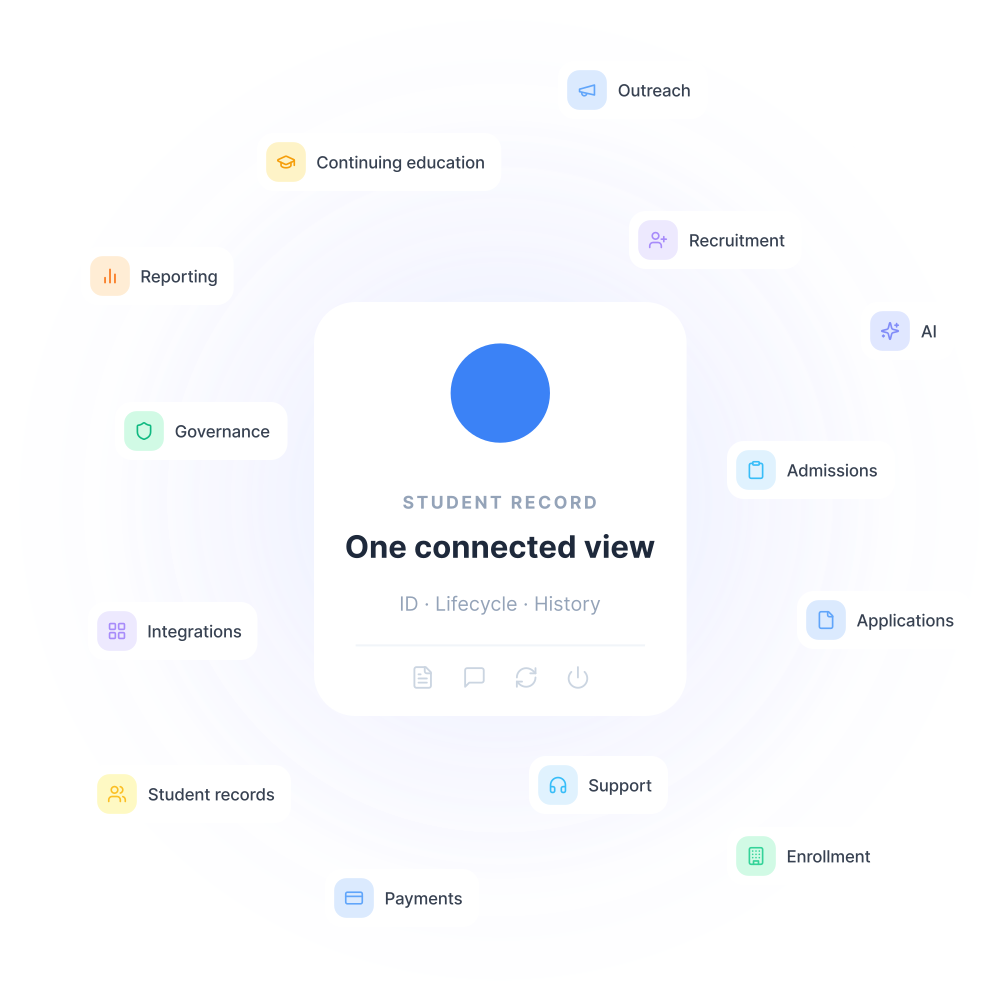
One connected student record at the centre of outreach, recruitment, admissions, applications, enrolment, payments, student records, support, reporting, continuing education, AI, integrations, and governance.
Operating Model

Public universities need a connected operating model

A public university is rarely a single admissions operation. It is a federation of faculties, schools, departments, programmes, and campuses, each with its own intake patterns, applicant profiles, review processes, and reporting requirements. Operational reality at this scale looks different from a smaller, single-portfolio institution.

Multiple faculties and departments, each with distinct admissions rules, document requirements, and decision workflows.

Undergraduate, postgraduate, doctoral, international, continuing education, and lifelong learning pathways running in parallel, often through different teams.

High-volume enquiries and applications across several intakes per year, with peaks that stress every system in the chain.

Widening participation, access, and outreach programmes that are central to the institution's public mission, not an add-on.

International recruitment with regional pipelines, language and document considerations, and a long lead time from first contact to enrolment.

Reporting obligations to national agencies, funding bodies, and institutional governance structures.

Cross-team dependencies between recruitment, admissions, registry, finance, IT, student support, and leadership.

When systems are fragmented across these teams, complexity compounds. Staff spend more time reconciling data than acting on it. Applicants and students experience the gaps. Leadership has to wait for reports rather than work from them.

A connected operating model is not about replacing every system. It is about giving the institution a coherent view of each student, end to end, so each team can do its work without losing the wider context.

Student Lifecycle

The public university student lifecycle is bigger than admissions

In a public university, the same person can interact with the institution at many points over many years.

Each of these stages typically lives in a different system. CRM captures the prospect. Outreach activity is often tracked separately. An application portal sees the applicant. Admissions teams manage the offer holder. The SIS records the enrolled student. Finance manages payments. Student support tracks cases. Continuing education sits in its own environment. Reporting teams reconstruct the picture afterwards.

The result is that few institutions can answer a basic question with confidence: what is our complete relationship with this person, across every interaction we have had with them?

Fragmented systems

Each team sees a slice. The picture is rebuilt by hand.

CRM
Outreach tracking
Application portal
Admissions workflow
SIS
Finance
Student support
Continuing education tools
Reporting spreadsheets

One connected student record

A single, continuous view from outreach to lifelong learning.

Recruitment and CRM
Applications and admissions
Enrolment
Payments
Student records
Reporting
Outreach context
Continuing education
Lifelong learning

A connected student record changes that. It links outreach to application, application to enrolment, enrolment to progression, and progression to alumni and lifelong learning. The institution stops treating each stage as a separate problem.

Full Fabric Platform

How Full Fabric supports public universities

Full Fabric is a unified platform for the full student lifecycle. It connects the operational areas that public universities depend on, around one student record.

CR

Recruitment and CRM

For enquiry capture, segmentation, campaign tracking, and engagement history across the prospect-to-applicant journey. Learn more on the higher education CRM platform and admissions CRM pages.

AA

Applications and admissions

Including a configurable online application portal, document collection, decision workflows, and admissions automation for repetitive operational tasks. See the student application management system for the full picture.

EM

Enrolment management

To move offer holders into enrolled students with continuity of record. Explore enrolment management software.

SR

Student information and records

That hold the institutional history of each student. Explore the student information system.

RD

Reporting and dashboards

So that leadership, admissions, recruitment, registry, and finance can work from consistent institutional data. See admissions dashboards and reporting.

AI

AI Console and AI-supported workflows

For natural-language questions over institutional data and assistance with drafting, routing, and coordination. Learn more about AI in Full Fabric.

IE

Integrations and ecosystem

So the platform sits coherently alongside finance, payments, LMS, identity, marketing, and analytics tools. See the integrations ecosystem.

SG

Security and data governance

Designed to support GDPR-aligned operations, role-based access controls, and auditability. See security and GDPR compliance and the dedicated GDPR compliance for higher education feature page.

The point is not the number of modules. The point is that they are designed to support a connected student record, consistent access controls, and reporting built on the same operational data, so the institution stops moving data manually between systems that should already know about each other.
One connected platform

Public university operations on a single student data model

CRM, admissions, applications, payments, enrolment, SIS, reporting, AI, integrations, and governance designed to work from the same continuous record.

Layer 01

CRM

Enquiries, segmentation, and engagement history.

Layer 02

Admissions

Programme-specific journeys and decision workflows.

Layer 03

Online application portal

Configurable applicant experience and document collection.

Layer 04

Payments

Deposits and payments linked to the student record.

Layer 05

Enrolment management

Continuity from offer holder to enrolled student.

Layer 06

SIS

Institutional history of each student.

Layer 07

Reporting

Operational data shared across teams and leadership.

Layer 08

AI Console

Natural-language questions within data and permissions.

Layer 09

Integrations

Finance, payments, LMS, identity, marketing, and analytics.

Layer 10

Governance

Access controls, auditability, and privacy-conscious operations.

Anchored by
One connected student record
Use Cases

Core use cases for public universities

Operational realities for the teams running undergraduate, postgraduate, international, outreach, continuing education, and enrolment.

Undergraduate admissions

High-volume intakes, programme-specific journeys

Operational problem

Undergraduate intakes are high-volume, time-sensitive, and operationally intense. Programme-specific requirements, deadlines, and decision workflows multiply quickly across a large institution.

How Full Fabric helps

Full Fabric supports undergraduate admissions with structured application journeys per programme, document collection, applicant communications, offer management, and a clean handoff into enrolment. Automation removes routine steps such as document chasing, status updates, and reviewer reminders, while keeping decisions with the right teams.

What teams gain

Faster operational cycles during peak intakes, fewer dropped handoffs between recruitment and admissions, and a clearer view of applicant progress at scale.

Postgraduate admissions

Decentralised review with consistent visibility

Operational problem

Postgraduate admissions are often decentralised. Faculty or department-level academics, supervisors, and committees may be involved in review, with requirements that vary by programme.

How Full Fabric helps

Full Fabric supports decentralised review with configurable workflows, faculty- or department-level access, document collection that matches programme requirements, and visibility into where each application sits. Offer and deposit tracking sit in the same record.

What teams gain

Consistency without forcing every department into the same process, and a shared view of postgraduate pipeline across the institution.

International recruitment

Regional pipelines, document complexity, market visibility

Operational problem

International pipelines play out over long timeframes, multiple regions, and complex document requirements. Public universities need to see how each market and channel is performing, not just total application numbers.

How Full Fabric helps

Full Fabric supports international recruitment with regional pipeline visibility, applicant geography and nationality analysis, source and campaign attribution, and a structured way to manage international document collection. Reporting allows market-level analysis alongside programme-level performance.

What teams gain

A clearer picture of where international applications come from, how they progress, and where the pipeline is strongest or weakest.

Widening participation & outreach

Continuity from outreach to application and beyond

Operational problem

Outreach and access activities often take place months or years before a student applies. Tracking that engagement separately from CRM and admissions makes it difficult to understand the institution's longer-term relationship with applicants from underrepresented backgrounds.

How Full Fabric helps

Full Fabric supports outreach activity tracking, engagement history before application, and continuity of record from outreach to application and beyond. The same individual can be followed through outreach participation, enquiry, application, enrolment, and progression.

What teams gain

An evidence base for widening participation work, and a way to demonstrate engagement and progression over time.

Continuing education & lifelong learning

Recognising returning and non-traditional learners

Operational problem

Short courses, professional development, modular learning, and returning learners increasingly sit alongside traditional degree programmes. These learners do not fit a standard linear undergraduate journey.

How Full Fabric helps

Full Fabric supports continuing education and lifelong learning with the same student record model, so a learner returning for a short course is recognised as the same person who previously studied, enquired, or attended an event. Programme history, communications history, and payment history live in one place.

What teams gain

A coherent way to manage non-traditional learners, and the ability to recognise returning learners rather than treat them as new prospects.

Enrolment, payments & student records

One record from application to enrolled student

Operational problem

The transition from applicant to enrolled student is where many institutions experience the largest operational seams. Records are recreated in new systems, payment status sits elsewhere, and applicant context is lost.

How Full Fabric helps

Full Fabric carries the record from application through to enrolment and into the student information system, with visibility into offer status, deposits, and enrolment milestones. Payment and deposit information is linked to the same record. See enrolment management software and the student information system for more.

What teams gain

Continuity of record, fewer manual handoffs, and a foundation for accurate institutional reporting.

Access & Lifelong Learning

Widening participation, international recruitment, and lifelong learning

For most public universities, these are not edge cases. They sit at the centre of the institutional mission.

Public mission

Widening participation & access

Widening participation and access are part of the public role of the university. Outreach activity, schools engagement, and access programmes generate relationships that may take years to convert into applications. Treating those interactions as disconnected events undervalues the work and makes it harder to demonstrate impact.

Outreach activity Schools engagement Access programmes Long-term relationship
Global pipeline

International recruitment

International recruitment is a significant operational commitment for many institutions. It creates complex requirements around documents, language, agents and partners, regional campaigns, and visa-related evidence. Generic CRMs and application tools often handle pieces of this, but not the full pipeline.

Regional campaigns Agents & partners Document complexity Market-level reporting
Returning learners

Continuing education & lifelong learning

Lifelong learning and continuing education are becoming more important across the sector, as learners return at different stages of life for short courses, microcredentials, professional development, and modular study. The same person may engage with the institution as an outreach participant, undergraduate, alumnus, and later as a returning learner. Without a connected record, those interactions look like separate people.

Short courses Microcredentials CPD Modular study
One connected record lets a public university support both mass-scale operations and individual context. The institution can recognise the long arc of each relationship while still running high-volume processes at intake.
Reporting

Data, reporting, and institutional accountability

Public universities operate inside a reporting environment that includes national statistics agencies, funding bodies, regulators, internal governance, and institutional leadership. The cost of inconsistent data is high.

Trustworthy reporting depends on trustworthy upstream operations. If applicant data is recreated three times between CRM, application portal, and SIS, the resulting reports are reconciliations rather than facts.

Full Fabric is designed so that the data used in dashboards and reporting comes from the same record that the operational teams use. Leadership can see recruitment, admissions, enrolment, and lifecycle performance by programme, intake, source, geography, applicant type, and widening participation activity and applicant context, where appropriate and governed by institutional policy, without waiting for a manual reconciliation cycle.

This does not remove the need for institutional reporting expertise or external submissions. It does mean that the underlying data is consistent across the teams that need it.

AI & Automation

AI and automation inside university workflows

Public university teams have more work to do than people to do it. AI and automation can take useful weight off operational teams without overhyping what the technology does.

Admissions automation

Admissions automation for follow-ups, document chasing, application status updates, reviewer coordination, and routine routing between teams.

AI Console

The AI Console for asking natural-language questions about applications, programmes, geography, intake performance, events, and student records, within the limits of data and permissions.

Drafting & workflow actions

Assistance with drafting communications and supporting workflow actions where configured.

Less repetitive admin

Reducing repetitive administrative work so staff can focus on applicant relationships, casework, and academic coordination.

AI supports staff decisions. It does not replace institutional judgement, admissions policy, or academic decision-making. The platform is designed so that humans remain in control of the outcomes that matter.
Governance

Integrations, security, and governance

Public universities rarely operate from one system. They need CRM, applications, payments, finance, SIS, LMS, reporting, identity, marketing tools, and national or system-level environments to work together.

Full Fabric is built to sit inside this ecosystem rather than try to replace all of it. The integrations ecosystem supports the connections that universities typically depend on, with a clear source of truth for the student record so that integrations do not create new fragmentation.

Security and data governance matter, especially for European institutions and for international recruitment that crosses jurisdictions. Full Fabric is designed to support GDPR-aligned operations, role-based access controls, auditability, and privacy-conscious data handling. See the security and GDPR compliance overview and the GDPR compliance for higher education feature page for detail.

Compliance is always a shared responsibility between platform and institution. The platform provides tools and controls; institutions remain responsible for how they configure and operate them.

Built For

Who this is built for

Teams across recruitment, admissions, registry, IT, finance, reporting, support, and leadership working from a shared student record.

Public university admissions teams

A consistent operational view across programmes, faculties, and intakes, with automation for the routine work and structure for the decisions that need human attention.

Recruitment and marketing teams

Engagement history, segmentation, and campaign attribution that connects enquiry activity to applications and beyond.

Widening participation and outreach teams

Continuity of record from outreach activity through to application, enrolment, and progression, with evidence to support institutional access goals.

International offices

Regional pipeline visibility, document management, source and campaign attribution, and market-level reporting alongside programme performance.

Registry and student records teams

A clean handoff from applicant to enrolled student, with a continuous record that supports academic administration and institutional reporting.

Student support teams

Context about the student's full relationship with the institution, within the limits of permissions and policy.

CIOs and IT leaders

A platform with a defined integration model, role-based access controls, auditability, and a clear governance posture.

See guidance for IT teams →
Finance and operations teams

Visibility into deposits and payment status linked to the student record, supporting cleaner reconciliation with finance systems.

Data and reporting teams

A consistent upstream source for operational and institutional reporting, reducing manual reconciliation.

Continuing education and lifelong learning teams

A way to manage non-traditional learners inside the same model as degree students, including returning learners.

Institutional leadership

A view of recruitment, admissions, enrolment, and lifecycle performance that comes from the same data the operational teams use.

See guidance for leadership teams →

Implementation

Implementation considerations

Moving to a unified platform at the scale of a public university is an operational design exercise, not a software install. Institutions that approach it as a strategic programme tend to get more out of the platform.

Areas to think through:

Step 01

Map the current student lifecycle

Mapping the current student lifecycle across faculties, departments, applicant types, and programmes.

Step 02

Define stages and ownership

Defining lifecycle stages, ownership at each stage, and the points where responsibility moves between teams.

Step 03

Align the teams

Aligning recruitment, admissions, registry, finance, IT, support, reporting, and leadership on a shared model of the student journey.

Step 04

Decide what stays, what changes, what integrates

Deciding which existing systems stay in place, which are replaced, and which are integrated. Few institutions replace everything.

Step 05

Review application journeys

Reviewing application journeys by applicant type, programme level, and intake, rather than assuming a single template.

Step 06

Define reporting requirements and data definitions

Defining reporting requirements and shared data definitions early. Reporting confusion almost always comes from undefined definitions, not technology.

Step 07

Plan migration

Planning migration from spreadsheets, generic CRMs, application tools, or legacy systems with realistic timelines.

Step 08

Phased rollout

Phased rollout by faculty, programme, applicant type, intake, or team, rather than a single large cutover.

Step 09

Ownership after go-live

Ownership after go-live, including the team responsible for governance, configuration changes, and continuous improvement.

Full Fabric can support this work, but the value of the platform depends on the operational design choices the institution makes around it.
See It In Action

See how Full Fabric supports your university

See how Full Fabric supports recruitment, admissions, enrolment, student records, reporting, widening participation, international recruitment, continuing education, and lifelong learning across your university.