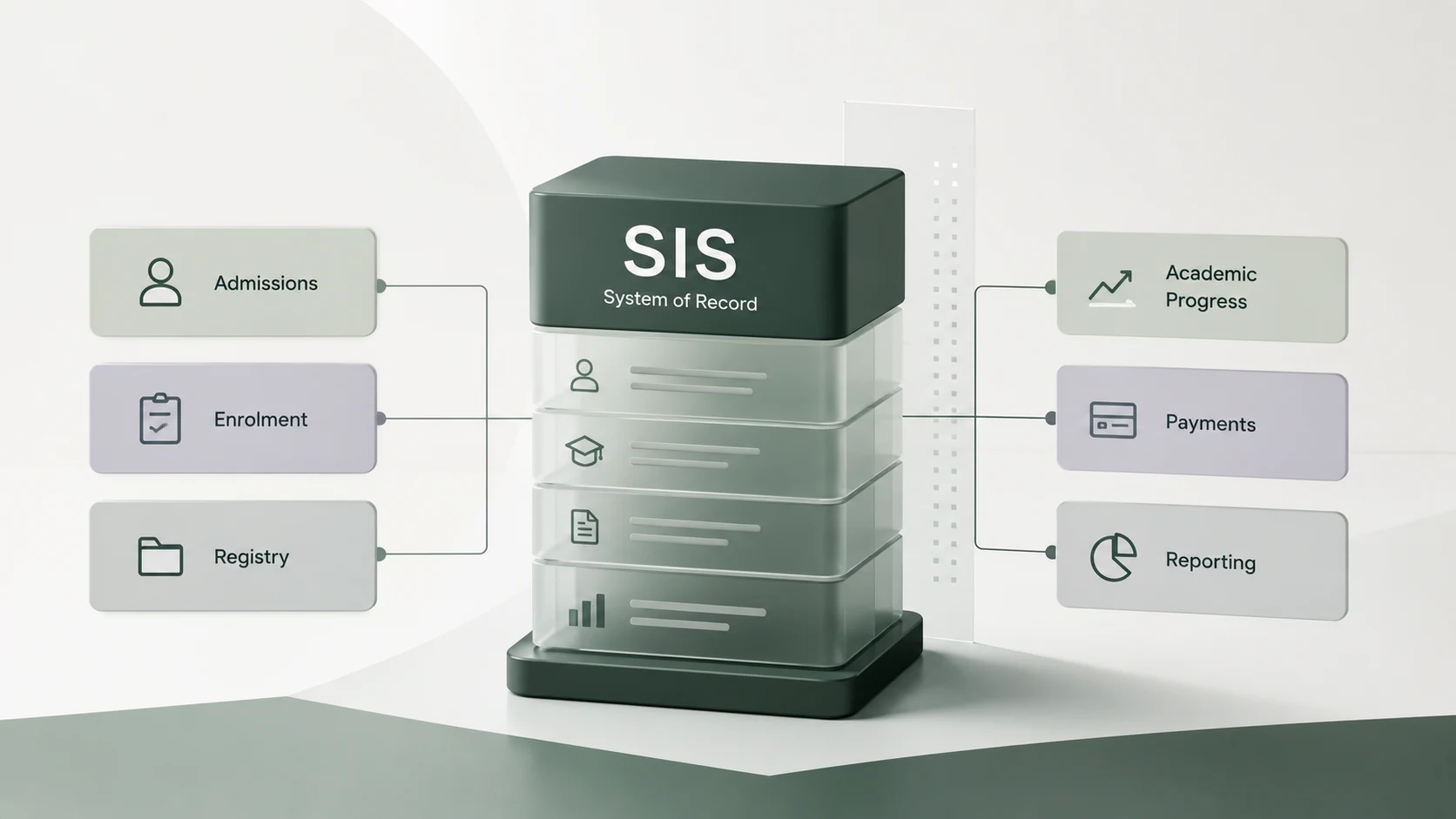
Student information systems are no longer back-office record databases. The remit has expanded: registrars, admissions teams, finance, academic operations and student services all expect to work from the same student record, and increasingly so do the students themselves. When that record is fragmented across a legacy SIS, a separate CRM, a finance system, a spreadsheet for executive education and a portal stitched together by integrations, the cost shows up everywhere — slower reporting, manual reconciliation, broken communications and a student experience that lags behind what learners encounter outside the institution.
Most higher education institutions are not choosing an SIS on a clean sheet of paper. They are weighing up replacement of a long-serving platform, consolidation of disconnected systems, or modernisation of an environment that no longer supports the way they actually run programmes — multiple intakes, executive education, short courses, lifelong learning, stackable credentials, dual-mode delivery, and increasingly complex compliance and data governance obligations.
This article compares 15 student information systems relevant to higher education in 2026. It covers enterprise SIS/ERP suites, modern cloud SIS platforms, lifecycle systems with SIS capabilities, and platforms suited to smaller institutions or specialist providers. It is not a universal ranking. The best SIS depends on institution size, operating model, internal capability and where the platform needs to sit alongside CRM, admissions, LMS and finance.
The development and maintenance of an in-house system is a complex and time-consuming task. Full Fabric lets you turn your full attention to maximizing growth and performance.

A student information system is the platform of record for student data and academic administration. At minimum, it manages student records, programme and course structures, enrolment, registration, academic progress, grades and transcripts, attendance, payments and fees, compliance reporting, and the institutional reporting that depends on all of it.
In modern higher education, the SIS rarely operates in isolation. It typically needs to connect with a CRM for recruitment and student relationship management, an admissions and applications system, a finance or ERP platform, a learning management system, identity and access management, a data warehouse, and the student-facing portal or app. How well an SIS handles those connections — natively, through integrations, or as part of a single platform — is often more important than any individual feature.
A practical evaluation goes beyond a feature checklist. The areas that tend to determine long-term fit are:
Student record and academic data model. Whether the underlying data structure supports your programme types, including non-standard cohorts, modular learning, executive education and continuing professional development. A rigid data model is the single biggest constraint institutions discover after go-live.
Programme, course, module and cohort management. Multi-intake calendars, rolling admissions, stackable credentials, custom assessment structures and credit frameworks should be configurable, not custom development.
Admissions and enrolment connectivity. Whether the SIS is genuinely connected to recruitment, applications and offer-holder workflows, or whether each stage requires a separate system and reconciliation.
Student self-service and staff experience. Modern interfaces for students, faculty and administrative staff. Heavy training requirements and poor mobile experience are persistent issues with older platforms.
Payments, billing and finance integration. Fee structures, scholarships, instalment plans, sponsored learners, third-party billing, and clean integration with the institution’s finance ledger.
Academic calendars, study plans, grades and transcripts. Including official transcripts, digital credentials and verification.
Reporting and analytics. Both operational reporting (registry, finance, compliance) and strategic reporting (recruitment performance, retention, programme economics). Reporting that requires a separate BI stack and significant ETL work is a hidden cost.
Compliance, audit trails and data governance. GDPR, UK GDPR, FERPA where applicable, accreditation reporting and national returns (HESA in the UK, IPEDS in the US, equivalents elsewhere).
Integration capability. APIs, event-driven integration, prebuilt connectors to LMS, finance, identity and CRM systems.
Support for multiple campuses, intakes, learner types and credentials. Including dual-mode delivery, online programmes, short courses and lifelong learning.
Configurability without heavy custom development. Configuration through the platform rather than code changes that bind you to a partner for every adjustment.
Implementation complexity and migration risk. Realistic timelines, data migration strategy, partner ecosystem and the institution’s own change capacity.
Cloud architecture and security. True SaaS architecture versus hosted legacy deployments, with the operational implications of each.
Suitability for the programmes you actually run. Traditional degree programmes, executive education, lifelong learning, professional development and non-traditional credentials each place different demands on an SIS.
The 15 platforms below sit in different categories: large enterprise SIS/ERP suites, modern cloud SIS platforms, lifecycle platforms with SIS capabilities, and systems aimed at smaller institutions or specialist providers. They are not directly interchangeable. A platform that is the right answer for a 40,000-student public university is rarely the right answer for a 1,200-student business school running executive education alongside degree programmes.
The order below is broadly grouped by category rather than by quality. Read the detailed reviews for context, and pay particular attention to the “best for” line in each.
| # | Platform | Best for | SIS category | Key strengths | Watch-outs |
|---|---|---|---|---|---|
| 1 | Ellucian Banner / Ellucian Student | Large universities, complex public institutions | Enterprise SIS/ERP | Depth of functionality, sector ubiquity, partner ecosystem | Implementation cost, complexity, modernisation pace |
| 2 | Full Fabric | Business schools, specialist providers, lifelong learning, executive education | Modern lifecycle platform with SIS | Unified student record across CRM, admissions, enrolment and academic management | Less suited to very large universities needing deep legacy ERP replacement |
| 3 | Workday Student | Institutions already on Workday Finance/HCM | Cloud SIS within ERP | Single Workday data model, modern UX, cloud-native | Best value when Workday is the wider institutional standard |
| 4 | Oracle Student / Oracle Fusion Cloud Student | Large institutions on Oracle/PeopleSoft stacks | Enterprise SIS/ERP | Integration with Oracle finance and HCM, scalability | Validate current product roadmap and PeopleSoft-to-cloud migration path |
| 5 | Anthology Student (Ellucian) | Existing Anthology Student customers under Ellucian ownership | Enterprise SIS | Established US footprint; now backed by Ellucian’s support and maintenance roadmap | Long-term product convergence with Ellucian’s wider portfolio is still being defined |
| 6 | Jenzabar One | Mid-sized US private institutions | Enterprise SIS | Strong US private-college fit, integrated suite | Primarily US-focused; legacy elements in some modules |
| 7 | Tribal SITS | UK higher education, HESA and statutory reporting contexts | Enterprise SIS | Deep UK regulatory fit, established footprint, active partner ecosystem | Constrained scale relative to larger global vendors; validate roadmap and partner ecosystem |
| 8 | Thesis Student Management | Small and mid-sized institutions in UK, Ireland, Canada and the US | Cloud SIS (Unit4 SIS spin-out) | No-code/configurable workflows, cloud-native, regional regulatory fit | Smaller customer base and partner ecosystem than enterprise vendors |
| 9 | Ellucian Colleague | Community colleges and smaller four-year institutions in North America | Enterprise SIS | Strong fit for community-college operations, established sector presence | Modernisation pace; evaluate cloud roadmap within Ellucian’s wider portfolio |
| 10 | Classe365 | Smaller institutions, training providers | Cloud SIS for smaller providers | Affordability, breadth in one platform | Less depth for complex HE registry needs |
| 11 | Classter | Smaller institutions, international schools, training providers | Cloud SIS for smaller providers | Configurability, breadth, multi-tier institutions | Best fit at smaller scale |
| 12 | Camu | Asia-Pacific universities and colleges | Cloud SIS | Regional fit, modern interface | Limited footprint outside core markets |
| 13 | Populi | Small US colleges, theological and specialist institutions | Cloud SIS for small institutions | All-in-one for small institutions, ease of use | Not suitable for large or complex universities |
| 14 | Blackbaud Student Information System | Independent schools, mixed K–HE contexts | School-focused SIS | Strong independent-school fit, Blackbaud ecosystem | Primarily K–12 / independent schools rather than full HE |
| 15 | Modern Campus Lifelong Learning / Extended Education | Lifelong learning and continuing education divisions | Adjacent platform for non-credit / extended education | Strong fit for non-credit, CE and workforce programmes | Not a full enterprise SIS for degree programmes |
Overview. Ellucian is the most recognisable name in higher education SIS, particularly in North America. Banner remains widely deployed at large public universities and complex multi-campus institutions, and Ellucian’s broader portfolio now includes Ellucian Student (its more modern cloud-oriented SIS direction), Colleague (for community colleges and smaller institutions) and PowerCampus. Following Ellucian’s acquisition of Anthology’s SIS and ERP business — which completed on 31 December 2025 — Anthology Student also now sits within the Ellucian portfolio (covered separately below).
Best for. Large, complex universities — particularly public institutions — that need depth of functionality, a substantial partner ecosystem and sector ubiquity.
Key strengths. Functional depth across registry, financial aid, academic records and reporting. Long-established presence in higher education means staff are often already trained, partners are plentiful, and the system handles edge cases that newer platforms have yet to encounter. Roadmap investment in ethos integration and analytics through the wider Ellucian ecosystem.
Watch-outs. Implementation cost and complexity are significant. The pace of modernisation has been a perennial discussion point in the sector, and institutions evaluating Banner specifically should be clear about whether they are buying the platform as it is today or as Ellucian’s longer-term cloud direction promises. Customisation tends to compound technical debt.
Why it matters. For large universities, Ellucian remains the default consideration. The evaluation question is rarely “should we consider Ellucian?” but rather “which Ellucian product line, and at what cost of modernisation?”
Overview. Full Fabric’s SIS is part of a unified higher education platform that brings together CRM, admissions, applications, enrolment, payments, communications, student records and academic management on a single data model. Rather than connecting separate systems through integrations, Full Fabric is built around one student record that persists from first prospect interaction through to alumnus.
Best for. Business schools, specialist providers, executive education divisions, lifelong learning units, and universities that run multiple intakes, modular programmes or non-traditional credentials alongside degree programmes. Particularly relevant for institutions consolidating away from a stack of disconnected tools.
Key strengths. A unified data model is the central point. The same record carries enquiry history, application data, offer status, enrolment, fees, academic progress and communications, which removes the reconciliation work that fragmented stacks generate. The platform is designed around the realities of higher education — programme models, intakes, cohorts, scholarships, sponsored learners — rather than adapted from a generic CRM or ERP. The higher education CRM and admissions and enrolment software sit on the same platform, so admissions and registry teams work from the same record without integration overhead.
Potential limitations. Full Fabric is a modern lifecycle platform rather than a full enterprise ERP replacement. For very large universities with deep legacy ERP entanglements, complex collective bargaining structures attached to academic workflows, or extensive in-house customisation built up over decades, a traditional enterprise SIS may be the more realistic option.
Why it matters. Institutions that want one student record across the lifecycle — and want the operational continuity from prospect to applicant to enrolled student to alumnus — have historically had to stitch this together from multiple vendors. Full Fabric is one of the few platforms purpose-built for this, which is why it shows up most often in evaluations at business schools, executive education providers, and specialist institutions where the operating model does not fit a traditional ERP-style SIS.
Overview. Workday Student extends Workday’s cloud ERP into higher education, sharing a data model with Workday Finance and HCM. Adoption has been steady at institutions that have already standardised on Workday for finance and human capital, particularly larger US universities.
Best for. Institutions already running Workday Finance or HCM, where the value of a single Workday data model across finance, HR and student outweighs the depth-of-feature trade-offs versus more established SIS platforms.
Key strengths. True cloud architecture, modern interface, and a single data model with Workday Finance and HCM. Strong analytics and reporting through the Workday platform. Frequent functional release cycles.
Watch-outs. Workday Student is best evaluated as part of a wider Workday institutional strategy rather than as a standalone SIS purchase. Functional maturity varies by area; institutions are typically working closely with Workday on roadmap items relevant to their programmes.
Why it matters. For institutions committed to Workday, a unified ERP and SIS environment is a credible answer to the integration overhead that defines so many higher education technology landscapes.
Overview. Oracle’s presence in higher education spans long-standing PeopleSoft Campus Solutions deployments and Oracle’s wider Fusion Cloud applications. Many institutions running PeopleSoft are weighing up the migration question, and Oracle’s cloud direction — including Oracle Fusion Cloud Student — is part of that conversation.
Best for. Large institutions already deeply invested in Oracle finance, HCM or PeopleSoft, particularly those evaluating cloud migration paths.
Key strengths. Scale, integration with the wider Oracle stack, and the operational stability of a long-established enterprise platform.
Watch-outs. The higher education product story at Oracle has moved over the years, and institutions should look carefully at current product naming, the cloud Student roadmap and the timeline for any PeopleSoft-to-cloud transition relevant to their footprint. Sector footprint is smaller than Ellucian’s, and reference customers vary by region and product line.
Why it matters. For Oracle-standardised institutions, the question is rarely whether to look at Oracle but how its current and future higher education products map to a multi-year modernisation plan.
Overview. Anthology Student is a cloud SIS with a substantial customer base, particularly in the US, that originated within the Campus Management lineage and was consolidated under Anthology following the wider Anthology–Blackboard merger. Ellucian completed its acquisition of Anthology’s SIS and ERP business on 31 December 2025, following the Chapter 11 bankruptcy process. More than 260 Anthology SIS and ERP customers have transferred to Ellucian, which has committed to continued support and maintenance of the existing platforms while longer-term integration plans are developed.
Best for. Existing Anthology Student customers now operating under Ellucian’s ownership, and institutions evaluating the platform within the context of Ellucian’s combined portfolio.
Key strengths. An established US customer base, particularly in private and proprietary institutions; depth in admissions, enrolment management and student finance workflows; and the operational stability that comes with Ellucian’s commitment to support continuity.
Watch-outs. The long-term product roadmap is still being defined under Ellucian’s ownership. Institutions should validate support model, integration strategy and how Anthology Student is positioned relative to Ellucian’s other SIS products (Banner, Colleague, Ellucian Student) over the coming evaluation cycle. The picture in 2026 is one of continuity, not yet convergence.
Why it matters. For institutions already on Anthology Student, the practical question is how Ellucian’s ownership shapes their roadmap. For prospective buyers, the platform is best evaluated alongside Ellucian’s wider product set rather than as a standalone choice, given that future investment decisions will sit within Ellucian’s portfolio strategy.
Overview. Jenzabar is a long-established higher education vendor focused on US private institutions, particularly small and mid-sized colleges and universities. Jenzabar One brings together SIS, CRM, finance and analytics components.
Best for. Mid-sized US private institutions looking for an integrated suite from a higher-education-specialist vendor.
Key strengths. Strong fit with US private-college operations, an established customer base, and a suite that covers most institutional functions.
Watch-outs. Primarily US-focused, with a smaller presence internationally. Some modules retain legacy characteristics and the modernisation story should be examined directly.
Why it matters. For its core market, Jenzabar is a familiar and well-established alternative to Ellucian Colleague.
Overview. SITS (Student Information Technology Solution), produced by Tribal Group, is one of the most widely deployed SIS platforms in UK higher education and has a meaningful international footprint, particularly across Australia and parts of Asia-Pacific. Ellucian announced an intended acquisition of Tribal in late 2023, but the proposed takeover lapsed after it failed to secure the required shareholder approval. Tribal remains an independent, AIM-listed company in 2026, with Jenzabar holding a significant minority stake.
Best for. UK universities and international institutions that need deep regulatory and reporting alignment, particularly for HESA returns, the Data Futures programme and other UK-specific statutory reporting.
Key strengths. Deep UK higher education fit, strong handling of complex degree structures, established customer base and well-understood functional patterns. Long-standing investment in regulatory reporting and an active partner ecosystem in the UK market.
Watch-outs. Tribal is smaller in scale than the largest global SIS vendors, and the shareholder structure — with a competitor holding a blocking minority — is a context worth understanding when evaluating long-term product strategy. Implementation and ongoing configuration typically require experienced partners.
Why it matters. For UK institutions, SITS remains a default consideration alongside Banner. The vendor’s independence in 2026 means the evaluation can focus directly on product fit and roadmap, rather than on integration questions tied to a larger acquirer’s portfolio strategy.
Overview. Thesis is a dedicated higher education SIS provider that emerged in 2021 as a separation of Unit4’s student information system business, following the buyout of Unit4’s ERP lines by TA Associates. The Thesis portfolio inherited Unit4’s student solutions — including Thesis Student Management — and is owned by Advent International. The company has positioned itself as a cloud-first SIS specialist focused on small and mid-sized higher education institutions.
Best for. Small and mid-sized higher education institutions in the UK, Ireland, Canada and the United States that want a cloud-native SIS without the complexity of an enterprise platform.
Key strengths. A cloud-native SaaS architecture, no-code and configurable workflows, and a focus on student administration, academic processes, reporting and lifecycle management. Strong fit for institutions in regulated markets — Thesis Student Management handles UK reporting requirements such as Data Futures and Student Loans Company submissions, with comparable regional alignment in Canada and the US. Implementation timelines are typically shorter than for enterprise SIS platforms.
Watch-outs. Customer base and partner ecosystem are smaller than the largest enterprise vendors, so institutions should validate the implementation model, regional references and the depth of functional fit for their specific operating context.
Why it matters. Thesis represents a category of mid-market cloud SIS providers focused on the segment that enterprise platforms tend to overshoot. For institutions in its target regions and size range, it is a credible alternative to retrofitting a larger enterprise SIS onto a smaller institutional footprint.
Overview. Ellucian Colleague is Ellucian’s SIS line designed for community colleges and smaller four-year institutions, distinct from the larger-scale Banner platform. Colleague has a long-established presence in North American community colleges and private institutions in the small-to-mid range, and Ellucian’s cloud direction extends to Colleague as part of its broader SaaS strategy.
Best for. Community colleges and smaller four-year institutions in North America, particularly those wanting a higher-education-specialist vendor without the scale and complexity associated with Banner deployments.
Key strengths. A platform calibrated to community-college operations — including non-traditional enrolment patterns, financial aid workflows and transfer-heavy student populations. Established sector footprint, experienced partner ecosystem and integration with Ellucian’s wider product set including financial aid, recruitment and analytics.
Watch-outs. Like other long-established SIS platforms, modernisation pace is a live question, and institutions should evaluate the cloud roadmap, the deployment model on offer and any planned convergence with Ellucian’s wider portfolio following the Anthology acquisition.
Why it matters. For its target segment, Colleague is a default alternative to Banner. Following Ellucian’s acquisition of Anthology Student, the practical evaluation question for community colleges and smaller institutions is increasingly which Ellucian product line — Colleague, Anthology Student, or Ellucian Student — best fits their operating model and roadmap preferences.
Overview. Classe365 is a cloud SIS aimed primarily at smaller institutions, training providers and schools, combining SIS, CRM, LMS and finance modules in a single platform.
Best for. Smaller higher education institutions, training providers and specialist colleges that need breadth without enterprise-grade complexity.
Key strengths. Affordability, breadth across SIS, CRM, LMS and finance in a single product, and a faster implementation timeline than enterprise SIS platforms.
Watch-outs. Functional depth in areas such as complex degree structures, large-scale assessment workflows and advanced reporting tends not to match enterprise SIS platforms.
Why it matters. For smaller institutions and training providers, Classe365 is a credible option where enterprise SIS platforms would be disproportionate.
Overview. Classter is a cloud SIS platform with multi-tier institutional capability, covering K–12, higher education and training providers. It is positioned on configurability and breadth.
Best for. Smaller institutions, international schools and providers that operate across multiple levels of education or want a configurable cloud SIS without enterprise overhead.
Key strengths. Configurability, multi-level institutional support, and a modern interface.
Watch-outs. Best fit at smaller scale; larger universities with complex registry needs will find limitations.
Why it matters. Classter is part of a category of cloud SIS platforms making mid-tier and small-institution SIS more accessible.
Overview. Camu is a cloud SIS with a focus on Asia-Pacific higher education, used at universities and colleges across the region.
Best for. Universities and colleges in Asia-Pacific markets where regional fit, language support and local compliance matter.
Key strengths. Regional alignment, a modern interface and a feature set built around the realities of the institutions it serves.
Watch-outs. Footprint outside its core markets is limited; institutions in Europe or North America are less likely to find sector references close to their own context.
Why it matters. Within its region, Camu represents a modern alternative to legacy SIS platforms.
Overview. Populi is a cloud SIS aimed at small US colleges, including a significant base of theological and specialist institutions. It bundles SIS, billing, online learning and basic CRM into a single platform.
Best for. Small US colleges (often under a few thousand students), particularly theological seminaries, faith-based institutions and specialist providers.
Key strengths. All-in-one design for small institutions, straightforward implementation, and pricing aligned to the segment.
Watch-outs. Not designed for large or complex universities. Functional depth is calibrated to its target market.
Why it matters. For its segment, Populi consistently appears as a practical alternative to retrofitting enterprise SIS platforms onto small institutions.
Overview. Blackbaud’s SIS sits within a portfolio better known for non-profit and independent-school software. Its strongest fit is independent schools and mixed K–HE contexts rather than full higher education.
Best for. Independent schools, including those with sixth-form or pre-college elements, and institutions already operating within the Blackbaud ecosystem for fundraising, finance or constituent management.
Key strengths. Strong independent-school fit, integration with the broader Blackbaud product set, and an established customer base in that segment.
Watch-outs. Not a full enterprise higher education SIS. Universities with degree-awarding operations should evaluate it carefully against higher-education-specific alternatives.
Why it matters. Included here for context: institutions operating across K–12 and early higher education boundaries sometimes consider Blackbaud, and it is useful to know where it fits and where it does not.
Overview. Modern Campus has built a product set around lifelong learning, continuing education, workforce development and non-credit programmes. It is not a full enterprise SIS for degree programmes; it is an adjacent platform that often runs alongside a traditional SIS.
Best for. Continuing education and lifelong learning divisions, professional and executive education units that operate non-credit or non-traditional programmes alongside a parent institution’s main SIS.
Key strengths. Genuine focus on the operational realities of non-credit and continuing education — registration models, instructor management, course catalogues, certificates and workforce-funded programmes that traditional SIS platforms tend to handle awkwardly.
Watch-outs. Not a replacement for an institutional SIS. The deployment pattern is typically alongside an existing SIS, not in place of it.
Why it matters. For institutions with significant non-credit, lifelong learning or workforce-funded activity, the lifelong learning category is a legitimate part of the SIS conversation — particularly where the traditional SIS does not handle these programmes well.
The right answer depends heavily on starting point, operating model and ambition.
If you are replacing a legacy SIS. Treat data migration and decommissioning as the central programme of work, not the new platform’s feature list. Map every workflow that depends on the existing SIS — including the workarounds — and decide which should be carried forward, which should be retired, and which should be redesigned. The strongest implementations are the ones where the institution arrives at vendor selection with a clear view of the operating model it wants to run, rather than expecting the vendor to define it.
If you are a large university with complex ERP requirements. Enterprise SIS/ERP vendors — Ellucian, Workday, Oracle — are the realistic candidate list. The evaluation is as much about partner ecosystem and implementation capability as the product itself, and the timeline is typically multi-year. Existing finance and HCM standards strongly influence the calculus.
If you need a modern cloud SIS connected to admissions and CRM. Look closely at platforms with a unified data model rather than a stack of integrated modules. The question to ask vendors is whether admissions, CRM, enrolment and academic records share the same underlying student record, or whether they are connected through APIs. Both can work, but the operational implications are different — particularly for reporting and reconciliation.
If you support executive education, lifelong learning or short courses. Traditional SIS platforms often struggle with rolling intakes, modular learning, non-credit programmes, sponsored learners and the commercial models that come with executive education. Modern lifecycle platforms and dedicated lifelong learning systems handle these models more naturally. This is one of the clearest fit signals in SIS selection.
If you need stronger student records and academic operations. Functional depth in registry, academic structures, assessment, transcripts and compliance reporting is where enterprise SIS platforms historically lead. The trade-off is implementation complexity and modernisation pace.
If you need better reporting and data governance. Look at how data leaves the SIS as well as how it is structured inside it. APIs, event-driven integration, support for data warehouses and the quality of native reporting all matter. A platform that requires a heavy ETL programme to produce usable institutional reporting is incurring a hidden cost.
If you want to reduce disconnected systems. Consolidation onto a unified platform — whether enterprise ERP-style or a modern lifecycle platform — is often the strategic objective. The honest question is how many of your current systems the candidate platform can credibly replace, and how many it will need to integrate with rather than absorb.
If implementation risk is a major concern. Smaller and more focused platforms tend to implement faster, but at the cost of breadth. Larger platforms implement more slowly but cover more of the institution. A staged approach — modernising the parts of the lifecycle that are most broken first — is often more realistic than a full-suite replacement on day one.
For institutions specifically reviewing CRM in parallel, our guide on choosing the right CRM for higher education covers the evaluation framework in more detail, and the wider context of student relationship management is closely tied to the SIS conversation.
Treating SIS selection as an IT procurement exercise. The system touches admissions, registry, finance, academic operations, student services and reporting. If those teams are not represented from the start, the selection will optimise for the wrong things.
Underestimating data migration. Legacy SIS data is rarely as clean as institutions assume. Migration is consistently the most underestimated part of implementation, particularly when historical academic records, transcripts and audit trails are involved.
Choosing a system without mapping student lifecycle workflows. Buying a platform before understanding how prospect-to-applicant, applicant-to-enrolled and enrolled-to-alumnus flows actually work in your institution leads to expensive rework.
Ignoring admissions and CRM connectivity. An SIS that is excellent in isolation but poor at receiving applicants from an admissions system, or feeding student data into a CRM for ongoing engagement, will create friction that staff feel daily.
Not involving registry, admissions, finance and academic operations early enough. Each of these functions has constraints the others do not see. Involving them after vendor selection is a reliable way to surface unsolvable problems late.
Prioritising feature breadth over operational fit. A long feature list does not mean a platform handles your operating model. The question is not whether the system can do something, but whether it does it the way your institution actually needs to.
Underestimating implementation time and internal change management. Enterprise SIS implementations are measured in years. Even modern cloud platforms require significant internal capacity. Vendor timelines describe the vendor’s work, not the institution’s.
Assuming one vendor’s suite automatically means one clean data model. Some vendor suites are built on a single data model. Others are integrated portfolios assembled through acquisition. Both can be marketed as “unified” — ask directly which it is.
Ignoring non-traditional learning models. Executive education, lifelong learning, short courses, modular programmes and stackable credentials place demands that traditional SIS platforms handle inconsistently. If these are part of your operating model now or in the next few years, they belong in the evaluation criteria.
Failing to define reporting requirements early. Reporting tends to be discussed at the end of implementation, when the data model is already fixed. The institutions that get the most value from a new SIS are the ones that define their reporting and analytics requirements as part of selection, not afterwards.
The best student information system depends on the institution. Large universities with complex ERP requirements will continue to look at enterprise SIS vendors — Ellucian, Workday, Oracle — and the evaluation will be as much about implementation partner and timeline as the platform itself. Institutions already committed to one of those vendors should evaluate ecosystem fit and roadmap before considering alternatives.
Smaller institutions and specialist providers may be better served by platforms calibrated to their scale — Populi, Classe365, Classter, Camu, Thesis or category-specific options — where implementation timelines are shorter and the platform is designed around the realities of smaller registry operations.
Institutions whose operating model centres on the full student lifecycle — business schools, executive education, lifelong learning providers, specialist institutions and universities running multiple programme types — should consider a modern lifecycle platform with SIS capabilities. This is where Full Fabric’s SIS is most relevant: one student record across CRM, admissions, enrolment, payments, communications and academic management, designed for institutions that want to reduce the reconciliation overhead of running disconnected systems.
Whichever category fits, the central principle holds. The platform should support the operating model, the data model should support the programmes you actually run, and the implementation plan should reflect your institution’s capacity to change — not the vendor’s ideal timeline.
A student information system (SIS) is the institutional platform of record for student data and academic administration. It manages student records, programme and course structures, enrolment, registration, academic progress, grades and transcripts, attendance, payments, compliance reporting and the institutional reporting that depends on student data.
There is no single best SIS. The right platform depends on institution size, operating model, existing systems and the programmes you run. Large universities tend to look at enterprise SIS vendors such as Ellucian, Workday and Oracle. Business schools, specialist providers and lifecycle-driven institutions often look at modern platforms such as Full Fabric. Smaller institutions typically evaluate platforms calibrated to their scale, such as Thesis, Populi or Classe365.
A CRM manages the relationship with prospects, applicants, students and alumni — enquiries, communications, recruitment activity and engagement. An SIS manages the official student record once an individual is enrolled — academic records, registration, grades, transcripts, fees and compliance. Modern higher education increasingly expects the two to share a single underlying student record so admissions, enrolment and student services are not working from different versions of the truth.
Key criteria include a flexible student data model, support for multiple programme types and intakes, native or genuinely integrated admissions and CRM connectivity, modern self-service for students and staff, strong reporting and analytics, robust compliance and audit trails, true cloud architecture, and realistic implementation and migration paths.
Enterprise SIS implementations typically take 18 months to several years for large universities, depending on scope, customisation and data migration complexity. Modern cloud SIS platforms aimed at smaller and mid-sized institutions can implement in a matter of months for tightly scoped deployments. Realistic timelines depend at least as much on institutional capacity to change as on the vendor’s delivery model.
Yes — but not all SIS platforms handle these models well. Executive education, lifelong learning, short courses, modular programmes and stackable credentials require flexible programme structures, rolling intakes, support for sponsored learners and commercial models that traditional degree-focused SIS platforms tend to handle awkwardly. Modern lifecycle platforms and dedicated lifelong learning systems are typically better suited to these models, and institutions running both traditional degrees and non-traditional programmes should evaluate this explicitly during selection.