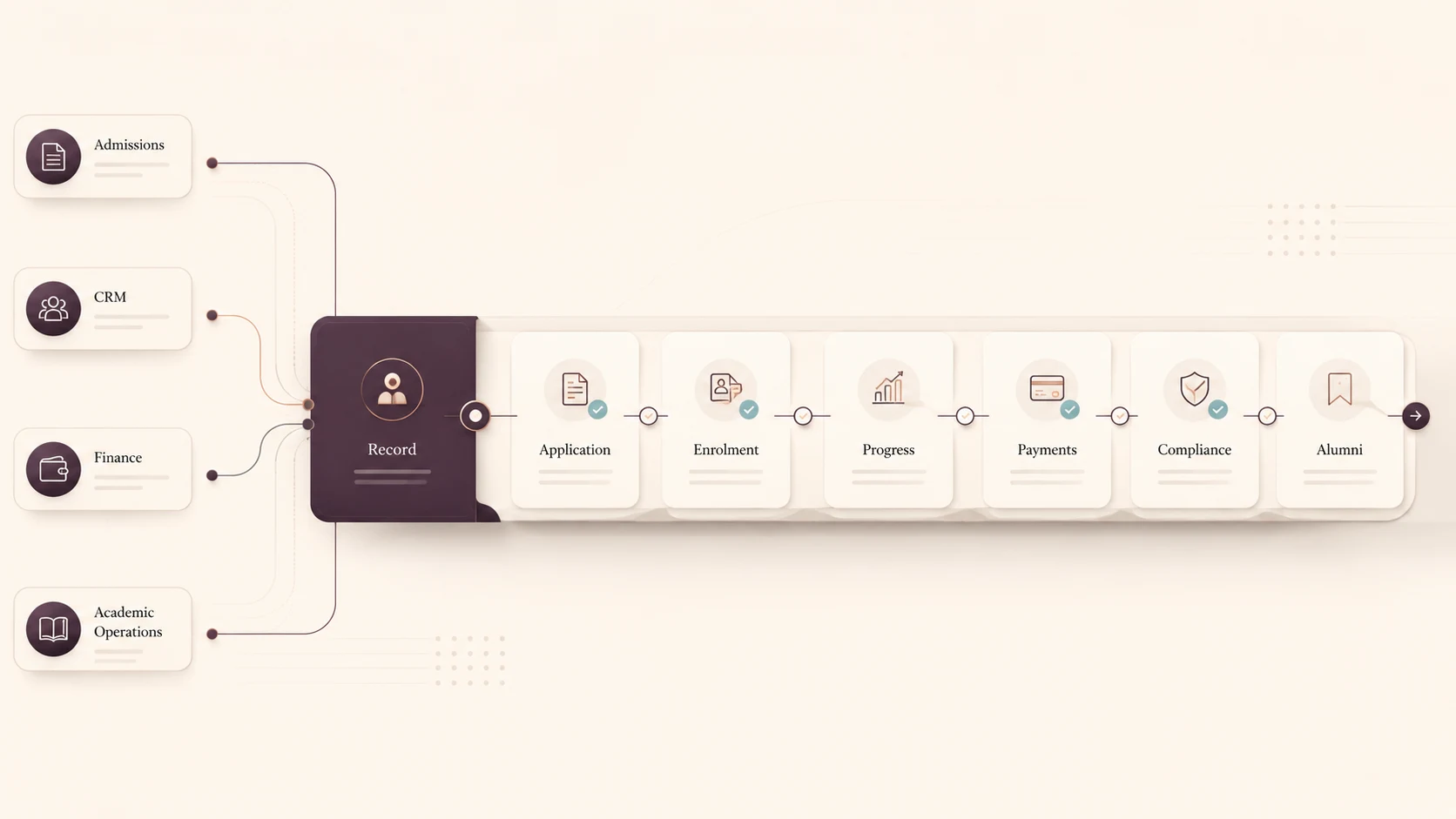
Student records are the operational backbone of higher education. They sit underneath admissions decisions, enrolment workflows, academic progress, fee collection, compliance reporting and most of what institutions report to government bodies and accreditors. When those records are fragmented across a legacy SIS, departmental spreadsheets, a separate admissions CRM and a handful of local databases maintained by individual teams, the consequences show up everywhere: reconciliation work that consumes registry staff, reporting figures that nobody fully trusts, compliance exposure when audit trails are incomplete, and a student experience that feels disjointed because nobody has a complete picture of the person they are dealing with.
The expectations placed on student record management have also widened. A modern student record needs to support more than basic biographical data and grades. Institutions now expect their systems to handle multiple intakes a year, modular and stackable programme structures, frequent student status changes, granular academic progress tracking, fees and payments, audit trails strong enough for regulators, CRM and admissions connectivity, and an increasing volume of executive education, lifelong learning and short course activity that does not fit traditional term-based models.
This article compares 10 student record management systems relevant to higher education in 2026. The shortlist deliberately spans different categories — enterprise SIS suites, modern lifecycle platforms, cloud systems for smaller institutions — because the right choice depends heavily on institutional size, programme mix and where each institution currently sits in its system landscape.
The development and maintenance of an in-house system is a complex and time-consuming task. Full Fabric lets you turn your full attention to maximizing growth and performance.

A student record management system is software used to store, manage and maintain official student data across the student lifecycle. In some institutions it is a standalone module; in others it is the records function of a broader Student Information System; in a growing number of cases it is a modern lifecycle platform that links student records to admissions, CRM and enrolment from the first enquiry.
Whatever the architecture, student records typically include:
It is worth being precise about adjacent categories, because the terms are often used interchangeably in vendor marketing. A Student Information System (SIS) is a broader platform that holds the official student record and supports operational workflows such as registration, scheduling, grading and finance. A CRM manages relationships and communications, primarily with prospective students, applicants and other contacts; it is not the system of record for enrolled students. Admissions software manages the application and decision process. A student record management system sits at the centre of these, holding the canonical record of who a student is and where they stand academically and financially at any point in their journey.
The strongest evaluations focus less on feature counts and more on whether the system can serve as a credible single source of truth for student data over many years of operational use. Practical criteria worth weighting include:
The right balance varies. A large research university replacing a 25-year-old SIS will weight enterprise depth, integration breadth and finance functionality heavily. A specialist business school running multiple intakes a year will weight admissions-to-enrolment continuity and flexibility around programme structure.
The 10 platforms below sit in different categories. Some are full enterprise SIS platforms where student records are part of a wider institutional system. Some are modern lifecycle platforms where the student record is connected to CRM, admissions and enrolment by design. Some are cloud student record systems aimed at smaller institutions. This is not a universal ranking — it is a guide to fit by institutional context. A platform that would be a poor fit for a 40,000-student public university may be the right choice for a 1,500-student specialist provider, and vice versa.
| Platform | Best for | System category | Key strengths | Watch-outs |
|---|---|---|---|---|
| Ellucian Banner | Large universities, complex public institutions | Enterprise SIS | Deep functional coverage, mature ecosystem | Implementation complexity, customisation overhead |
| Full Fabric | Business schools, specialist providers, executive education, lifelong learning | Modern lifecycle platform | Unified record across CRM, admissions, enrolment, payments, records | Less suited to very large research universities needing deep legacy ERP replacement |
| Workday Student | Institutions standardised on Workday for finance/HR | Cloud enterprise SIS | Unified data model with HCM and finance, modern UX | Newer in market than incumbents, fit varies by region |
| Oracle Fusion Cloud Student | Institutions on Oracle Cloud finance/HR | Cloud enterprise SIS | Integration with Oracle ERP, cloud-native architecture | Still maturing in higher education footprint |
| Anthology Student | US-focused mid-to-large institutions | Enterprise SIS (now within Ellucian’s SIS/ERP portfolio) | Strong North American footprint, established functionality | Roadmap clarity following Ellucian acquisition |
| Jenzabar One | Small-to-mid US private institutions | Integrated SIS suite | Breadth across SIS, CRM, finance for smaller institutions | Primarily US-focused; less flexible than modern platforms |
| Tribal SITS | UK and international universities | Enterprise SIS | Deep functionality for UK regulatory reporting (HESA) | Heavy implementation, traditional architecture |
| Thesis Student Management | UK-focused universities | Modern SIS | Cloud-native UK SIS designed around modern data model | Smaller installed base than incumbents |
| Ellucian Colleague | Small-to-mid US institutions | Enterprise SIS | Long-standing fit for community colleges and smaller four-year institutions | Legacy architecture in parts; cloud migration ongoing |
| Populi | Very small US private institutions and seminaries | Cloud SIS | All-in-one for small institutions, predictable pricing | Limited scale and complexity ceiling |
Ellucian Banner is one of the most widely deployed student information systems in higher education globally, particularly across large public universities in North America and a significant international footprint. As a student record management system, Banner offers deep functional coverage across admissions, registration, academic records, financial aid, accounts receivable and graduation, with mature integrations into Ellucian’s wider ecosystem (CRM Advance, CRM Recruit, Ethos integration platform).
Best for: Large universities and complex public institutions that need depth across every operational area and have the resources to support an enterprise SIS over decades.
Key strengths: Functional breadth across the entire student lifecycle, strong financial aid and US compliance support, large user community, extensive third-party ecosystem, and a clear cloud direction through Banner running on Ellucian Cloud.
Watch-outs: Banner deployments often carry significant customisation accumulated over many years, which can complicate upgrades and cloud migration. Implementation and reimplementation projects are major undertakings, and the user experience in some modules reflects the system’s age relative to cloud-native alternatives.
Why it matters for student record management: For institutions whose scale and complexity demand a true enterprise SIS, Banner remains a credible long-term home for the official student record. The question is rarely whether Banner can hold the data; it is whether the institution can sustain the operating model around it.
Full Fabric is a modern lifecycle platform built specifically for higher education, combining CRM, admissions, applications, communications, payments, student records and SIS-related workflows in a single system. Its distinguishing feature is a unified student record: the same person record carries through from first enquiry to applicant, enrolled student, active learner and alumnus, without the data fragmentation that comes from stitching together separate systems.
Best for: Business schools, specialist providers, executive education, lifelong learning institutions, and any organisation running multiple intakes a year, modular programmes, short courses or stackable credentials. Particularly relevant for institutions moving away from disconnected spreadsheets, legacy databases and separate admissions and SIS tools.
Key strengths: One student record across the full lifecycle, connected admissions and enrolment workflows, flexible programme structures that accommodate non-traditional models, integrated payments, and a higher education CRM that shares the same data model as the student record rather than syncing to it. Reduces operational friction caused by separate systems and the manual reconciliation work that comes with them.
Watch-outs: Full Fabric is built around a modern lifecycle approach. It is a stronger fit for institutions that want a connected platform than for very large research universities looking for a like-for-like replacement of a deeply customised legacy ERP environment.
Why it matters for student record management: When the student record begins at enquiry rather than at enrolment, registries spend less time reconciling admissions exports against the SIS, and academic operations teams have a fuller history of every student. For institutions where the operational pain comes from separate systems rather than the SIS itself, a unified lifecycle platform addresses the cause rather than the symptom.
Workday Student is the higher education extension of Workday’s cloud platform, sharing a data model with Workday Financial Management and Workday HCM. For institutions already standardised on Workday for finance and HR, this shared foundation is the central argument: student, employee and financial data live in the same system.
Best for: Institutions that are already running Workday for finance and HR, or planning to, and want a single cloud platform across the back office and student data.
Key strengths: Unified data model with HCM and finance, cloud-native architecture, modern user experience, continuous delivery model rather than major version upgrades.
Watch-outs: Workday Student is newer in the higher education market than Banner or Colleague, and implementations have varied in complexity and timeline. Institutions should evaluate the current state of the product against their specific functional requirements rather than assume parity with incumbents.
Why it matters for student record management: The promise of student records living in the same platform as finance and HR is substantial — particularly for reconciliation between student accounts, payroll for student employees, and faculty workload. The practical question is implementation maturity for the specific institutional model.
Oracle Fusion Cloud Student, part of the broader Oracle Fusion Cloud Applications suite, is positioned as a cloud-native student system that integrates with Oracle Cloud ERP and HCM. As with Workday, the value proposition leans heavily on the shared platform with finance and HR.
Best for: Institutions already committed to Oracle Cloud for ERP and HCM that want to consolidate on a single vendor across administrative systems.
Key strengths: Integration with Oracle ERP, cloud-native architecture, and the operational consistency that comes from a single platform across finance, HR and student data.
Watch-outs: Oracle’s higher education footprint is smaller than Ellucian’s, and the product continues to mature. Institutions should look closely at reference customers operating at similar scale and complexity, and at how regional functional requirements are supported.
Why it matters for student record management: Like Workday Student, the appeal is architectural rather than feature-by-feature. Institutions weighing Oracle Fusion Cloud Student are typically choosing it because of a wider Oracle commitment, not in isolation.
Anthology Student is the SIS lineage that includes the former Campus Management CampusNexus Student product. Ellucian completed its acquisition of Anthology’s Student Information Systems (SIS) and Enterprise Resource Planning (ERP) business on 31 December 2025, following its successful bid in Anthology’s Chapter 11 bankruptcy process, with more than 260 Anthology SIS and ERP customers transferring to Ellucian. Anthology Student is now best understood as part of Ellucian’s SIS and ERP portfolio. The broader Anthology brand and its other products should not be assumed to have moved across; the acquisition was specifically of the SIS and ERP business.
Best for: US-focused mid-to-large institutions, particularly those already on Anthology Student or evaluating a known SIS option during the period of vendor transition.
Key strengths: Established functionality across the student lifecycle, strong North American compliance and financial aid support, and support continuity under Ellucian, with future integration strategy still to be validated.
Watch-outs: The transition to Ellucian introduces product strategy questions that institutions should evaluate carefully. Ellucian now operates Banner, Colleague, Anthology Student and other student systems within its portfolio, and the long-term roadmap for each product line matters more than it would for a single-product vendor. Ellucian has committed to continuing support and maintenance of the existing Anthology SIS and ERP systems, but the longer-term product convergence picture is still emerging.
Why it matters for student record management: Anthology Student remains a credible record system for existing customers. New evaluators should weigh roadmap clarity alongside functional fit.
Jenzabar One is an integrated suite for small-to-mid-sized US institutions, particularly private colleges and universities. It covers SIS, CRM, finance and student engagement within a single vendor relationship.
Best for: Small-to-mid US private institutions that prefer a single vendor across administrative systems and value an installed base of similar institutions.
Key strengths: Breadth across SIS, CRM and finance for institutions that do not want to assemble a best-of-breed stack, and a community of similar-sized peer institutions.
Watch-outs: Jenzabar’s market is largely US-based, and the platform’s flexibility around non-traditional programme models is more limited than modern lifecycle platforms. Institutions with significant executive education or international operations should evaluate fit carefully.
Why it matters for student record management: For institutions whose profile matches Jenzabar’s core market, the appeal is consolidation around one vendor rather than best-in-class depth in any single module.
Tribal SITS:Vision is one of the most widely used SIS platforms in UK higher education and is also deployed across a number of international institutions. Its functional depth around UK regulatory reporting, particularly HESA and the post-HESA Data Futures reporting model, is a major reason for its persistence in the market.
Best for: UK universities and international institutions that need deep alignment with UK-style regulatory frameworks.
Key strengths: Strong UK regulatory reporting, mature functionality across registration, programme management and assessment, and a large UK installed base with a long history of operational use.
Watch-outs: SITS deployments tend to be heavy, with significant configuration accumulated over time. The user experience reflects the system’s age in places, and modernisation programmes are non-trivial. Institutions should evaluate the platform’s cloud trajectory and what a long-term operating model looks like.
Why it matters for student record management: For UK institutions, SITS remains a serious contender for the official student record, particularly where regulatory complexity is high. The trade-off is between regulatory depth and modern architecture.
Thesis Student Management is a cloud-native SIS aimed at higher education, positioned as a modern alternative to traditional incumbents. Thesis was established in 2021 as a dedicated SIS business when Unit4 separated its Student Information System line, following the strategic growth buyout of Unit4’s ERP business by TA Associates. Since then it has operated as a dedicated SIS provider focused on higher education, with a particular footprint in the UK and Canada and a growing presence in the US through its Elements product.
Best for: UK-focused universities, and small-to-mid institutions in Canada and the US, seeking a modern cloud-native SIS as an alternative to long-established incumbents.
Key strengths: Cloud-native architecture, modern user experience, and a data model designed without the constraints of long-running legacy products. A clearer focus on the higher education student system market than its predecessor product within Unit4.
Watch-outs: The installed base is smaller than SITS or Banner, and institutions should evaluate the platform against their specific functional requirements and reference customers at comparable scale. Maturity in specific functional areas should be tested against the institution’s own use cases.
Why it matters for student record management: Thesis represents the broader trend of cloud-native, modern-architecture SIS options entering a market historically dominated by long-established products. For institutions willing to take a modernisation stance, it is worth evaluating alongside the incumbents.
Ellucian Colleague is the SIS lineage focused on small-to-mid US institutions, with a particularly strong presence in community colleges and smaller four-year institutions. It is a sibling product to Banner within Ellucian’s portfolio, addressing a different segment of the market.
Best for: Small-to-mid US institutions, particularly community colleges and smaller private institutions that want a proven SIS with a peer community of similar institutions.
Key strengths: Long-standing fit for its core market, breadth of functionality appropriate to smaller institutional scale, and integration with Ellucian’s wider product set.
Watch-outs: Parts of Colleague’s architecture reflect its age. Ellucian’s cloud direction applies to Colleague as well as Banner, and institutions should understand where the product sits on that journey before committing to a long-term path.
Why it matters for student record management: For institutions in Colleague’s core market, the product remains a credible record system. The strategic question is whether the institution wants to continue on Colleague’s modernisation path or evaluate alternatives.
Populi is a cloud SIS designed for very small US private institutions, including a strong presence among seminaries, faith-based colleges and other small specialist institutions. It bundles SIS, CRM, billing and learning functions into a single all-in-one product.
Best for: Very small private institutions, typically under a few thousand students, that need an affordable all-in-one cloud system without the complexity of an enterprise SIS.
Key strengths: Predictable cloud pricing, simple administration, broad functional coverage for small institutions in one product, and ease of implementation relative to enterprise platforms.
Watch-outs: Populi is built for institutions of a particular scale and complexity. It is not designed to replace an enterprise SIS at a large university, and institutions with complex programme structures, significant executive education activity or extensive integration requirements will reach its ceiling.
Why it matters for student record management: Populi shows that for the right institutional profile, a focused cloud SIS can serve as a perfectly adequate student record system without the cost and risk of a large enterprise deployment.
If your student records are fragmented across systems. The first task is to define what the official student record actually is and which system holds it. Until that is clear, no platform will solve the problem, because the problem is operational as much as technical. A modern lifecycle platform such as Full Fabric is a strong option where the fragmentation runs from enquiry through to enrolment; an enterprise SIS consolidation is the right path where the fragmentation is between multiple departmental databases under a large institution.
If you are replacing a legacy SIS. Treat this as a multi-year programme, not a software purchase. Data migration, business process redesign, integration rebuilds and reporting reconstruction are all major workstreams. The choice of platform matters, but execution matters more.
If you need a full enterprise student record system. Banner, Workday Student, Oracle Fusion Cloud Student, Anthology Student, Tribal SITS and Colleague are the credible options, with the right answer depending on scale, region, existing finance and HR systems, and roadmap fit.
If you need student records connected to CRM and admissions. This is where modern lifecycle platforms differ from traditional SIS-plus-CRM stacks. If admissions-to-enrolment continuity, communications history and a single person record across the lifecycle are the priority, evaluate Full Fabric carefully — alongside any incumbent SIS plus CRM integration option.
If you run executive education, lifelong learning or short courses. Traditional SIS platforms designed around term-based undergraduate programmes often handle non-traditional models awkwardly. Platforms designed with flexibility around intakes, modules and stackable credentials — Full Fabric is one — are likely to fit more naturally.
If reporting and compliance are the main pain points. The bottleneck is often the data model, not the reporting tool. A platform that holds clean, consistent records across the lifecycle is the foundation; reporting capability sits on top of that.
If implementation risk is a major concern. Smaller, more focused platforms carry less risk than large enterprise SIS programmes, but only if institutional scale and complexity genuinely match the platform’s design.
If your institution is smaller or specialist. Lighter cloud systems such as Populi, or modern lifecycle platforms aimed at specialist providers, may serve better than an enterprise SIS that would be over-engineered for the operating model.
Treating student records as only an IT problem. Student records are an academic operations and registry problem first. Without registry, admissions, finance and academic leadership at the table from the start, the system will be optimised for the wrong constraints.
Ignoring admissions and CRM data. A student record that begins at enrolment loses the entire history of the person’s relationship with the institution. The result is duplicate records, lost communications history and poor visibility into recruitment performance. This is one of the central arguments for student relationship management as a way of thinking about the lifecycle rather than as a separate CRM function.
Keeping too many local spreadsheets after implementation. Most fragmentation problems return within 18 months of go-live because departmental spreadsheets quietly reappear. Governance has to be active, not assumed.
Underestimating data migration and data cleansing. Migration typically takes longer and costs more than initial estimates because the source data is messier than expected. Plan for substantial cleansing effort regardless of platform.
Not defining the official student record early. If multiple systems hold overlapping data and no decision is made about which is authoritative, the new platform will inherit the same fragmentation.
Failing to involve registry, admissions, finance and academic operations. Each function holds different requirements. Leaving any of them out produces a system that solves part of the problem and creates new ones.
Prioritising feature breadth over data model fit. Long feature lists do not compensate for a data model that cannot represent the institution’s actual programme structure.
Assuming a vendor suite automatically means one clean student record. A suite of separate modules under one vendor brand may still require integrations and reconciliation. Investigate the data model, not just the product catalogue.
Ignoring non-traditional programme models. Executive education, short courses and stackable credentials are often treated as edge cases during selection and then become major operational headaches afterwards.
Leaving reporting requirements until after implementation. Reporting needs should shape the data model and configuration decisions, not be retrofitted at the end.
The right student record management system depends on institutional size, programme complexity, existing systems and operating model. Large universities and complex public institutions will continue to need enterprise SIS platforms — Banner, Workday Student, Oracle Fusion Cloud Student, Anthology Student, Tribal SITS or Colleague — chosen on the basis of scale, region and ecosystem fit. Institutions already committed to Ellucian, Workday, Oracle or Jenzabar should evaluate roadmap and ecosystem alignment as carefully as functional fit. Smaller and specialist institutions may be better served by lighter cloud systems such as Populi.
Institutions looking for one student record across CRM, admissions, enrolment, payments, communications and academic management — particularly business schools, specialist providers and institutions running executive education, lifelong learning or stackable credentials — should evaluate Full Fabric’s modern student records platform alongside the more traditional options. For a wider view of SIS-specific options, the broader SIS comparison covers the same territory from a different angle.
Whatever platform an institution chooses, the underlying principle is the same: a student record management system earns its place by being the trusted, consistent home of student data across the lifecycle, not by being the most feature-rich product in a procurement spreadsheet.
A student record management system is software used to store, manage and maintain official student data across the student lifecycle, including personal details, application history, enrolment status, programme and module records, grades, fees, communications and compliance data. It may be a standalone product, the records function of a broader SIS, or part of a modern lifecycle platform that connects CRM, admissions, enrolment and records.
There is no single best system. The right choice depends on institutional size, programme complexity, existing finance and HR systems, and the balance between enterprise depth and modern lifecycle continuity. Large universities typically look at Banner, Workday Student, Oracle Fusion Cloud Student, Anthology Student, Tribal SITS or Colleague. Business schools, specialist providers and institutions with significant executive education or lifelong learning activity often evaluate modern lifecycle platforms such as Full Fabric. Smaller institutions may find a focused cloud SIS such as Populi sufficient.
They overlap but are not identical. An SIS is a broader platform covering registration, scheduling, grading, finance and operational workflows. Student record management is the specific function of holding and maintaining the official student record. In some products, student record management is the records module of a wider SIS; in others, it is a standalone or lifecycle-oriented platform.
Priorities include a flexible data model that fits the institution’s programme structure, genuine connectivity between admissions, enrolment and records, robust student status management, clean audit trails, reliable reporting and analytics, integrations with CRM, LMS and finance systems, and honest implementation risk. Configurability without bespoke development and support for non-traditional programme models are increasingly important.
A consistent, authoritative student record reduces the manual reconciliation that produces unreliable reporting figures, and provides the audit trail that compliance frameworks such as GDPR, FERPA and sector-specific reporting regimes require. Reporting and compliance improvements come primarily from data model quality, not from reporting tools layered on top of fragmented data.
Yes, but not all platforms handle it equally well. Traditional SIS products designed around term-based undergraduate programmes often struggle with multiple intakes, short courses, stackable credentials and the lighter administrative footprint of lifelong learning. Modern lifecycle platforms designed with flexibility around intakes and modular structures — Full Fabric is one example — tend to fit non-traditional programme models more naturally.