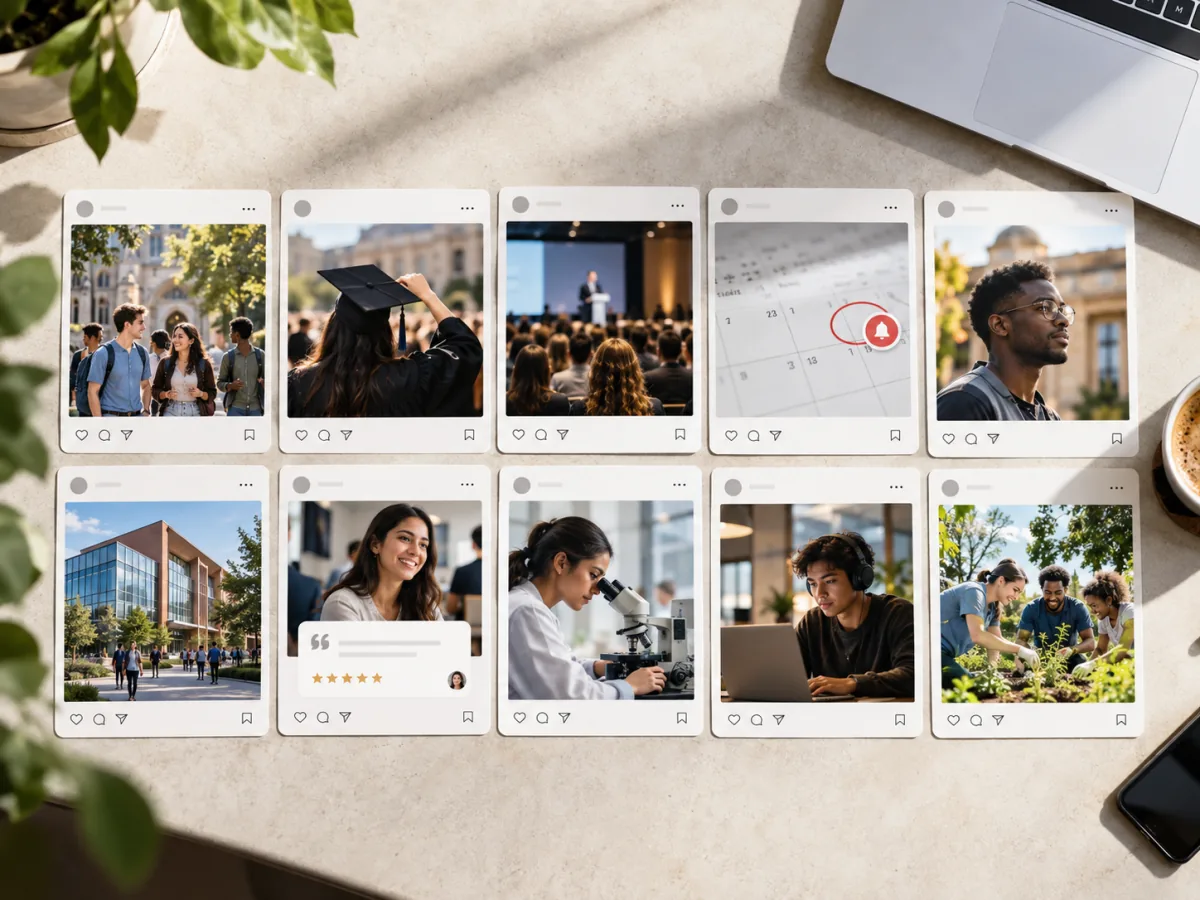
Most higher ed social media managers know the moment. There is a gap in next week's calendar, the open day has already been promoted three times, and someone suggests "a nice campus shot".
Below are 10 social media post ideas for higher ed teams that can go straight into a content plan. Each starts with a question a prospective student, applicant, offer holder, current student or graduate is genuinely trying to answer, and comes with format options, an example hook and the metric that shows whether it did its job. Most can be produced with existing institutional content, students and staff rather than a large dedicated production budget, and none assumes every post has to be a Reel.
What should universities post on social media? The most useful university social media content usually falls into four groups:
The ten ideas below cover all four groups. Whichever you choose, a good post has a clear job, a real person or detail at its centre, a format chosen for the message and a call to action that matches the viewer's stage.
The development and maintenance of an in-house system is a complex and time-consuming task. Full Fabric lets you turn your full attention to maximizing growth and performance.
A post is not successful simply because it gets engagement. Every post should have a job: attracting attention, answering a question, helping someone judge fit, reducing uncertainty, showing academic value, promoting an event, prompting an application step, supporting offer holders, building current-student community or keeping graduates connected.
The practical principle is simple:
Start with the question or decision the audience needs help with, then choose the social format. Do not start with whatever format is currently trending.
It also helps to be clear about social media's role. In UCAS's End of Cycle Survey 2025 of placed applicants, 12% of the 4,911 respondents to its university-awareness question selected social media as one of the ways they first became aware of the institution where they were placed, up two percentage points from 2024. Respondents could select all options that applied, and other routes remained at least as prominent: 27% selected the UCAS website, 22% living nearby, 17% family members and 15% current students or alumni.
Keystone Education Group's State of Student Recruitment 2026, based on more than 67,000 prospective international students from over 150 countries surveyed between October 2025 and April 2026, adds an important nuance. Keystone reports that over half of these prospective international students now use AI or social media in their search, yet both are among the least trusted channels: 72% rate university websites as "very" or "extremely" trustworthy, compared with 30% for AI results.
Social media is a discovery, influence and validation layer. It does not replace the institutional website; more often it sends people there to check what they saw, which is why several ideas below link back to accurate, current university information. For the broader picture on discovery and trust, see Higher Education Marketing Trends to Watch.
Before any idea goes into the calendar, check five things: the audience (prospective undergraduates, postgraduates, parents, offer holders, current students or alumni), the job the post should do, its usefulness to the viewer, the format that communicates it most clearly and the sensible call to action, if any.
| Post idea | Best for | Useful formats | Metric to watch |
|---|---|---|---|
| 1. Day in the life of a real student | Showing student experience | Short video, Stories, carousel | Completion rate, saves |
| 2. Answer one question students keep asking | Reducing uncertainty | Carousel, short video, Stories | Saves, link clicks |
| 3. 60-second lesson from a lecturer | Demonstrating academic fit | Short video, YouTube | Watch time, shares |
| 4. What students actually create | Proving learning in practice | Carousel, walkthrough video | Saves, profile visits |
| 5. Alumni career path as a journey | Making outcomes understandable | Carousel, LinkedIn post, interview | Shares, programme-page clicks |
| 6. One campus place students want to see | Practical fit and reassurance | Short video, photo carousel | Saves, replies |
| 7. Deadline or process as a checklist | Driving timely action | Carousel, static post, Stories | Saves, link clicks |
| 8. One event, several posts | Extending event value | Stories, short video, carousel | Registrations, replay views |
| 9. One proof point explained properly | Building trust | Single graphic, carousel, short video | Shares, click-through |
| 10. Let the audience choose | Feedback and community | Polls, question stickers | Responses, follow-up post performance |
Why it works: Prospective students are trying to answer a very personal question: what would my actual life here look like? A generic campus montage does not answer it. A specific day does. UCAS's 2025 survey found that location (51%) and social life and extracurricular activities (28%) were among the factors that influenced placed applicants' choices, and a day-in-the-life post touches both.
What to post: Follow one student through a real day: the commute, first class, a seminar or lab, lunch, the library, a society or part-time job, accommodation and the evening. The value is in the specifics: how long the bus takes, what a seminar room looks like, where people actually eat.
Formats: Reel, TikTok or YouTube Short; a Stories sequence published through the day; a photo carousel if the student prefers not to talk on camera.
Example hook: "What does a Tuesday actually look like for a first-year engineering student?"
What to measure: Completion rate and average watch time for video; saves and shares; replies asking follow-up questions.
Make it work in practice:
Why it works: Admissions teams already know what prospects ask, because they answer the same questions every week. Turning those answers into social content reduces uncertainty at scale. Focused, clearly worded answers also work well in social search, and the same answer can live on the website, where search engines and AI-assisted discovery tools may pick it up.
What to post: One useful answer per post, with a link to the full official information. Topics depend on your institution and jurisdiction, for example:
Cost is a strong candidate: in UCAS's 2025 survey, 73% of placed applicants said they were concerned about the cost of living.
Formats: A carousel with the question on slide one and the answer across three to five slides; a 30 to 60 second video from an admissions officer; a Stories Q&A; or short text with a simple graphic.
Example hook: "What does 'conditional offer' actually mean? Here's the short version."
What to measure: Saves, shares, link clicks to the relevant page, and whether the same question appears less often in the admissions inbox afterwards.
Watch out: Where immigration, fees, funding or legal rules are involved, do not simplify beyond accuracy. Summarise the principle and point to the current official university or government source.
Why it works: Prospects are choosing a course and a learning experience, not just a campus. In UCAS's 2025 survey, the quality of staff and teaching (33%), teaching facilities (33%) and the range of modules (30%) all influenced placed applicants' decisions, yet many feeds show little of what learning feels like.
What to post: A lecturer explains one interesting idea in about a minute: a week-one concept, a lab demonstration, a design critique, a business case, a research question or three misconceptions about the subject.
Formats: Short vertical video for TikTok, Reels and Shorts; a longer YouTube version; LinkedIn for postgraduate and executive audiences.
Example hook: "What can behavioural economics explain about the supermarket queue?"
What to measure: Average watch time, completion rate, shares and saves. If you link to the programme page, track click-through.
Watch out: Do not turn academics into scripted salespeople. Let expertise carry the post; it should interest someone who never applies.
Why it works: "Our students do amazing things" is a claim. A finished architecture model, a working prototype or a consulting report for a real client is evidence of the standard prospects would work towards.
What to post: Pick one project and tell its story in four steps:
Suitable work ranges from prototypes, fashion collections and software to research posters, campaigns, performances, startups and thesis insights.
Formats: Carousel showing process and final result; before-and-after images; a short interview with the student; a screen-recording walkthrough for digital work; a mini case study on LinkedIn.
Example hook: "What our robotics students built in 12 weeks." (Use only if it is true for your programme.)
What to measure: Saves, shares, profile visits and comments from the relevant subject community.
Watch out: Get permission before publishing identifiable work, credit students properly and check client confidentiality on commercial projects.
Why it works: Career outcomes matter to applicants. UCAS reports that 79% of placed applicants in its 2025 survey were confident their chosen route would help them get a job when they graduate. A single "meet our successful alumna" headshot, though, tells prospects very little. A pathway does.
What to post: Show the steps, not just the destination. Two structures work well:
Programme → internship → first role → current roleWhy I chose this programme → what surprised me → first job → what I still use from the degreeThe middle steps are the most useful part: they show how people actually get from a course to a career.
Formats: Carousel timeline; split-screen "then and now" video; short interview; quote plus career-path graphic; a LinkedIn post for postgraduate, MBA and executive education audiences.
Example hook: "From a second-year placement to leading a sustainability team: the four steps in between."
What to measure: Shares, saves, comments from peers, and clicks to the programme or careers page.
Watch out: Do not cherry-pick extraordinary outcomes and imply they are typical. If you include salary, placement or employment statistics, source them, state the cohort and year, and keep individual stories clearly separate from aggregate data.
Why it works: Repeated "beautiful campus" posts quickly blur together. Focusing each post on one practical place connects it to a real decision question, and helps international or distant prospects who cannot easily visit.
What to post: One place per post, shown the way a student would use it: an accommodation room, the library late at night, a lab, the careers office, the gym, the students' union, a study space, accessible facilities, the neighbourhood, the route from the station or the international student support desk.
Formats: Short walk-through video, photo carousel with practical captions, Stories, or a fuller YouTube tour.
Example hook: "From the train station to campus in 45 seconds." Or: "What can you actually use in our library at 10pm?"
What to measure: Saves, shares, replies and direct messages asking follow-up questions; clicks to accommodation or visit pages.
Watch out: Show real conditions, not only the newest building.
Why it works: Administrative information makes good social content when it is genuinely useful. A clear checklist is something people save, share with a parent and return to, and it reduces avoidable missed steps.
What to post: A short, practical checklist for one moment in the cycle:
Formats: Carousel (usually clearest), static checklist, short explainer or Stories reminders.
Example hook: "5 things to do after accepting your offer."
What to measure: Saves, shares, link clicks and, where tracking allows, completion of the related action, such as accommodation applications or enrolment tasks.
Watch out: Social media should not be the authoritative record for dates that change. Use real dates only when verified and current, and always point to the official page as the source of truth.
Why it works: Open days, webinars, fairs and applicant days often get a single promotional post, which wastes most of their content value. UCAS's 2025 survey found that 79% of placed applicants attended in-person open days and 96% of attendees found them useful, so the event clearly matters. Social content can extend its value to people who could not be in the room.
What to post: Plan a small sequence around each event.
Before:
During:
After:
Formats: Stories for live coverage, short video for highlights, carousels for "questions we answered today".
Example hook: "Can't make Saturday's open day? Here are the five questions everyone asked."
What to measure: Event registrations from social links, replay views, saves on the "questions answered" posts, and replies asking about the next event.
Watch out: Social engagement is not proof that an event caused enrolments. The job is to extend its reach.
Why it works: Universities often publish data as disconnected numbers in a banner. One meaningful proof point, explained properly, is more persuasive and more trustworthy than a wall of statistics.
What to post: One proof point and what it means: student satisfaction, accreditation, graduate outcomes, a research result, scholarship investment, cohort diversity, an industry partnership or a sustainability result.
A useful structure:
[Figure] of [defined cohort] did [outcome]. Here is what was measured, who was included and why it matters.
Before publishing any statistic, ask which year, population and programme it covers, what the denominator was, whether it is externally verified and what it actually means for a prospective student.
Formats: A single strong graphic with a clear caption; a carousel that unpacks the number; a short video showing the story behind it.
Example hook: "What does our accreditation actually change for students? Three practical differences."
What to measure: Shares, saves, click-through to the source or programme page, and the quality of comments.
Watch out: Never invent or inflate statistics. If a number cannot survive the questions above, do not post it.
Why it works: When responses shape later content, interactive posts create a feedback loop:
question → audience response → future content → better understanding of audience needs
What to post: A genuine question with a clear promise to act on the answer:
Then publish the content and credit the audience: "You asked, so here it is."
Formats: Polls, Stories question stickers, comment prompts, live Q&As.
Example hook: "You choose: which part of campus should our students show you next week?"
What to measure: Number and quality of responses, and the performance of the follow-up posts compared with your usual content.
Watch out: Avoid generic engagement bait ("Tag a friend!"). Responses are qualitative insight, not representative research: poll respondents are not a sample of your applicant pool.
It depends on the audience and the objective. Behaviour varies by age, country, programme, qualification level and recruitment market, so treat the use cases below as directional rather than a ranking.
For context, Pew Research Center's 2025 survey found that among US adults aged 18 to 29, 95% said they use YouTube, 80% Instagram, 63% TikTok, 58% Snapchat and 48% Reddit. These are general US platform-use figures, not a survey of prospective university students, but they illustrate why younger audiences should not be treated as belonging to one social platform.
Useful for visual student and campus content, carousels, Reels and Stories. In Rival IQ's 2025 Social Media Industry Benchmark Report, higher education was the clear engagement leader on Instagram, and carousels led higher education engagement there, with Reels close behind.
Useful for short-form, student-led content, quick explainers and informal discovery. Higher education led TikTok engagement in Rival IQ's 2025 benchmark, and Quid's 2026 successor report continues to show higher education outperforming benchmarks, particularly on Instagram and TikTok.
Useful for searchable video, deeper explainers and tours. Shorts and long-form video can coexist on one channel, which suits ideas 3 and 6.
Useful for postgraduate and executive education, alumni, careers, research and institutional stories, and employer-facing content.
May remain useful for parents, alumni, local communities and certain markets. In Pew's 2025 data, 80% of US adults aged 30 to 49 said they use Facebook, the highest of any age group. That is general usage, not daily use or a measure of parents specifically, so check your own audience data before relying on it.
Treat benchmark data carefully. Both Rival IQ and Quid calculate engagement rate as interactions divided by follower count across a sample of organisations per industry. This is commercial engagement data, not evidence of applications or enrolment.
Short-form video can be valuable, but Rival IQ's 2025 benchmark noted that photos and carousels continue to drive strong higher education engagement alongside video. Choose the format that communicates the idea best: a deadline checklist is usually clearer as a carousel, a day in the life is naturally a video, an alumni career path often works as a carousel or LinkedIn post, and a lab demonstration benefits from video.
For more on building video capability, see 4 Video Marketing Strategies for Higher Education.
The ten ideas map onto a simple editorial planning framework. This is a way of organising a calendar, not an industry benchmark or standard ratio.
| Content job | Ideas that fit |
|---|---|
| Help: answer questions and explain processes | 2, 7 |
| Show: demonstrate student life, learning and facilities | 1, 3, 6 |
| Prove: use work, alumni and evidence | 4, 5, 9 |
| Invite: prompt participation, events and next steps | 8, 10 |
Check monthly that no category has disappeared: a feed of only "Show" looks pleasant but unhelpful, and a feed of only "Help" feels like a noticeboard.
A feed where every post says "apply now", "book now" or "register now" quickly becomes repetitive. A healthy plan needs both value-first content, which informs, demonstrates, reassures or answers questions, and conversion-oriented content, which drives registrations, enquiries, programme-page visits, applications or offer-holder actions. No evidence-based ratio suits every institution; conversion content naturally increases near deadlines and events.
Avoid manipulative prompts and false urgency.
There is no universal schedule. Benchmarks describe what other organisations do; they do not prove the best frequency for yours. Establish a cadence your team can sustain without sacrificing usefulness, then adjust it using platform and institutional data.
Universities do not need to join every meme, audio trend or challenge. First ask:
"Be authentic" is not useful advice on its own. In practice, authentic higher ed content tends to have:
It does not mean skipping editorial review, inaccurate information, poor accessibility, posting without consent or abandoning brand standards.
Student-generated content works best with a clear brief and real creative freedom. Give student creators the objective, factual boundaries, privacy and safeguarding rules, and brand guardrails, then leave tone, structure and personality to them. Do not assume student or user-generated content can be reposted without permission: follow your institution's consent, privacy, safeguarding and image-use processes, and consult your own legal or data protection team on anything jurisdiction-specific. For the wider trend, see 5 Higher Education Marketing Trends You Can't Ignore and 5 Higher Education Marketing Approaches to Attract Gen Z.
AI can help with ideation, variations, transcription, repurposing and summarisation. It should not be used to publish invented student quotes, fake campus experiences, fabricated outcomes or synthetic testimonials: authenticity cannot be generated by presenting AI output as a student's lived experience.
Useful social content should also be usable social content. Build these into every post:
Small teams do not need ten separate shoots to use these ideas. One source asset can support several posts. For example, a single 20-minute interview with a final-year student could become:
These are versions of one idea, not additional ideas. Plan capture with repurposing in mind: shoot vertical and horizontal, take stills and note the strongest quotes. 6 Content Marketing Strategies for Universities covers the wider content mix beyond social.
Measure each post against its job:
A post with 100,000 views is not automatically more valuable than one with 2,000 views that sends 80 qualified visitors to a programme page. Reach and likes are useful diagnostics; the mistake is treating them as proof of recruitment impact.
Tag social links with UTM source, medium and campaign, use consistent naming, send traffic to specific landing pages and make sure enquiry forms and event registrations capture the source.
Attribution will still be incomplete. Links shared in private messages (dark social) often arrive untagged, people discover you on a phone and apply later on a laptop, many are influenced by videos they never click, most journeys involve multiple touchpoints and platform privacy restrictions limit tracking. Track what can be tracked, and do not pretend the rest is more precise than it is.
Social platforms tell a university what happened on the platform. A connected recruitment CRM can help the institution understand what happened after someone clicked, enquired, registered for an event or started an application.
In practice: a post generates interest; a clear CTA leads to a programme page, enquiry form or event registration; source data is captured where possible through UTM parameters; the prospect enters the CRM with that source attached; recruitment and admissions continue through the lifecycle; and the team evaluates downstream progression by campaign, source and medium.
Full Fabric is not a social media scheduler, content-creation tool, social listening platform or social analytics product. Its role begins when social activity brings someone into the recruitment journey: it can store UTM parameters against each profile for segmentation and reporting, and its UTM lifecycle attribution report shows, for each combination of UTM campaign, source and medium, the number of unique visitors to Full Fabric pages, the number who became profiles and how many profiles sit in each lifecycle state. Where UTM data is captured, this helps teams look beyond clicks towards what happened later in the student journey.
This does not prove that a post caused an enrolment, and it is not multi-touch attribution. Cost-based measures such as cost per enrolment need spend data from the relevant advertising, analytics or finance source. For how connected data supports recruitment more broadly, see 6 Student Recruitment Strategies That Actually Work.
Content that helps people make decisions or feel part of the community: real student days, answers to common questions, short lecturer lessons, student work, alumni career paths, practical campus places, checklists, event content, clearly explained proof points and audience-led posts. Each post needs a defined job and, where relevant, a link to accurate information on the university website.
Visual student and campus content, FAQ carousels, checklists, student work and single-place campus posts. Rival IQ's 2025 benchmark found carousels led higher education engagement on Instagram, so not every post needs to be a Reel.
Short, informal, student-led content: day-in-the-life videos, quick answers, lecturer explainers and campus walk-throughs that feel native rather than like repurposed adverts.
There is no universal frequency. It depends on platform, resources, audience, content supply and objectives. Set a rhythm you can sustain without losing quality, then adjust it using your own data.
Not automatically. Video suits student days, tours and demonstrations; carousels and photos are often clearer for checklists, career paths and explanations.
Use real voices, specific details, natural language and honest expectations, with ordinary moments alongside highlights. Authentic content still needs consent, accuracy checks, accessibility and brand guardrails.
Yes, with a clear brief, factual and safeguarding boundaries, brand guardrails and real creative freedom. Follow institutional consent, privacy and image-use processes, and never repost student content without permission.
Repurpose. One interview, event or project can produce a short video, a carousel, Stories, a LinkedIn post and website copy. Plan capture with several outputs in mind and use Help, Show, Prove and Invite to keep the calendar balanced.
Against each post's job: reach for awareness; saves, shares and watch time for usefulness; clicks, registrations and enquiries for action. Where tracking allows, connect UTM-tagged traffic to later recruitment stages.
Lead with value. Lecturer lessons, student work and alumni career paths show a programme's substance; link them to the programme page with a CTA such as "Explore the modules", and save "apply" CTAs for when the audience is ready to act.