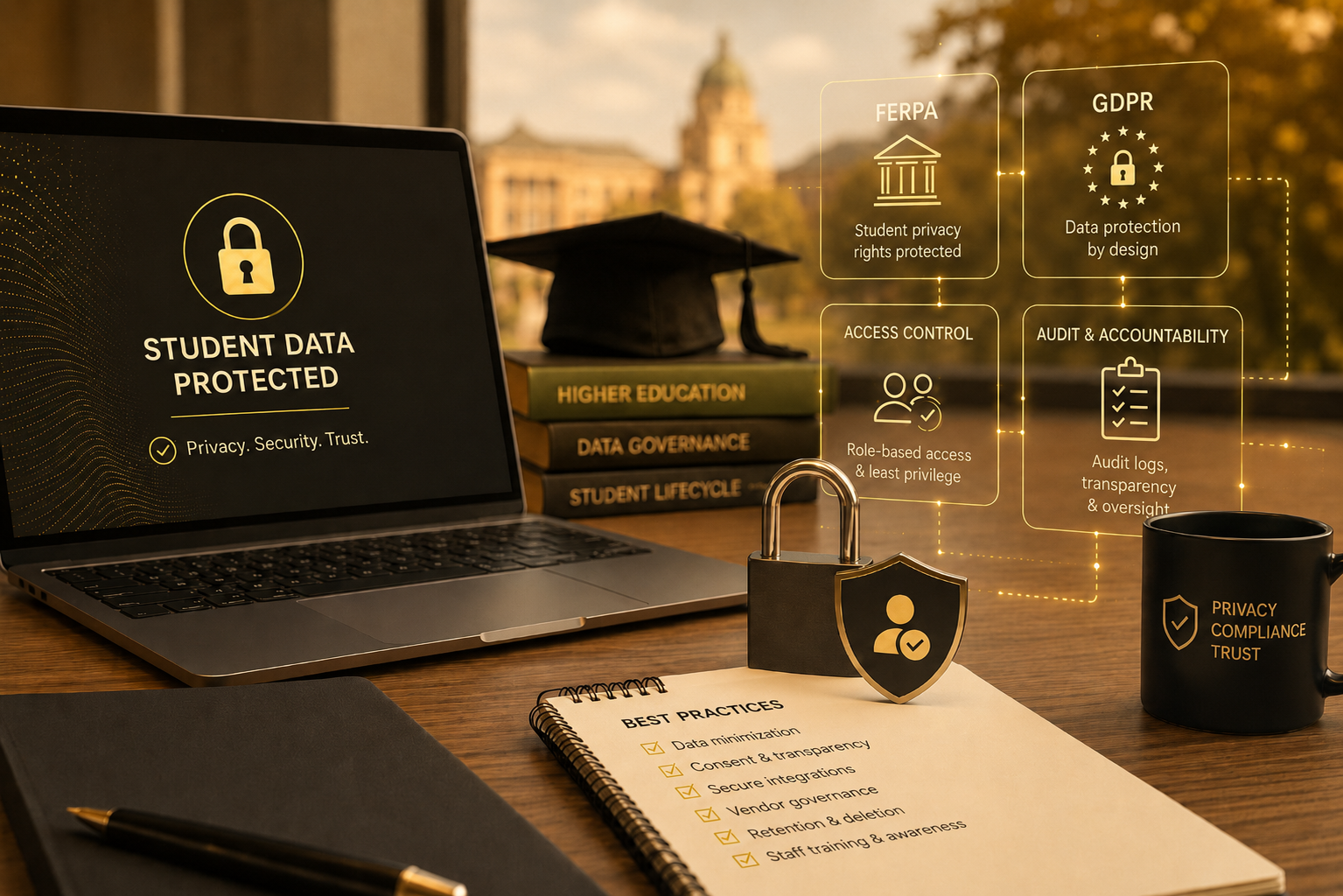
Student data privacy is no longer a back-office compliance issue handled quietly by the registrar. In a modern institution, student data moves across CRM, admissions, the student information system, the LMS, finance, marketing automation, reporting tools, analytics platforms, AI assistants and a long list of third-party vendors. Each connection point creates a place where access has to be defined, where data has to be protected, and where decisions have to be traceable.
The development and maintenance of an in-house system is a complex and time-consuming task. Full Fabric lets you turn your full attention to maximizing growth and performance.

In the United States, the Family Educational Rights and Privacy Act (FERPA) is the foundation. It sets baseline rights for students and baseline obligations for institutions that receive funds under applicable U.S. Department of Education programmes. But FERPA is no longer the whole picture. Higher education leaders also need to think about GDPR for EU and UK learners, state privacy laws, cybersecurity frameworks, vendor risk management, AI governance, consent and communications, and broader institutional data governance.
This article sets out practical best practices for student data privacy and FERPA compliance in higher education. It is written for CIOs, IT leaders, registrars, admissions and recruitment leaders, compliance officers, data protection officers and student services leaders responsible for the security and governance of student data across the full learner lifecycle.
This article provides general guidance for higher education teams. It is not legal advice. FERPA, GDPR and other privacy obligations depend on institutional context, jurisdiction and the specific ways data is used. Institutions should work with legal, compliance and data protection specialists before making policy decisions or interpreting specific obligations.
FERPA is a federal law that protects the privacy of student education records and the personally identifiable information contained in those records. It applies to educational agencies and institutions that receive funds under applicable U.S. Department of Education programmes, including most public and private postsecondary institutions that participate in federal student aid programmes.
Three points matter most for higher education teams.
Two further points often get overlooked. First, FERPA requires institutions to maintain a record of requests for access to, and disclosures of, personally identifiable information from education records, with limited exceptions (U.S. Department of Education FAQs). In practical terms, that is an audit-log requirement. Second, FERPA generally applies to students in attendance. Applicants who never enrol are generally not covered by FERPA, but their data is still sensitive and is typically subject to other obligations, including GDPR for EU and UK applicants, state privacy laws, institutional policy and contractual controls. If an applicant does enrol, the information collected during admissions can become part of the education record.
FERPA is necessary but not sufficient. International recruitment, online programmes and cross-border data flows pull GDPR and other privacy regimes into the conversation.
The student lifecycle now runs through more systems than at any point in higher education's history. A typical learner record can touch the CRM, the application portal, the admissions platform, the student information system (SIS), the LMS, the payments platform, marketing automation, reporting dashboards, the careers system, the alumni database, several integration layers and a growing number of AI tools.
A few factors make this harder than it used to be:
The implication is straightforward. Privacy in higher education is now a function of system architecture as much as policy. If the architecture is fragmented, the policy will be hard to enforce.
The following practices are operational. They are written to be implementable by IT, admissions, registrar, compliance and student services teams working together.
Start by building a shared understanding of which records are education records under FERPA and which are not. Then map where those records live across the CRM, admissions platform, SIS, LMS, finance system, support tools, marketing automation and reporting platforms. Without that map, no policy can be enforced consistently.
Document what data is collected, where it is stored, who owns it, who can access it, how it flows between systems, and how long it is retained. Many institutions hold pieces of this knowledge informally. Writing it down is the first step toward governance. It is also a prerequisite for almost every cybersecurity framework, including the Identify function of the NIST Cybersecurity Framework.
Permissions should reflect role, department, programme, campus and the legitimate educational interest defined in your annual FERPA notification. A faculty member, an admissions officer and a finance clerk should see different fields and different records. Where possible, access should be reviewed periodically rather than granted once and forgotten. U.S. Department of Education guidance is explicit that institutions should use reasonable methods to ensure school officials only access the records in which they have a legitimate educational interest.
You should be able to answer the question: who accessed, changed, exported or disclosed this student's record, and when. FERPA requires schools to maintain a record of disclosures of personally identifiable information from education records, subject to limited exceptions. Beyond the legal minimum, audit logs are essential for incident response and internal accountability.
Directory information may be disclosed without consent only if the institution has properly designated it, given public notice of what is included, and offered students a reasonable opportunity to opt out (directory information guidance). Several practical points follow.
Written consent should be the default for disclosures that do not fall under a clear exception. Disclosures under the school official exception need to rest on a defined and defensible legitimate educational interest. Where vendors act as school officials, the relationship must satisfy the conditions in the FERPA regulations, including direct institutional control over the use and maintenance of the records and a commitment by the vendor not to disclose the information further without consent.
Every disconnected system, side-spreadsheet and parallel CRM creates a copy of the student record that nobody is governing properly. Reducing duplication is a privacy intervention, not just a tidiness exercise. A connected higher education CRM, tied to admissions and the SIS, removes a category of risk that policies alone cannot address.
Vendor risk now sits at the centre of student data privacy. Contracts should cover data processing terms, sub-processors, retention, deletion, breach notification, security controls and the right to audit. API access should follow least-privilege principles and be reviewed periodically. Many institutions use the Higher Education Community Vendor Assessment Toolkit (HECVAT) and structured procurement reviews to assess third parties before signing.
Applicants share documents, identification, financial information and personal histories long before they enrol. That data is often handled by recruitment, admissions, agents and marketing teams. Architecting admissions and enrolment software on the same system of record as enrolled-student data is one of the most effective ways to reduce sprawl and bring pre-enrolment data under the same governance regime as enrolled-student data. Where FERPA does not yet apply, GDPR, state privacy laws and institutional policy typically still do.
Reporting is where privacy programmes often quietly leak. Uncontrolled CSV exports, dashboard screenshots and analyst spreadsheets create copies of sensitive records outside the systems where access and audit are enforced. Best practice is to make reporting happen inside the platform, restrict exports to specific roles, anonymise or aggregate where possible, and avoid building processes that depend on ungoverned spreadsheets.
AI tools are not inherently incompatible with FERPA or GDPR, but they need to be governed with the same rigour as any other system that touches student records. The Future of Privacy Forum has published practical guidance on vetting AI tools for legal compliance in education, with a focus on vendor terms, training data and de-identification. Practical steps include:
Institutions that recruit internationally, deliver online programmes globally, or have campuses in the UK or EU will often need to consider FERPA and GDPR side by side. UK GDPR is enforced by the Information Commissioner's Office, and EU GDPR guidance is published by the European Data Protection Board. Both regimes extend rights such as access, rectification, erasure and restriction of processing to data subjects, alongside requirements on lawful basis, transparency, security and international transfers. Wherever practical, design privacy controls to satisfy the stricter of the two regimes for a given dataset.
Privacy training only works when it is grounded in the real situations staff face: a parent asking about their adult child's grades, a colleague's curiosity-driven search, a recruiter wanting to export an applicant list, a faculty member pasting a class roster into a generative AI tool, a finance team needing payment history. Use real cases, not abstract principles.
Student data should not be kept indefinitely by default. Retention schedules should be lawful, documented and operationally enforceable across systems. Deletion should be a planned step at the end of a defined period, not a manual cleanup task that never quite happens. Retention and deletion are GDPR cornerstones and are also good practice under FERPA.
This is the through-line of every practice above. A policy that the system cannot enforce is a policy that will fail at the edges. Permissions, audit logs, the data model, integrations, workflows and governance need to support the policy by default.
Use the following as a working checklist for institutional readiness. It is not exhaustive, and it does not replace legal review.
Policy carries you only as far as the systems will let it. The architectural goal is to make the right behaviour the easy behaviour.
A unified higher education platform supports this in several ways:
Full Fabric is built around this principle. It brings CRM, admissions, payments, student information and management system records, and reporting into one connected platform, with security and GDPR compliance considered at the architectural level rather than retro-fitted. Institutions reviewing platforms can consult Full Fabric's Trust Center for security documentation, and the GDPR compliance in higher education feature page sets out the platform's consent, retention and privacy controls in detail.
This is not a guarantee of FERPA or GDPR compliance. Compliance depends on institutional policy, configuration, staff behaviour, legal interpretation and ongoing governance. What the right architecture can do is remove the most common structural reasons compliance breaks down in practice.
A pattern emerges across institutions that have struggled with student data privacy. These are the recurring mistakes worth checking against.
Student data privacy and FERPA compliance are operational disciplines, not just policy documents. They depend on governance, legal oversight, training and systems that make the right behaviour possible by default. Institutions that succeed treat privacy as a continuous design choice across the student lifecycle: in the CRM, in admissions, in the SIS, in finance and reporting, and increasingly in AI.
For institutions reviewing the privacy and governance risks created by disconnected CRM, admissions, SIS and reporting tools, a unified platform can make student lifecycle governance significantly easier. Full Fabric supports this by bringing CRM, admissions, payments, student records and reporting onto one connected unified higher education platform, with security and GDPR considerations built into the architecture. Combined with legal advice, staff training and ongoing review, the right platform choice can reduce a significant category of operational privacy risk.
FERPA is the Family Educational Rights and Privacy Act, a U.S. federal law that protects the privacy of student education records and the personally identifiable information they contain. In higher education, it applies to most institutions that receive funds under applicable U.S. Department of Education programmes, including most institutions that participate in federal student aid. Once a student is 18, or attends a postsecondary institution at any age, FERPA rights transfer from the parent to the student.
FERPA protects education records, which are records directly related to a student and maintained by the institution or by a party acting for the institution. This includes transcripts, grades, disciplinary records and other personally identifiable information held in those records. Some information may be designated by the institution as directory information, but students must be given public notice of the categories and a reasonable opportunity to opt out of disclosure.
FERPA's protections generally begin once a student is in attendance at the institution, and applicants who never enrol are generally not covered. However, admissions and pre-enrolment data is typically sensitive, and where an applicant does enrol, information collected during admissions can become part of the education record. Even where FERPA does not apply, admissions data is often subject to other obligations, including GDPR for UK and EU applicants, state privacy laws, institutional policy and vendor contracts. Treat applicant data as sensitive regardless of FERPA's formal scope.
Practical priorities include mapping where student data lives across all systems, applying role-based access control and least privilege, maintaining audit logs of sensitive access and changes, reducing duplicated records, governing vendor access, controlling exports and spreadsheets, defining retention and deletion schedules, and training staff with realistic scenarios. EDUCAUSE has identified data governance and classification as foundational to this work, and the NIST Cybersecurity Framework is widely used as a baseline.
Vendor management for student data should include written contracts that set out data processing terms, sub-processor controls, security requirements, breach notification, retention and deletion. Where vendors act as school officials under FERPA, the relationship must satisfy the conditions in the FERPA regulations, including direct institutional control over the use and maintenance of education records and a commitment not to disclose the information further without consent. Periodic vendor reviews and structured assessments such as HECVAT add a useful layer of due diligence.
For institutions in the UK or EU, or those processing data of learners based there, UK GDPR and EU GDPR add rights and obligations alongside FERPA-style frameworks. These include rights of access, rectification, erasure and restriction, requirements around lawful basis and transparency, rules on international data transfers, and obligations to maintain appropriate technical and organisational security measures. The UK regulator publishes guidance through the Information Commissioner's Office, and EU-level guidance is published by the European Data Protection Board. Institutions should design controls to satisfy the stricter of the relevant regimes for each category of data.