

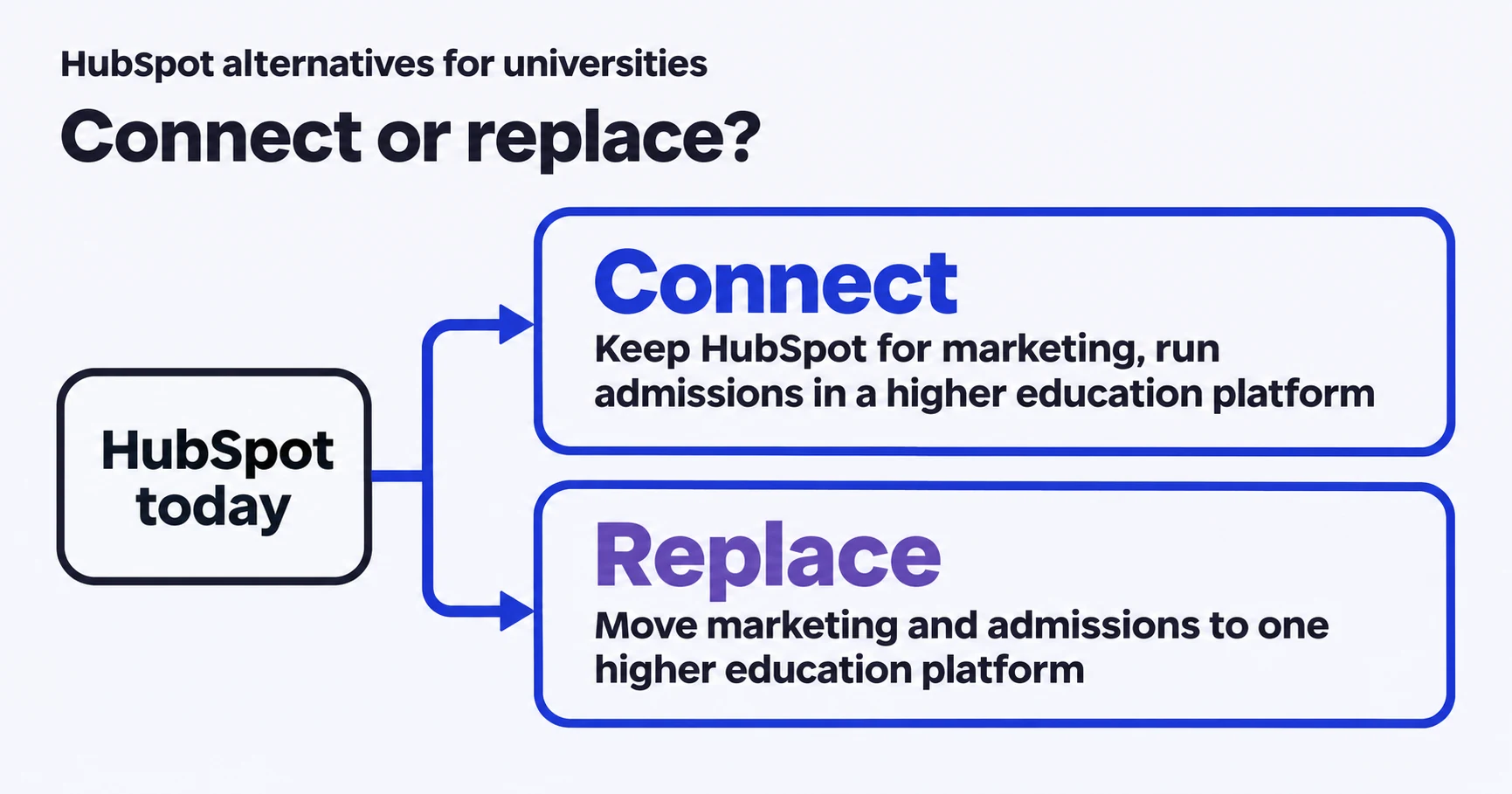
The best HubSpot alternatives for universities are platforms built for higher education, because HubSpot is a general marketing and sales CRM with no native model for applications, admissions decisions, offers or enrolment. Full Fabric, Salesforce Education Cloud, Slate, Element451, Ellucian and, in the UK, Student CRM are built for higher education and cover admissions as well as recruitment, although the scope of each, and how much of it is native rather than configured, varies; Microsoft Dynamics 365 suits Microsoft-centred institutions willing to configure it. But replacing HubSpot is not always the right answer. If your marketing team works well in HubSpot and the real gap is admissions, connecting HubSpot to an admissions platform can be the less disruptive route; whether it also costs less depends on licences, integration, implementation and maintenance on both sides. Full Fabric supports both routes: it can replace HubSpot, or run admissions alongside it through a native HubSpot integration.
Transparency note: Full Fabric publishes this article and appears first in it. Vendor capabilities are based on each vendor's public, first-party documentation as of November 2026, and Full Fabric's on its Help Center. We have tried to be fair about where other platforms, including HubSpot itself, may be the better fit. If something is out of date, tell us and we will correct it.
HubSpot is a capable marketing platform, and many universities and business schools use it for enquiry capture, nurture emails, landing pages and campaign reporting. The friction starts where marketing ends.
None of this makes HubSpot a poor choice for recruitment marketing. It means the decision is less "which tool is better than HubSpot?" and more "which jobs should HubSpot keep doing, if any?"
Start with where the problem actually sits. The table below summarises the two routes.
| Your situation | Likely best route | Why |
|---|---|---|
| Marketing runs well in HubSpot; admissions runs on spreadsheets, email or a dated portal | Connect HubSpot to an admissions platform | Keeps the marketing team's tools and history, and fixes the part that is broken |
| Marketing wants to report on applications, offers and enrolments, not just enquiries | Connect, with admissions data flowing into HubSpot | Attribution needs downstream stages; an integration can supply them |
| Two CRMs are already in use and the data rarely matches | Replace HubSpot with a single higher education platform | One record removes reconciliation between two CRMs; well-integrated systems can also keep data consistent, but the integration has to be maintained |
| HubSpot costs are rising with contact volumes and most use is basic email | Replace, if the admissions platform covers your campaign needs | May avoid paying for the same contacts in two systems; compare total costs, including migration |
| Institution-wide CRM is the goal, across recruitment, students and alumni | Replace with a lifecycle platform, or use Salesforce or Dynamics as the institutional CRM | HubSpot was not built as a student record |
Two points are easy to miss. First, higher education CRMs do not automatically match HubSpot's depth in landing pages, ads, social and multi-touch attribution; if those matter, ask each vendor to demonstrate them, or keep HubSpot for that work. Second, connecting two systems only helps if the integration carries the fields that matter, particularly the original enquiry source and consent, so that reporting survives the hand-over from marketing to admissions. Our guide to admissions analytics and conversion software explains why attribution should be measured on enrolled students rather than enquiries.
Full Fabric is listed on the HubSpot Marketplace, and its HubSpot connector is documented in detail in the Full Fabric Help Center. In summary:
The documented limits are worth reading before you choose this route. The Help Center states that there is no initial import, so records that exist when a switch is turned on reach HubSpot only when they next change. One HubSpot portal connects per institution. Full Fabric is the source of truth for mapped properties, so manual edits to those properties in HubSpot are overwritten at the next sync, and an empty mapped field in Full Fabric clears the HubSpot value. Deleting a record in Full Fabric does not delete it in HubSpot.
If you decide to replace HubSpot, judge alternatives on the work your teams do every cycle, not on a generic CRM feature list.
| Criterion | What good looks like | Why it matters |
|---|---|---|
| Higher education data model | Programmes, intakes, applications, decisions, offers and enrolment as native records | Avoids forcing admissions into sales deals or custom objects |
| Campaigns and nurture | Segmented email campaigns, automated journeys, event invitations and delivery and engagement reporting | The part of HubSpot you are most likely to miss |
| Forms and landing pages | Enquiry and event forms that can be embedded on the institution's website and feed the CRM directly | Keeps enquiry capture working on day one |
| Applications and admissions | Configurable application forms, document collection, review and decision workflows, offer letters | The main reason to move to a higher education platform |
| Attribution to enrolment | Source captured at enquiry and kept on the record through to enrolment | Lets marketing be judged on students, not clicks |
| Consent and GDPR | Consent by channel and topic where consent is the lawful basis, optional double opt-in, retention controls and support for data subject rights | UK and EU GDPR apply to every prospect record, whatever the lawful basis |
| Hosting and security | Clear data location and recognised certifications | Procurement teams in the UK and EU will ask |
| Integrations | SIS, LMS, payments, UCAS or application services, and the institutional CRM if one remains | No admissions platform works alone |
| Migration support | Help to move contacts, history, consent records and active workflows | Source, consent and workflow history do not move across automatically; they have to be mapped |
This is an editorial comparison, not hands-on testing. We reviewed each vendor's public, first-party documentation (product pages, help centres and knowledge bases) in November 2026 and mapped it against the criteria above. Full Fabric's capabilities are taken from its Help Center. Where a vendor's documentation does not address something, we say so; that does not mean the product cannot do it. We excluded general business CRMs without a higher education offering from the main list, and cover them briefly below. Ask every vendor to demonstrate the points that matter to you with your own data.
| Platform | Type | Admissions and applications | Marketing campaigns | Works alongside HubSpot | Best fit |
|---|---|---|---|---|---|
| Full Fabric | Student lifecycle platform: CRM, admissions, payments, SIS | Native | Campaigns, forms, events, workflows | Yes, native integration | UK and European universities and business schools |
| Salesforce Education Cloud | Higher education edition of Salesforce | Native, typically configured with a partner | Marketing automation; Marketing Cloud sold separately | Through integration projects | Institutions standardising on Salesforce |
| Slate (Technolutions) | Admissions CRM | Native | Communication tools included in the licence | Not documented in the pages we reviewed | US admissions offices |
| Element451 | AI-led CRM and engagement platform | Native | Email nurture and student journeys | Not documented in the pages we reviewed | Teams prioritising AI-driven engagement |
| Ellucian | Recruiting and admissions within Ellucian Student | Native | Multichannel outreach: text, email, chat | Not documented in the pages we reviewed | Institutions already on Ellucian |
| Microsoft Dynamics 365 | General CRM and marketing platform | Requires configuration | Customer Insights – Journeys | Through integration projects | Microsoft-centred institutions |
| Student CRM | UK higher education CRM | Native | Email and SMS campaigns, events | Not documented in the pages we reviewed | UK universities and colleges |
Overview: Full Fabric is a student lifecycle platform for higher education. Its higher education CRM sits on the same record as applications, admissions decisions, offers, payments and student records, so the enquiry that marketing captures is the same profile the admissions team reviews and the registry enrols.
Best for: universities and business schools in the UK and Europe that want to replace HubSpot with a single higher education platform, or keep HubSpot for marketing and run admissions in Full Fabric.
Key strengths:
Watch-outs:
Bottom line: our recommendation for institutions that want admissions and recruitment marketing on one record, with the option of keeping HubSpot where it adds value.
Overview: Education Cloud is Salesforce's higher education product, which Salesforce describes as bringing together its CRM and next-generation SIS capabilities. Salesforce describes marketing automation and AI built directly into the CRM.
Best for: large institutions that want Salesforce as the institution-wide CRM.
Key strengths: a broad platform across recruitment, admissions, student success and advancement, much of it configured for each institution; extensive integration and customisation options; a large partner ecosystem.
Watch-outs: Marketing Cloud is listed as a separate product. The Education Cloud page lists consumption-based credits for AI, Agentforce and data as add-ons, and implementations usually involve a partner. Budget for configuration and ongoing administration.
Bottom line: a strong option when Salesforce is already the institutional platform; a heavier project than most HubSpot replacements.
Overview: Slate is an admissions CRM that Technolutions describes as covering admissions, student success and advancement offices. Applications, reading and decisions are part of the platform, and its licence includes communication tools.
Best for: admissions offices, mainly in the US, that want one admissions system with communications built in.
Key strengths: a mature admissions workflow; communications, events and reporting within one licence that Technolutions describes as having "no add ons, no hidden costs".
Watch-outs: its customer base and processes are US-centred. The pages we reviewed do not state a hosting region or describe a HubSpot integration, so European institutions should confirm GDPR arrangements and how marketing data would move across.
Bottom line: a proven admissions CRM; check fit for UK and EU processes and data protection.
Overview: Element451 is an AI-led CRM and engagement platform for higher education. It describes email nurture campaigns through to complete student journeys as part of the platform.
Best for: recruitment teams that want AI-assisted engagement and automated journeys.
Key strengths: according to Element451, marketing and engagement are built into the platform rather than added on, with AI agents, natural-language reporting and admissions workflows on the same platform.
Watch-outs: its positioning and customer base are largely US. The pages we reviewed do not describe a HubSpot integration or EU data hosting; ask about both.
Bottom line: in our assessment, the platform in this list whose positioning is closest to HubSpot's marketing focus; confirm European fit.
Overview: Ellucian's Recruiting & Admissions capabilities sit within Ellucian Student, alongside its student information systems. Ellucian describes multichannel outreach by text, email, chat and self-service.
Best for: institutions already running Ellucian student systems.
Key strengths: recruitment, admissions and student records from one vendor; established higher education footprint.
Watch-outs: the value is greatest inside the Ellucian ecosystem. Check which outreach and analytics capabilities are included in the Ellucian Student licence and which are separate products.
Bottom line: a natural choice for Ellucian customers; less compelling as a standalone HubSpot replacement.
Overview: Dynamics 365 is Microsoft's business applications suite. Customer Insights – Journeys provides marketing automation, including real-time journeys across email, text message and push notifications, event planning and marketing forms.
Best for: institutions standardised on Microsoft 365, Power BI and Azure that want a configurable CRM.
Key strengths: close ties to the Microsoft stack; strong reporting through Power BI; flexible data model.
Watch-outs: it is not a higher education product out of the box. The Microsoft documentation we reviewed does not describe a current higher education data model for admissions, so applications, decisions and offers have to be configured or provided by a partner.
Bottom line: a platform to build on rather than a ready-made admissions system.
Overview: Student CRM is a UK vendor that describes its product as an all-in-one CRM built for UK universities and colleges, covering recruitment, marketing, events and admissions.
Best for: UK universities and colleges that want a UK-focused recruitment CRM.
Key strengths: as described on its site, enquiries, applications, events, international agent management and email and SMS campaigns in one system; UK compliance areas such as GDPR, UKVI, OfS and HESA; UK-based support.
Watch-outs: check the depth of admissions decision and offer workflows against your process, and how it connects to your student records system.
Bottom line: worth shortlisting for UK institutions focused on recruitment.
Some lists recommend general business CRMs. Zoho CRM, for example, has an education page, but Zoho describes the product as an industry-agnostic CRM customised for different sectors. That puts it in a similar position to HubSpot: a CRM that can capture and nurture prospects, but without a native admissions model. Replacing HubSpot with another general CRM does not, on its own, add admissions capability; it makes sense mainly when the problem is HubSpot's cost or fit for marketing rather than admissions.
A migration is where institutions lose data they did not know they needed. Before you switch:
Higher education platforms that cover admissions as well as recruitment, to different depths: Full Fabric, Salesforce Education Cloud, Slate, Element451, Ellucian and, in the UK, Student CRM. Microsoft Dynamics 365 suits Microsoft-centred institutions willing to configure it. For a wider comparison, see our guide to the best CRM platforms for higher education.
For recruitment marketing, yes: enquiry capture, nurture emails, landing pages and campaign reporting are its strengths. It is not built for admissions. Applications, decisions, offers and enrolment need either custom configuration or a separate admissions platform.
Not natively. HubSpot's default objects do not include applications, and custom objects require an Enterprise subscription. Most institutions run applications in an admissions platform and send the stage data into HubSpot for reporting.
Yes. Full Fabric is on the HubSpot Marketplace, and its integration sends profiles, applications by programme, emails and documents from Full Fabric into HubSpot as contacts, deals, email activities and notes, once pipeline rules are configured for deals. The native sync runs from Full Fabric to HubSpot; sending HubSpot data into Full Fabric is a separate set-up with a HubSpot custom code workflow and a Data Hub Professional or Enterprise subscription.
Yes, and for many institutions it is the more practical route. The integration has to carry the original source, consent and admissions stages into HubSpot, so that marketing can report on applications, offers and enrolments rather than enquiries alone.
Exporting each object with its properties and associations, mapping source and UTM fields, mapping and checking consent records, rebuilding the workflows you still need and timing the cut-over to avoid the middle of an admissions cycle.
Whether you want to replace HubSpot or connect it to admissions, we can show you both set-ups with a process like yours. Book a demo.

