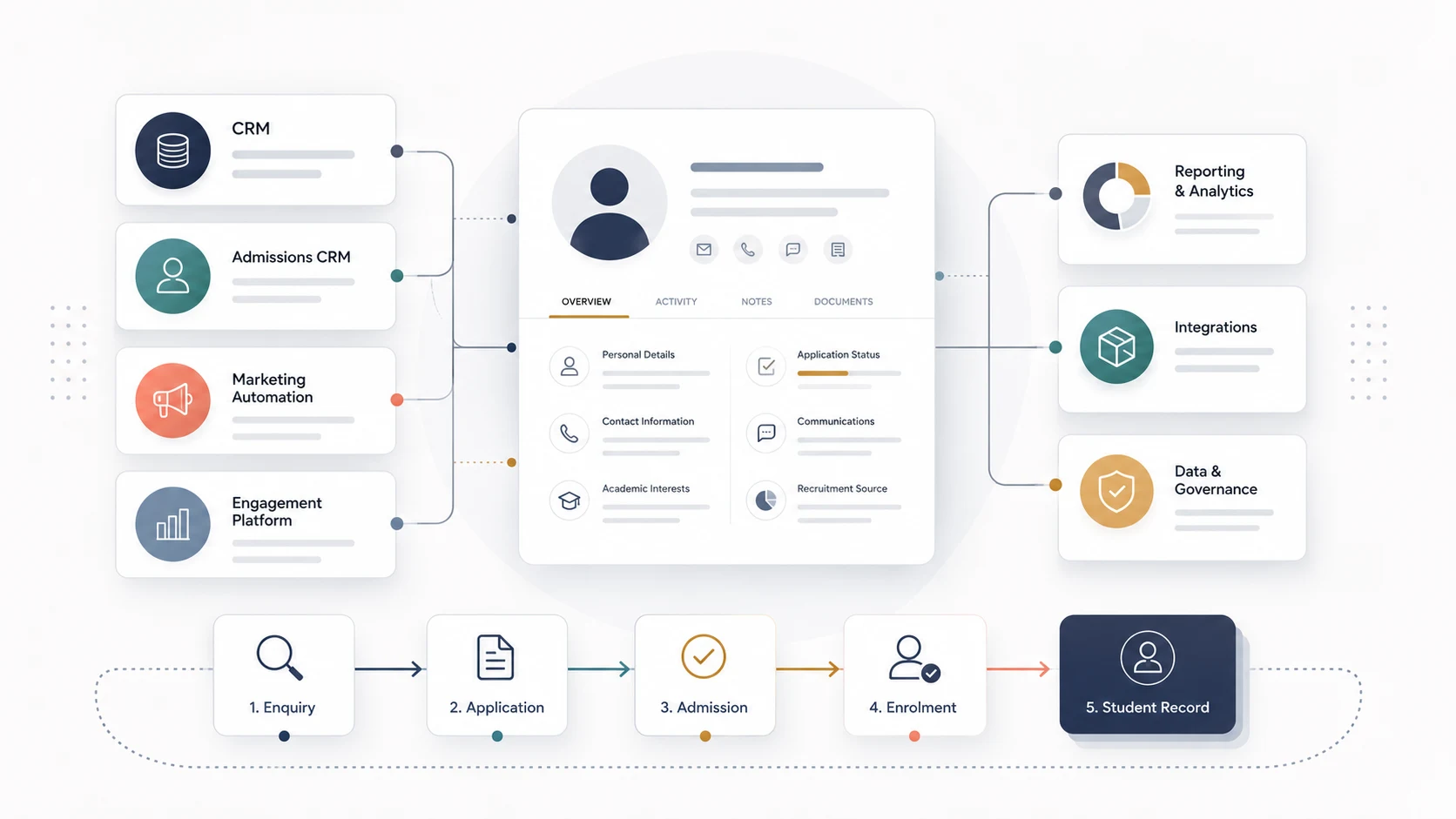
Higher education CRM has quietly changed shape. A CRM used to be where prospective students lived: enquiries flowed in, a recruitment team worked the list, and the rest of the institution caught up later through spreadsheets, exports, or a separate application portal. That model still exists, but it no longer reflects what most universities, business schools and colleges actually need.
The shift is operational. Recruitment, admissions, enrolment, communications, finance and student services are no longer easily separable. Applicants expect personalised contact across multiple programmes and intakes. Admissions teams need visibility from first enquiry through to enrolled student. IT leaders are being asked to reduce the number of disconnected systems rather than add more. Leadership wants reporting that ties marketing spend to enrolled students, not just to leads.
In this article, a higher education CRM platform means a system used to manage relationships and interactions with prospective students, applicants, enrolled students, alumni or other institutional audiences across recruitment, admissions, enrolment, communications and student lifecycle workflows. Some platforms cover most of that scope; others cover only part of it.
The market has become more crowded and more nuanced as a result. Some platforms are general-purpose enterprise CRMs adapted for education. Others are admissions-first CRMs built for a specific part of the funnel. A smaller group are purpose-built higher education CRM platforms designed around the full student lifecycle. None is universally the best choice; the right system depends on what the institution is trying to operate.
This article compares 15 platforms credibly used by, or relevant to, higher education in 2026, with the aim of helping admissions, marketing, IT and registry leaders see which kind of platform fits which kind of institution.
Transparency note. Full Fabric is our own platform and is included in this comparison. The list is not intended to present one universal winner; it is organised around institutional fit, platform category and use case, so readers can understand which platforms are strongest in which higher education contexts. Where Full Fabric is less suited, the article says so.
The development and maintenance of an in-house system is a complex and time-consuming task. Full Fabric lets you turn your full attention to maximizing growth and performance.

A handful of criteria tend to separate platforms that can credibly support a university operation from those that need significant configuration to reach the same point.
Higher education-specific workflows. Admissions is not a sales funnel. Application stages, decision committees, conditional offers, document checks, deferrals and intake structures are particular to the sector. A CRM that treats these as native concepts behaves very differently from one that approximates them through custom objects.
Enquiry-to-enrolment visibility. The most useful CRMs let admissions, marketing and registry teams see the same student record at every stage (enquiry source, application progress, communications, offer status, payment status, enrolment) without nightly syncs between disconnected systems.
Admissions and application management. Institutions running multiple programmes, rolling intakes or executive education benefit from native application workflows; institutions with a single annual cycle and a strong existing portal may not.
Communications and segmentation. Higher education communication is unusually segmented: by programme, intake, fee status, country, agent, scholarship, learner type. A CRM that supports this depth without bolt-on tools is more useful than one that depends on an external marketing platform.
Reporting and conversion analytics. Reporting should reflect how admissions teams actually work (pipeline by programme, conversion by source, yield by intake, decline reasons by region) and be accessible to non-technical users.
Integrations. SIS, application portals, payment systems, marketing tools, data warehouses and finance systems all sit around the CRM. The depth of integrations often determines how much value the CRM delivers.
Data privacy and consent. UK GDPR, EU GDPR, FERPA and increasingly active national regulators require consent to be managed at record level. CRMs that treat consent as a first-class concept reduce risk significantly.
Configurability without heavy development. Admissions operations change every cycle. A CRM that requires a developer or partner for every adjustment becomes a bottleneck.
Implementation realism. Project length, partner dependency and time to first business value vary widely. Underestimating this is the single most common cause of regret in CRM selection.
Fit across teams. A CRM that suits IT but frustrates admissions, or pleases marketing but blocks registry, rarely succeeds. The best evaluations involve all four groups from the start. A longer treatment is available in how to evaluate a CRM for your university.
The 15 platforms below sit in three broad groups: purpose-built higher education CRMs, enterprise CRMs adapted for education, and marketing, admissions or automation platforms that institutions often use as part of a wider higher education CRM stack. Not every platform listed is a complete higher education CRM in its own right; some are included because institutions realistically consider them when building or reviewing their recruitment and admissions technology, alongside or in place of a dedicated CRM.
| Platform | Best for | Higher education focus | Key strengths | Watch-outs |
|---|---|---|---|---|
| Full Fabric | Institutions wanting CRM connected to admissions, enrolment and student records | Purpose-built higher education lifecycle platform | Unified student record; native admissions and SIS workflows | Less suited to institutions wanting CRM only |
| Slate by Technolutions | US undergraduate admissions offices with internal Slate expertise | Purpose-built admissions CRM | Deep customisation; mature reader workflows; strong community | Depth depends on in-house capability; CRM-first scope |
| Salesforce Education Cloud | Large universities standardising on Salesforce | Horizontal CRM with education layer | Mature ecosystem; strong marketing, service and analytics | Education functionality often partner-built; admin-heavy |
| Microsoft Dynamics 365 | Institutions standardised on Microsoft and Azure | Horizontal CRM with education accelerators | Office, Teams and Power Platform integration | Education workflows need partner build |
| HubSpot | Marketing-led recruitment and top-of-funnel engagement | Marketing automation and CRM (not an admissions CRM) | Strong marketing automation, lead nurturing and reporting | No native admissions or application management; usually paired with an admissions platform |
| Element451 | US institutions modernising engagement and outreach | Higher-education-specific engagement CRM | AI-driven outreach; modern UX; good for top-of-funnel | Lifecycle coverage typically stops before SIS |
| TargetX by Liaison | US institutions using Liaison CAS applications or wanting an admissions CRM on Salesforce | Admissions CRM (built on Salesforce) | Established admissions tooling; CAS integration; Salesforce foundation | Salesforce-platform dependencies; depth beyond admissions varies |
| Ellucian (CRM Recruit, Advise, Advance) | Existing Ellucian Banner or Colleague customers | ERP-aligned higher education CRM suite (moving onto Dynamics 365) | Tight alignment with Banner and Colleague; covers recruitment, advising and advancement | Strongest case depends on existing Ellucian footprint; mid-platform transition |
| Encoura / Anthology Reach and Encompass | Institutions on the former Anthology lifecycle engagement products | Higher education engagement portfolio (on Microsoft Dynamics 365) | Breadth across recruitment, engagement, advancement and student success | Recent ownership transition from Anthology to Encoura; institutions should validate roadmap |
| Jenzabar CRM | US community colleges and smaller private institutions | ERP-aligned CRM | Tight coupling with Jenzabar One | Best where Jenzabar is already the SIS |
| Creatrix Campus | Institutions wanting a broad modular platform | Modular higher education suite | Wide module coverage at accessible price points | Module depth varies; regional concentration |
| Blackbaud | Advancement, schools and mixed K–HE institutions | Advancement-led and schools-focused | Strong fundraising, alumni and K–12 functionality | Less suited to core university admissions |
| Zoho CRM | Smaller institutions and short-course providers | General-purpose CRM | Affordable, configurable, broad business suite | No native higher education model |
| Pipedrive | Very small recruitment teams, language schools, short-course or commercial training units | Lightweight sales CRM (not an admissions CRM) | Simple pipeline UX; quick to deploy; low cost | No native applications, offers, intakes or lifecycle coverage; not a credible primary university CRM |
| Mautic | Institutions with strong technical capability wanting self-hosted marketing automation | Marketing automation component, not a full CRM | Open source; full control over hosting and data; no licence fees | Not an admissions or lifecycle CRM; ownership shifts to internal engineering effort |
Overview. Full Fabric is a higher education platform that combines CRM, admissions, applications, communications, payments and student records on a single data model. It is used by universities, business schools and specialist providers, including institutions running executive education, lifelong learning and complex international recruitment alongside their core degree programmes.
Best for. Institutions that want CRM and admissions deeply connected to enrolment and the student record, rather than a CRM bolted to a separate application portal, marketing tool and SIS.
Key strengths. Native handling of programmes, intakes, cohorts and learner types; one identity for a person from enquiry through to enrolled student; configurable admissions workflows that admissions teams can adjust without development; communications, segmentation and consent on the same record; integrations with payment providers, finance systems and data warehouses.
Potential watch-outs. Institutions that genuinely only want a marketing CRM, or that have very recent and significant investment in a separate admissions and SIS stack they intend to keep, will get less benefit from the unified model. Institutions whose recruitment model is principally large-scale content marketing and paid acquisition may also prefer to pair a dedicated marketing platform such as HubSpot with a connected admissions system.
Why it matters for higher education. The practical case for a unified student record is operational rather than conceptual. When the same person exists as a marketing lead in one system, an applicant in another, a student in a third and a fee payer in a fourth, every handoff between teams becomes a reconciliation problem, and conversion analytics that depend on stitching those records together are never quite trustworthy. Connecting CRM, admissions, enrolment, payments and student records around one identity removes most of that friction: admissions sees the same record marketing nurtured, registry sees the same record admissions admitted, and finance sees the same record registry enrolled. This matters most for institutions whose operating shape stresses generic CRMs: business schools with intensive intakes, executive education providers running rolling programmes and short courses, universities with stackable credentials or lifelong learning portfolios, and institutions managing complex international recruitment across multiple programmes. For those settings, connected admissions and enrolment workflows on one platform reduce the integration tax that mixed stacks accumulate over time.
Overview. Slate is the most widely adopted admissions CRM in North American higher education, particularly across undergraduate admissions offices at private universities and liberal arts colleges. It is mature, deeply configurable and backed by an active practitioner community.
Best for. Undergraduate-heavy US institutions with the internal capacity to operate a highly configurable admissions CRM, often alongside a separate SIS.
Key strengths. Extensive customisation of forms, workflows and reader processes; strong event, travel and recruitment activity management; well-developed application reader workflows; large user community.
Potential watch-outs. Slate rewards investment in internal expertise; institutions without that capability tend to rely on consultants. Lifecycle coverage stops short of the SIS, so most Slate institutions continue to operate a separate system of record and finance system.
Why it matters for higher education. For US undergraduate admissions, Slate is often the benchmark. Its limitations are less about capability and more about scope: it is excellent at admissions, but does not aim to be the lifecycle platform.
Overview. Salesforce Education Cloud is built on the Salesforce platform and brings the wider Salesforce ecosystem (Marketing Cloud, Service Cloud, Tableau, MuleSoft) to higher education. It is frequently selected by institutions already using Salesforce elsewhere or wanting a horizontal CRM foundation for the long term.
Best for. Large universities standardising on Salesforce across multiple departments, with the implementation budget and internal capability to shape the education-specific layer.
Key strengths. Mature CRM foundation; extensive AppExchange ecosystem; strong marketing, service and analytics; familiar administration model for organisations with existing Salesforce capability.
Potential watch-outs. Architecturally a horizontal CRM with an education layer rather than a higher-education-native product. Education-specific functionality often depends on partner-built extensions, which adds implementation cost and ongoing dependency. Lifecycle coverage beyond admissions usually involves additional products.
Why it matters for higher education. Where Salesforce is the institutional standard, the case is strong. For institutions running Salesforce alongside admissions-specific tooling, Full Fabric provides a Salesforce connector so admissions and CRM workflows stay aligned without forcing premature consolidation.
Overview. Microsoft Dynamics 365 is Microsoft’s enterprise CRM and applications suite, used in higher education by institutions standardised on the broader Microsoft estate: Azure, Office, Teams and Power Platform. Several specialist partners offer higher education accelerators built on Dynamics.
Best for. Institutions deeply invested in Microsoft infrastructure, with internal Dynamics or partner capability to implement and maintain education-specific workflows.
Key strengths. Native integration with Microsoft 365, Teams and Azure; strong reporting via Power BI; flexible development model through Power Platform; familiar identity management.
Potential watch-outs. Dynamics is a general enterprise CRM. Education-specific workflows (applications, intakes, decision processes, programme structures) typically come from a partner accelerator rather than the base product, so the strength of the implementation partner becomes a significant factor.
Why it matters for higher education. Dynamics tends to suit institutions whose IT strategy is Microsoft-first and who want their CRM to sit inside that estate rather than alongside it.
Overview. HubSpot is a marketing-led CRM and automation platform widely used in higher education for top-of-funnel recruitment, content marketing and lead nurturing. It is rarely chosen as a full admissions CRM, but is one of the most credible options for institutions that want a modern marketing platform sitting alongside their admissions stack.
Best for. Marketing-led recruitment teams, particularly at business schools and executive education providers running lead generation campaigns, content programmes and paid acquisition at scale.
Key strengths. Strong inbound marketing tooling; user-friendly automation and segmentation; clear reporting on marketing performance; quick to deploy; broad ecosystem of marketing integrations.
Potential watch-outs. HubSpot does not natively model applications, intakes, offers, conditions, document review or enrolment. It is recruitment marketing and lead nurturing, not admissions management. Institutions using HubSpot almost always pair it with an admissions platform or an SIS-side workflow and integrate the two so that marketing engagement and admissions progress remain connected.
Why it matters for higher education. Many institutions find HubSpot is the right tool for recruitment marketing but not for admissions. The pairing pattern is common enough that Full Fabric provides a HubSpot connector to keep recruitment engagement and admissions workflows in sync without duplicating data.
Overview. Element451 is a higher-education-specific CRM with a strong focus on AI-driven engagement and conversational outreach. It combines CRM, marketing automation and an AI assistant aimed at modernising the top of the admissions funnel.
Best for. US institutions, particularly community colleges and mid-sized universities, looking to modernise enquiry capture, prospect engagement and early-stage communications.
Key strengths. Modern user experience; conversational AI for early-stage engagement; native higher education concepts such as programmes and applications; faster time to value than larger enterprise platforms.
Potential watch-outs. Lifecycle coverage typically extends to admissions rather than into the SIS. Institutions wanting a unified record beyond enrolment will still pair Element451 with a separate system of record.
Why it matters for higher education. Element451 has built credible momentum in the US engagement-led CRM segment. It is a strong option for institutions whose primary pain is top-of-funnel rather than lifecycle continuity.
Overview. Liaison is widely known for its centralised application services (CAS) used across US graduate, professional and specialist programmes. Its CRM offering is TargetX by Liaison: the TargetX product Liaison acquired in 2020, built on the Salesforce platform and now positioned as Liaison’s higher education CRM alongside its application services.
Best for. US institutions already using Liaison CAS for graduate, professional or specialist applications, or institutions wanting an admissions CRM built on Salesforce with established higher education tooling.
Key strengths. Strong Liaison CAS integration; mobile-first applicant experience; established admissions workflows; benefits from the underlying Salesforce platform for extensibility and integration.
Potential watch-outs. Because TargetX is a Salesforce-platform product within Liaison’s wider portfolio, institutions should validate how the modules they need (CAS, CRM, retention tooling) fit together as a coherent stack rather than as separate components. Lifecycle coverage typically extends to admissions and early student engagement rather than into the SIS.
Why it matters for higher education. For institutions whose admissions process is built around Liaison CAS, TargetX is a natural complement. For institutions outside that pattern, evaluation typically focuses on the Salesforce-platform admissions tooling against Salesforce Education Cloud and other CRMs.
Overview. Ellucian is one of the largest higher education software vendors, with a long-established footprint in SIS (Banner, Colleague) and ERP. Its CRM portfolio covers three products: CRM Recruit for admissions and enrolment, CRM Advise for student success and advising, and CRM Advance for fundraising and alumni engagement. Ellucian has announced that these products are being migrated to Microsoft Dynamics 365, which institutions should factor into evaluation timing.
Best for. Existing Ellucian Banner or Colleague customers wanting tighter alignment between their SIS and their recruitment, advising or advancement workflows.
Key strengths. Native integration with the Ellucian SIS estate; coverage across recruitment, advising and advancement under one vendor; established US and international footprint; benefiting from Microsoft Dynamics 365 as the underlying CRM platform going forward.
Potential watch-outs. Institutions should clarify the current status of the Dynamics 365 transition during evaluation, including which products are on the new platform and which are still on the older architecture. Outside the Ellucian SIS footprint, the case is harder to make against more focused admissions CRMs.
Why it matters for higher education. For Ellucian SIS institutions, CRM Recruit and its companion products remove integration friction within the Ellucian estate. For others, more focused admissions CRMs tend to be more directly competitive on the admissions side.
Overview. Reach, Encompass, Engage and Advance, historically marketed as the Anthology lifecycle engagement and student success portfolio, moved into Encoura’s higher education engagement portfolio in late 2025 and early 2026, following Anthology’s Chapter 11 restructuring. Anthology itself continues to focus on its Teaching & Learning business (including Blackboard), while Ellucian acquired Anthology’s enterprise operations including Anthology Student. Reach is a higher education CRM built on Microsoft Dynamics 365, covering recruitment, admissions and student success; Encompass, Engage and Advance cover engagement, communities and advancement.
Best for. Institutions already using the former Anthology lifecycle engagement products, or institutions evaluating an integrated higher education engagement portfolio built on Microsoft Dynamics 365.
Key strengths. Breadth across recruitment, engagement and advancement under one vendor; Microsoft Dynamics 365 foundation; established higher education footprint inherited from the Anthology customer base; Encoura’s broader strengths in higher education research and engagement data.
Potential watch-outs. The transition from Anthology to Encoura is recent. Institutions evaluating Reach, Encompass, Engage or Advance should validate the current product roadmap, support model and integration approach under Encoura ownership, and check how cleanly the components share data given their separate product histories.
Why it matters for higher education. For institutions already on these products, the practical question is continuity and roadmap under Encoura. For institutions evaluating the portfolio fresh, the underlying Microsoft Dynamics 365 architecture and Encoura’s higher education focus are the relevant factors to weigh.
Overview. Jenzabar provides higher education software primarily to US community colleges and smaller private institutions. Its CRM sits alongside Jenzabar One, its broader student information and ERP platform.
Best for. US community colleges and small to mid-sized private institutions already operating Jenzabar One or considering it as their SIS.
Key strengths. Tight coupling with the Jenzabar SIS; sized and priced for the community college segment; established US footprint.
Potential watch-outs. Outside the existing Jenzabar customer base, the CRM is rarely evaluated in isolation. Institutions on a different SIS will usually look elsewhere.
Why it matters for higher education. Jenzabar’s CRM case is strongest when paired with its broader platform, which is also the pattern in which it tends to be selected.
Overview. Creatrix Campus is a modular higher education platform that includes CRM, admissions, learning management, accreditation and other higher education functions. It is most active in Asia, the Middle East and parts of the Americas.
Best for. Institutions wanting a broad, modular higher education suite at accessible price points, particularly in markets where Creatrix has established regional presence.
Key strengths. Wide module coverage; positioning as a single platform for multiple higher education functions; pricing accessible to institutions outside the largest enterprise tier.
Potential watch-outs. Module depth varies, and institutions should evaluate individual modules against their specific operational needs rather than assuming uniform maturity across the suite. Regional presence affects partner availability.
Why it matters for higher education. Creatrix has carved out a meaningful position in markets underserved by the larger US-centric vendors, and is worth evaluating where regional fit and breadth matter.
Overview. Blackbaud’s strongest higher education footprint is in advancement and fundraising, through Raiser’s Edge NXT. Its Education Management products are most established in K–12 and mixed K–HE schools rather than in standalone university admissions.
Best for. Institutions whose CRM priority is advancement, alumni relations and fundraising, or schools and small higher education providers within Blackbaud’s Education Management footprint.
Key strengths. Mature fundraising and advancement functionality; strong reporting on giving and alumni engagement; established presence in independent schools.
Potential watch-outs. Blackbaud is not typically chosen as the primary admissions CRM at universities. Institutions evaluating it should be clear about which use case they are buying for.
Why it matters for higher education. For advancement teams, Blackbaud is often the default. For admissions teams at universities, it is rarely the primary choice.
Overview. Zoho CRM is a general-purpose CRM at the more affordable end of the market, used by some smaller institutions, short-course providers and continuing education arms. It is part of a broader Zoho business application suite.
Best for. Small institutions, language schools, short-course providers and continuing education units that need a configurable CRM at a contained cost.
Key strengths. Affordable, configurable, broad app suite covering CRM, marketing, finance and operations; low barrier to entry.
Potential watch-outs. Zoho is not a higher education product. Programmes, intakes, applications, offers, conditions and enrolment are not native concepts and must be modelled through custom fields and workflows. The further an institution moves from straightforward recruitment, the more configuration is required.
Why it matters for higher education. Zoho can be a sensible choice for institutions whose CRM needs are essentially recruitment-led and not deeply integrated with academic operations.
Overview. Pipedrive is a lightweight sales-pipeline CRM. In higher education contexts, it is occasionally used by very small recruitment teams, language schools, short-course providers and commercial training units that operate a simple enquiry-to-sale pipeline outside formal degree admissions.
Best for. Very small recruitment teams, language schools, short-course providers or commercial training units with a simple, linear pipeline and no formal admissions process.
Key strengths. Simple, visual pipeline UX; quick to deploy; low training overhead; affordable for small teams.
Potential watch-outs. Pipedrive is a sales-pipeline tool, not an admissions or higher education CRM. It has no native concept of applications, intakes, offers, conditional admission, document review, enrolment or student status. It is not a credible primary CRM for a university or for any institution running a formal admissions cycle.
Why it matters for higher education. Pipedrive can be appropriate for commercial training units, language schools or short-course operations with a simple sales pipeline. It is not suitable for university or college admissions and should not be evaluated as a primary higher education CRM.
Overview. Mautic is an open-source marketing automation platform. It is not a CRM and not an admissions CRM; it is included here because institutions with strong technical capability sometimes deploy it as the marketing automation component of a wider higher education stack, alongside a separate CRM and SIS.
Best for. Institutions with strong internal engineering capability that want self-hosted, open-source marketing automation as one component of a wider recruitment technology stack, often driven by data sovereignty, hosting or licensing considerations.
Key strengths. Open source with no licence fees; full control over hosting and data; meaningful capability in email, segmentation and basic automation; flexible integration model with separate CRM and SIS components.
Potential watch-outs. Mautic is marketing automation, not a CRM, and not an admissions platform. It has no native model for applicants, applications, offers or enrolment. Total cost of ownership shifts from licence fees to internal engineering, hosting and support effort, which is often underestimated. It should be evaluated as a stack component rather than as a full higher education CRM platform.
Why it matters for higher education. Mautic appears in higher education stacks more often than vendor marketing implies, particularly in European institutions with strong in-house technical teams. It is best understood as a marketing automation component used alongside an admissions or lifecycle CRM, not as a replacement for one.
The right CRM depends less on feature counts than on which problem is most pressing. The framings below point to different categories of platform.
If your priority is admissions and enrolment. Look at platforms that handle applications, decisions, offers and intakes natively, and that connect those workflows to communications and reporting. Full Fabric, Slate, Element451 and TargetX by Liaison sit in this category, with different scopes: Full Fabric extends to enrolment and student records, Slate is admissions-centric, Element451 leans toward engagement, and TargetX by Liaison is strongest where CAS is in play.
If your priority is enterprise CRM flexibility. Salesforce Education Cloud and Microsoft Dynamics 365 are the credible choices. The decision usually follows the institution’s broader IT strategy: Salesforce-first or Microsoft-first. Both require partner-led implementation to fit higher education operations.
If your priority is marketing automation. HubSpot is the strongest mainstream option, with Mautic as a self-hosted alternative for technical institutions. In both cases, expect to pair the marketing platform with a separate admissions CRM.
If your priority is student lifecycle visibility. Look at platforms that share one record across enquiry, application, enrolment and student status. Full Fabric is purpose-built for this; the Encoura / Anthology portfolio can deliver elements of it depending on configuration; Ellucian can deliver it within its own SIS estate.
If your priority is low implementation complexity. Smaller, focused platforms (Element451, Full Fabric for institutions whose shape fits the model, Zoho or Pipedrive for the simplest cases) tend to deliver faster than enterprise CRMs requiring partner-led configuration.
If your institution has complex programme structures or multiple learner types. Executive education, stackable credentials, rolling admissions, open enrolment, sponsored learners and international cohorts stress generic CRMs quickly. Purpose-built higher education platforms tend to model these natively; horizontal CRMs tend to require custom objects.
If your IT team wants fewer disconnected systems. Unified platforms (Full Fabric in the CRM-plus-admissions-plus-SIS direction, the Encoura / Anthology portfolio in the broader engagement direction) reduce the integration surface. Mixed stacks (Slate plus HubSpot plus SIS plus payments) work, but require ongoing integration ownership. A more detailed framing of how CRM, admissions and the wider student lifecycle fit together is covered in what student relationship management means in higher education.
A handful of patterns recur across CRM selection projects that go badly. Most are avoidable with deliberate attention early.
Choosing a generic CRM without mapping admissions workflows. The most common failure is selecting a horizontal CRM on the strength of its general capabilities and discovering, during implementation, how much higher-education-specific work is needed to make it usable for admissions.
Underestimating implementation and integration effort. The licence cost is rarely the largest line. Partner fees, internal time, integration build, training and the months of reduced productivity during transition all matter.
Treating CRM as only a marketing database. A CRM scoped purely for marketing tends to disappoint admissions, frustrate registry and produce reporting leadership cannot trust. Defining scope before vendor selection avoids this.
Ignoring handoffs between teams. Marketing, admissions, registry, finance and student services all touch the student record. CRMs that handle the handoffs poorly create operational friction even when each team’s individual experience is acceptable.
Not planning data governance and reporting early. Reporting is rarely an afterthought to be solved later. Institutions that define their reporting model (pipeline, conversion, yield, source attribution, programme performance) before vendor selection tend to choose differently from those that do not.
Prioritising feature lists over operational fit. Reference calls and structured demos using your own programmes and intake structure are more informative than checklists.
Failing to involve IT and admissions teams together. CRMs chosen by IT in isolation tend to underweight admissions reality; CRMs chosen by admissions in isolation tend to underweight integration and governance. Joint selection produces better outcomes.
There is no single best CRM for higher education. The right choice depends on what the institution is trying to operate.
Institutions with a Salesforce-first or Microsoft-first IT strategy and the capacity for partner-led implementation are well served by Salesforce Education Cloud or Microsoft Dynamics 365. Institutions whose primary pain is marketing rather than admissions will get more value from HubSpot, or from Mautic as a component for self-hosted setups. US undergraduate admissions offices with internal capability often find Slate hard to beat. Institutions modernising engagement at the top of the funnel will find Element451 credible. Existing Ellucian or Jenzabar customers, and institutions on the former Anthology lifecycle engagement products now under Encoura, should evaluate those vendors and their current roadmaps carefully against the alternatives before assuming the same-vendor case wins.
Institutions whose pain is fragmentation (too many systems around the student, conversion analytics that never quite reconcile, registry and admissions working from different versions of the same record) should consider a purpose-built lifecycle platform. Full Fabric is built for that case, and is particularly relevant to business schools, universities and specialist providers managing complex admissions, multiple intakes, executive education, lifelong learning or international recruitment around one student record.
A demo grounded in your own programmes, intake structure and operational pain points will tell you more than any comparison article. For institutions reviewing whether their current CRM stack is creating too much operational fragmentation, Full Fabric can help demonstrate what a unified student lifecycle model looks like in practice, using your real programme shape rather than a generic walkthrough.
A higher education CRM is a customer relationship management platform built around the way universities, colleges and business schools actually operate: managing prospective students, applicants, offers, enrolments and ongoing student relationships across programmes, intakes and learner types. It differs from a generic CRM in that it models concepts such as applications, decisions, conditional offers, programmes and cohorts natively, rather than approximating them through custom fields.
There is no single best CRM for universities. The right platform depends on the institution’s operating model, IT strategy, programme structure and the specific problem it is trying to solve. Slate is a strong US admissions CRM. Salesforce Education Cloud and Microsoft Dynamics 365 suit institutions standardising on enterprise CRM estates. HubSpot is strong on marketing. Full Fabric is purpose-built for institutions wanting CRM connected to admissions, enrolment and student records around one student identity.
Salesforce Education Cloud is a credible option for higher education, particularly for large institutions standardising on Salesforce across multiple departments. Its strength is the breadth of the Salesforce ecosystem and the maturity of its CRM foundation. The trade-off is that education-specific functionality often depends on partner-built extensions, and lifecycle coverage beyond admissions usually requires additional products and integrations.
A generic CRM is built around a sales pipeline: leads, opportunities, deals and contacts. A higher education CRM is built around the student lifecycle: enquiries, applicants, offers, enrolments, programmes, intakes and cohorts. The difference is not cosmetic: admissions workflows, application stages, consent management, intake structures and conversion analytics behave very differently when modelled natively versus approximated through custom objects.
Universities should look at native higher education workflows, enquiry-to-enrolment visibility, application management depth, segmentation and personalisation, reporting and conversion analytics, integrations with SIS and payments, GDPR and consent handling, configurability without heavy development, support for multiple programmes and learner types, and realistic implementation complexity. Fit across admissions, marketing, IT and registry teams matters as much as feature coverage.
A CRM supports admissions and enrolment by tying every interaction with a prospective student to a single record: enquiries, application progress, communications, offers, conditions, payments and ultimately enrolled status. Where the CRM also handles applications and integrates with the SIS, that record carries forward into the student lifecycle, giving admissions, registry and leadership teams a consistent view of pipeline, conversion and yield without reconciling exports between systems.