Universities and business schools use the phrase "student lifecycle" constantly, and often mean different things by it. An admissions team may use it to describe the path from enquiry to enrolment. A registry team may use it for the path from registration to award. A regulator may use it to describe access, success and progression. A software vendor may use it to describe whatever its product covers.
Learners experience none of these boundaries. For the individual, there is one relationship with one institution. It starts before an application form and may continue long after a graduation ceremony. The gap between that single relationship and the many teams, processes and systems an institution uses to manage it is the practical problem this article addresses.
The development and maintenance of an in-house system is a complex and time-consuming task. Full Fabric lets you turn your full attention to maximizing growth and performance.

The student lifecycle in higher education is the complete sequence of interactions and institutional states through which a learner moves, from first awareness and enquiry, through application, admission, enrolment, study, progression and completion, into alumni engagement and, increasingly, a return for further learning. It is the whole relationship between a person and an institution, not only the period in which they are formally registered as a student.
Four qualifications apply as soon as the definition is on the page.
For these reasons the lifecycle is better understood as a set of relationships an institution maintains over time than as a funnel people pass through once. Three things are worth keeping distinct throughout: the learner's continuous relationship, the operational stages an institution uses to organise it, and the technology and processes that support those stages.
Several authoritative organisations describe the student lifecycle. Their descriptions are compatible but not identical, because each answers a different question. In what follows, the organisation's own published terminology is distinguished from this article's interpretation of it, and both from the practical framework presented later.
Jisc, the UK's digital, data and technology agency for tertiary education, has long framed the lifecycle broadly. Its historical Prospect to Alumnus work treated the lifecycle as spanning a learner's relationship with the institution before, during and after formal study, and drew attention to student information being held across systems that were not joined up. More recently, Jisc's joint research with UCISA and ARC on student records described student record systems as business critical because they interact with numerous core processes and systems, and noted a common tension between academic autonomy and the desire for centralised, standardised processes (Jisc co-design, 2024).
Read together, this is a useful broad definition: a full journey from enquiry to graduation and beyond, with the student record system historically carrying much of the data across it.
The Office for Students (OfS), the regulator for higher education in England, uses a different lens. In its access and participation framework, the "whole student lifecycle" is the set of stages through which a person considers, applies for, participates in and moves on from higher education, grouped as access, success and progression. Its stated aim is to reduce the gaps seen for access to, success in and progression beyond higher education for underrepresented groups (Office for Students). English universities structure their access and participation plans around this model, sometimes subdividing it into access, continuation, attainment and progression.
This is a regulatory model concerned with equality of opportunity and outcomes in England. It is compatible with an operational lifecycle, but it is not an operational systems model and is not presented internationally as one. It says nothing about where an enquiry record should live or when an applicant becomes a student.
UCAS describes itself as the discovery service for higher education in the UK, and its research and data work follow learners from choice and application through to enrolment and beyond. Its reports have examined the full student lifecycle of particular groups, from the reasons they chose to study to their experiences and post-graduation plans (UCAS reports), and its 2025 data-linking project with Jisc traced accepted offers through to actual enrolment (Jisc, 2025). UCAS does not publish an official lifecycle taxonomy, but the activities its research and data cover can be read, illustratively, as discovery, application, enrolment, completion and employment.
The point is that the stage model depends on where you stand. An admissions service sees a cycle; a regulator sees equality outcomes; an institution sees an operational relationship.
EDUCAUSE, the US-based association for higher education technology, does not publish a canonical lifecycle model. Its contribution is the institutional data perspective. Its 2026 Top 10 issues include building a data-centric culture across the institution, data analytics for operational insight, and moving from reactive to proactive use of data (EDUCAUSE, 2026 Top 10); its 2027 list adds reducing friction for more seamless technology experiences (EDUCAUSE, 2027 Top 10). These priorities also have implications for lifecycle management, particularly where fragmented data and institutional handoffs affect the learner experience.
The conclusion is not that one of these models is right. It is that an institution adopting a lifecycle model should choose it deliberately, document it, and make sure its teams and systems use the same stage definitions. The framework below is offered in that spirit.
The twelve stages that follow are a practical operational model, not an official or universally recognised taxonomy. They are deliberately granular at the points where institutions most often hand work between teams, because that is where continuity is most at risk. Institutions can consolidate or rename them to fit their own structures.
One qualification applies to stages five to seven in particular. The point at which an accepted applicant formally becomes an enrolled or registered student varies by institution and jurisdiction. In some systems acceptance of an offer and payment of a deposit triggers enrolment; in others, enrolment is a separate administrative act, and registration for modules is a third. The stage names below should be read with that variation in mind.
The learner is forming options: searching, comparing, attending events, talking to peers and agents. The institution is usually unaware of the individual at this point, so its main task is to make it easy for interest to become a recorded enquiry without the person having to repeat themselves later. Marketing typically owns this stage. A common risk is that discovery activity sits in channels such as web analytics, event tools and agent spreadsheets that never connect to a person record.
The person is now known: they have submitted a form, registered for an open day, spoken to a recruiter or arrived through a partner. The institution needs to capture programme interest, source, consent and communication preferences, respond quickly and consistently, and begin a history that will matter later. Marketing, recruitment and international teams are commonly involved. The handoff can break if enquiries are held in a tool that admissions does not use, so that the same person is set up again when they apply.
The learner submits a formal application through the institution's own portal, a national service such as UCAS, or both. The institution must link that application to the existing person, collect documents and references, manage deadlines and fees, and give the applicant visibility of what is outstanding. Admissions owns the stage; programme teams and finance often contribute. Enquiry history, programmes of interest and consent should carry into the application, and someone applying to several programmes should remain one person.
Applications are reviewed, scored, interviewed and discussed by admissions staff, faculty and committees. The institution needs structured evaluation, auditability of decisions and clear status communication. Evaluation outcomes and rationale need to persist, because they inform conditions, scholarships and, later, academic support. The risk here is less about identity than about decisions and communications being recorded in different places.
An offer is made, often conditional, and the learner decides. The institution tracks conditions, deadlines, deposits, scholarship terms and competing offers while keeping communications relevant to the person's actual status. This stage can loop: deferrals, programme changes and reconsiderations are normal. Communications that keep recruiting someone who has already accepted, or stop nurturing someone still deciding, are the typical failure.
The accepted applicant confirms their place and, depending on local process, becomes an enrolled student at this point or shortly afterwards. This is often where the admissions system hands the person to the student record system, and in some institutions it can be a fragile transition: if it requires an export, a new identifier and manual re-keying, the person may temporarily exist in two systems and some admissions context may not travel. Admissions, registry and finance all have a stake.
The student registers for modules, confirms personal details, satisfies compliance requirements, receives credentials and gains access to the learning environment, timetable and student services. IT, registry, student services and academic administration are involved. Identity, programme, conditions already met, documents already supplied and preferences already expressed should carry forward. The experiential symptom of a weak handoff is familiar: being asked in week one for information submitted months earlier.
The longest stage and the one with the most systems: LMS or VLE, assessment, attendance, timetabling, library, accommodation, finance and support. The institution needs an authoritative academic record and a reliable picture of engagement, while most teaching activity happens in specialist tools. The continuity challenge is keeping the student record and the learning environment in agreement rather than moving data between them.
Students progress between years or stages, change programme, interrupt, return, or need academic, financial or wellbeing support. Progression decisions, interventions and case history need to attach to the person without being exposed to teams who have no need to see them. Student services, academic tutors, registry and, where relevant, visa compliance teams are involved, and access must be role-based and purpose-specific.
Awards are confirmed, transcripts and certificates issued, and the formal registration ends. Registry and academic administration own the stage. The decision that shapes everything afterwards is whether the person's record changes state to graduate and alumnus, or whether a separate alumni record is created elsewhere. The first keeps the relationship connected; the second requires an integration to keep it connected.
The graduate remains part of the institution's community through communications, events, mentoring, volunteering, careers support and, for some, philanthropy. Alumni relations, careers and development teams are involved. Full Fabric's guide to alumni management software covers the detail; the lifecycle point is that graduation changes a person's status, not their identity.
The alumnus enquires about executive education, a postgraduate degree, a microcredential or a short course. If the institution recognises them, the new enquiry joins an existing relationship, with relevant prior history available subject to retention rules and appropriate permissions. If it does not, the person becomes a new lead and the lifecycle restarts without memory. Lifelong learning, executive education and admissions teams share this stage, and it is a clear test of whether an institution has a lifecycle or a sequence of departments.
| Lifecycle stage | What the learner is doing | Institutional priority | Data and context that needs to continue |
|---|---|---|---|
| Awareness and discovery | Exploring options, comparing institutions | Make interest easy to record | Source and channel, once the person is known |
| Enquiry and recruitment | Asking questions, attending events | Respond fast; start the relationship | Programme interest, consent, communications history |
| Application | Submitting forms and documents | Link the application to the known person | Enquiry history, documents, fees paid |
| Admissions and evaluation | Waiting, interviewing, supplying evidence | Structured, auditable decisions | Evaluation outcomes, conditions, decision rationale |
| Offer and decision | Weighing offers, meeting conditions | Convert without losing relevance | Offer terms, deposits, deferral and change history |
| Acceptance and enrolment | Confirming a place | Turn applicant into student without re-keying | One identity, relevant admissions record |
| Registration and onboarding | Choosing modules, getting access | Remove repeat requests for known information | Programme, documents provided, preferences |
| Active study | Learning, assessment, campus life | Authoritative academic record; engagement visibility | Registrations, grades, attendance, interactions |
| Progression and support | Advancing, pausing, seeking help | Timely support with appropriate access controls | Progression decisions, case history (role-restricted) |
| Completion and graduation | Finishing, receiving an award | Close the registration, not the relationship | Award, transcript, status change to alumnus |
| Alumni relationship | Staying connected, giving back | Engagement grounded in real history | Programme, cohort, event and communication history |
| Return and lifelong learning | Enquiring or applying again | Recognise the known person | Relevant prior history, subject to retention rules and permissions |
The term sits alongside several others that are used loosely. Keeping them distinct helps institutions decide what they are actually trying to improve.
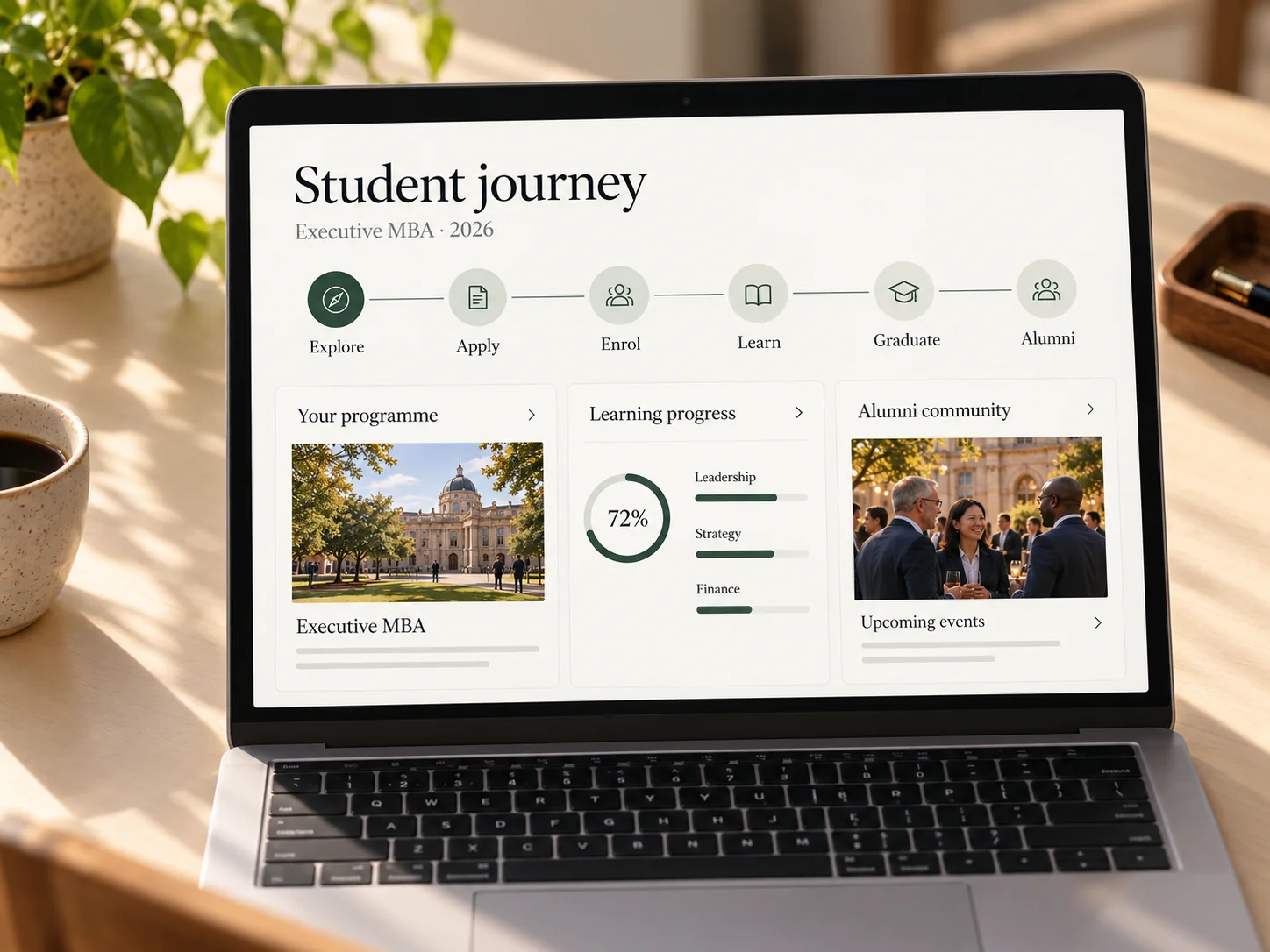
The student lifecycle describes the broad institutional stages and states a learner passes through over time: the structural view. The student journey describes the learner's lived experience within and between those stages: the touchpoints, expectations and friction they encounter. Journey mapping, the practice of documenting that experience for a specific persona or segment, is a discipline in its own right. The lifecycle tells you where the handoffs are; the journey tells you how they feel.
The admissions funnel is a subset of the lifecycle. It typically runs from prospect through application, offer and acceptance, and ends at enrolment. It is a conversion model, useful for recruitment planning, but it says nothing about study, progression, completion, alumni or return. Institutions that manage only the funnel can lose sight of the person at the moment they become a student.
Student experience describes the quality and character of a learner's interactions with the institution: how well taught, supported, informed and treated they feel. The lifecycle describes when and where those interactions occur. A coherent lifecycle operating model supports a good experience, because it reduces repeat requests and irrelevant communications, but it is not the experience itself.
The student lifecycle is the underlying institutional concept: the relationship and its stages. Student lifecycle management is the organisational, process and technology discipline used to manage that relationship coherently: stage definitions, ownership, handoffs, systems, data governance and measurement. This article is about the former; the latter is what institutions build once they have agreed what the lifecycle is.
Institutions have always managed each stage. What has changed is the cost of managing them separately.
The same person should not become a new record each time they cross a boundary: enquiry to applicant, applicant to student, student to alumnus, alumnus to returning learner. Duplicates split the history, so communications, consents, documents and decisions attach to one copy or the other and no one sees the whole relationship. Reconciling duplicates after the fact can be expensive and incomplete; preserving identity at the point of transition is one of the most effective approaches.
Programme interests, applications, communications, decisions, enrolment details, academic history, engagement and preferences should remain connected across stages, so that each team starts with context rather than a blank screen. This does not mean every member of staff sees everything, or that every historical data item remains available indefinitely. Access should remain role-based and purpose-specific, and retention schedules and purpose limitation continue to apply. An alumni officer does not need the transcript; a recruiter does not need a wellbeing case note. Continuity is about the institution being able to connect relevant information, not about exposing all of it.
Fragmentation becomes visible at handoffs: marketing to recruitment, recruitment to admissions, admissions to registry, registry to student services, student services to alumni relations, alumni relations back to admissions or lifelong learning. Each is a moment when ownership, systems and definitions can change at once. Institutions that design handoffs explicitly, agreeing what moves, who owns it next and which system is authoritative, tend to have fewer gaps than those that leave them to integration work afterwards.
Leadership needs to understand movement across stages: how enquiries become applicants, offers become enrolments, students progress and complete, and graduates return. Departmental reports cannot answer those questions when each department counts a different population under a different definition. Lifecycle reporting depends on shared identity and shared stage definitions.
The symptoms of lifecycle fragmentation are mundane and corrosive: re-submitting documents, receiving recruitment emails after enrolling, being treated as a stranger when returning as an alumnus. Individually minor, together they signal that the institution does not recognise the person it is talking to.
AI and automation are only as useful as the identity, definitions, permissions and lifecycle context beneath them. An assistant that cannot tell whether "withdrawn" refers to an application or a programme, or whether two records describe one person, will produce fluent and wrong answers. Full Fabric's article on data governance in higher education covers the foundations; the lifecycle point is that coherent stage definitions and persistent identity are among the most important of them.
Not every institution has these problems, and none is caused by legacy technology alone. They are process and architecture problems that can appear wherever stages are managed in isolation.
The common thread is that the lifecycle was not designed as a whole. Each stage was optimised locally, and the seams were left to integration projects, spreadsheets and goodwill.
Traditional diagrams imply a single direction: prospect, applicant, student, graduate, alumnus. That describes one undergraduate degree taken straight after school reasonably well. It describes modern higher education incompletely, which includes:
In England, the Lifelong Learning Entitlement (LLE), a student finance reform, is expected to encourage more modular and credit-based study. Current government guidance provides for funding applications from late October 2026 for eligible courses and modules starting from January 2027, with eligible modular provision introduced in phases, and not all institutions or modules will automatically qualify (GOV.UK, Lifelong Learning Entitlement overview). Full Fabric's analysis of what the Lifelong Learning Entitlement changes covers the operational implications. Business schools have lived with non-linearity for years: the same person may attend an open evening, take a short course, return for a certificate and later join an executive programme with employer sponsorship.
The implication for the data model is that a person must be able to hold multiple relationships with the institution, concurrently and over time, with each application, enrolment and programme attached to the same identity. A model that assumes one application, one intake and one programme per person will either refuse the second relationship or create a second person. Full Fabric's lifelong learning and executive education solutions are built on that assumption, but the requirement applies to any architecture.
No single department owns the whole lifecycle, and assigning it to one can create as many problems as it solves. Ownership is distributed by stage, and the institution's task is to make each stage's ownership explicit while governing the handoffs collectively.
| Function | Typical lifecycle responsibility |
|---|---|
| Marketing and recruitment | Awareness, enquiry, early relationship, source attribution |
| Admissions | Application, evaluation, offer, conditions, conversion to enrolment |
| Registry / academic administration | Enrolment, registration, academic record, progression, award |
| Finance | Fees, deposits, instalments, sponsorship, refunds across stages |
| Student services | Onboarding, support, wellbeing, case management |
| Academic departments | Teaching, assessment, academic progression decisions |
| Careers | Employability, placements, graduate outcomes |
| Alumni relations and development | Post-graduation engagement, community, philanthropy |
| IT and data teams | Identity, integration, authoritative sources, access control, reporting infrastructure |
| Senior leadership | Lifecycle strategy, cross-functional governance, investment decisions |
Structures vary, and smaller institutions combine several of these in one team. What matters is that every stage has a named owner, every handoff has an agreed definition of what moves and which system is authoritative, and a forum exists where owners resolve conflicts about identity, definitions and data use. That is lifecycle governance, and it is distinct from any one team's operational ownership.
Many systems typically touch the lifecycle: CRM and recruitment tools, application and admissions systems, the student information or student records system, payment and finance systems, the LMS or VLE, identity and access management, communications platforms, student portals, analytics and the data warehouse, alumni and advancement systems, and careers platforms.
The student lifecycle is not one piece of software, and it does not have to be supported by one. Institutions generally choose one of three patterns:
None of these is universally superior. In every case, lifecycle continuity depends on the same things: persistent identity, documented authoritative ownership for each data domain, defined lifecycle states and transitions, governance, appropriate permissions, and reliable, monitored integration. An institution that achieves these through integration has a working lifecycle architecture; an institution that buys one platform and leaves governance undefined does not. Full Fabric's piece on the SIS as a north star for higher education leaders discusses where the authoritative student record should sit; the lifecycle is broader than the SIS, and a records system alone cannot carry it.
The phrase is used often and misunderstood almost as often. A single student record should not mean:
It should mean that the institution can reliably identify the same person and their relationships across every lifecycle stage, with clearly governed authoritative data, role-based access and a history that accumulates within retention rules rather than resetting at each boundary.
A connected lifecycle platform can implement this directly, by holding the person once and changing their state as they move from enquirer to applicant to student to alumnus. An integrated architecture can achieve it through a persistent identifier, agreed system-of-record decisions for each data domain, and governed synchronisation. Both are legitimate. Neither removes the need for matching rules, data stewardship and periodic cleansing: a single record reduces the opportunities for duplicates to arise, it does not make them impossible.
No single metric represents lifecycle health, because each stage asks a different question. Illustrative measures include:
Two cautions. Each measure depends on institutional definitions: an "enrolment" counted at acceptance, deposit, registration or census date produces four different figures. And measuring stages in isolation hides the connections that matter most, such as whether recruitment channels that generate many applications also generate students who complete. Lifecycle metrics only become comparable when stage definitions are shared and identifiers persist.
These phrases are increasingly searched together, and they are not the same thing.
The student lifecycle is the institutional concept: the relationship and its stages, as described in this article. It exists whether or not the institution has any particular software.
A student lifecycle platform is a technology architecture intended to support multiple lifecycle stages in a connected way, usually with one record per person. It is not a formally standardised software category. Vendors use the phrase for anything from an admissions CRM with an alumni module to a combined CRM and SIS platform, so buyers should evaluate the actual scope: which stages the platform genuinely holds, which it integrates with, and where identity and history are preserved or lost at the boundary. Full Fabric's guide to what a student management system is sets out the related terminology.
Full Fabric is a higher education platform built on a single data model, with the stated principle of one platform, one student record, one lifecycle. In lifecycle terms, its CRM and recruitment, admissions and enrolment, payments and student information system capabilities operate on the same person record. The architectural benefit is that the move from applicant to enrolled student can be handled as a change of status on an existing record rather than a migration between systems, although the enrolment process itself is configured to each institution's own rules. The same record continues into alumni status, with relationship management, communications and events available for alumni. Its lifelong learning solution is designed to recognise returning learners against existing records and attach new enquiries to the existing relationship, and the UCAS Connector brings UCAS applications onto the same record as direct applicants.
Full Fabric therefore supports a connected operational student lifecycle around one person record, particularly across CRM, admissions, enrolment and student information, while integrating with the wider institutional stack where required.
The limits should be stated plainly. Full Fabric is not an LMS and does not deliver course content; it is not a finance ledger, a data warehouse or an enterprise master data platform; and it does not remove the need for integrations with those systems. Nor does connecting systems guarantee a good student experience; that still depends on process design, governance and the people running the lifecycle. What a connected platform can do is keep the lifecycle core on one coherent record with shared identity, permissions and history, which reduces the number of handoffs an institution has to govern by hand.
The student lifecycle is the complete sequence of interactions and institutional states through which a learner moves, from first awareness and enquiry through application, admission, enrolment, study, progression, completion, alumni engagement and possible return for further learning. It is the whole relationship between a person and an institution.
There is no universally mandated list. A practical operational model has twelve stages: awareness and discovery; enquiry and recruitment; application; admissions and evaluation; offer and decision; acceptance and enrolment; registration and onboarding; active study; progression and support; completion and graduation; alumni relationship; and return and lifelong learning. Regulators and sector bodies group these differently; the Office for Students in England, for example, uses access, success and progression.
Before the application. It begins when a person first becomes aware of, or enquires about, the institution, and the institution's record of the relationship should begin at the first recorded enquiry.
It does not necessarily end at graduation. Completion ends the formal registration, but the relationship can continue through alumni engagement and may resume with a new enquiry, application or enrolment years later.
Yes. Alumni engagement is a lifecycle stage, and the same person may later become a returning learner, mentor, employer contact or donor. Treating graduation as the end of the lifecycle is a common way for institutions to lose connection with people they already know.
The lifecycle describes the broad institutional stages and states over time. The student journey describes the learner's actual experience, touchpoints and friction within and between those stages. The lifecycle is structural; the journey is experiential.
Student lifecycle management is the organisational, process and technology discipline used to manage the student lifecycle coherently: agreeing stage definitions, assigning ownership, designing handoffs, choosing and integrating systems, governing data and measuring movement between stages.
Typically a CRM, application and admissions systems, a student information or records system, payment and finance systems, an LMS or VLE, identity management, communications tools, student portals, analytics and alumni or careers platforms. The lifecycle can be supported by a connected platform covering several stages, by well-integrated specialist systems, or by a combination.
A technology architecture intended to support multiple lifecycle stages in a connected way, usually around one record per person. It is not a formally standardised category; vendors use the term for very different scopes, so buyers should verify which stages a platform genuinely holds.
Because without it the institution cannot reliably recognise the same person across stages. Duplicate records split history, consents and communications, weaken reporting across stages, and lead to people being asked for information the institution already holds. A single student record means persistent identity and governed authoritative data, not one database for everything.
By choosing and documenting a stage model, naming an owner for every stage, defining what moves at every handoff and which system is authoritative, preserving identity across transitions, applying role-based access rather than universal visibility, and reporting on movement between stages with shared definitions. The technology can be a connected platform, integrated specialist systems or both; the governance is required in every case.