

Top 15 Salesforce Education Cloud Alternatives for 2026
Salesforce Education Cloud is one of the most widely evaluated platforms in higher education, and in 2026 it is also one of the broadest. It combines a higher education CRM with modules for Recruitment and Admissions, Academic Operations, Student Success, Student Financials, and Advancement and Alumni Relations, plus a growing set of AI agents and next-generation student information system (SIS) capabilities. That breadth is why "Salesforce Education Cloud alternatives" is a harder question than it looks: an institution replacing Salesforce may be replacing a recruitment CRM, an admissions system, an advancement database, an emerging SIS layer, or all of them at once.
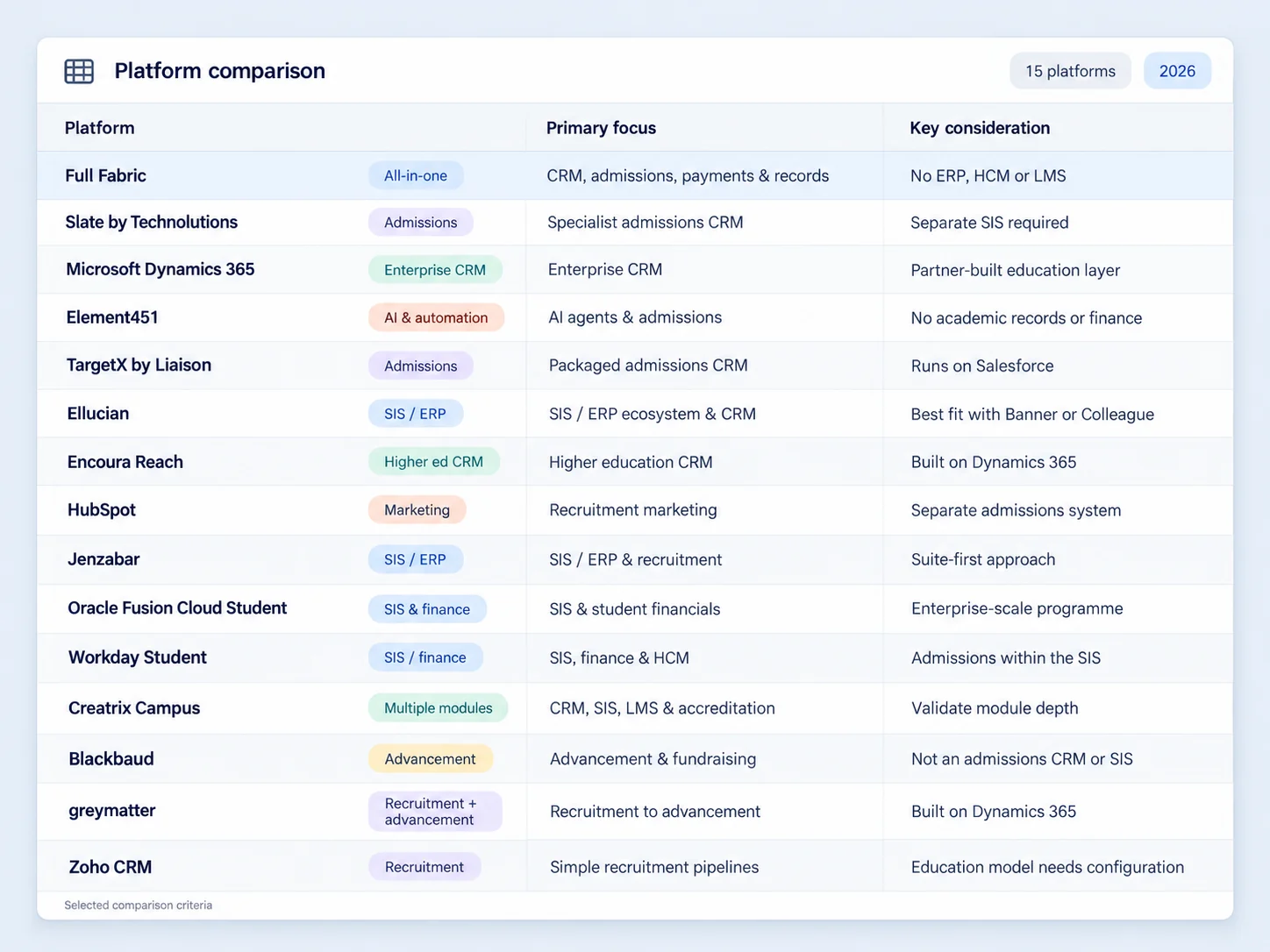
This article compares 15 alternatives against the scope and operating model of Salesforce Education Cloud as it stands in September 2026: what Salesforce currently sells, why institutions look elsewhere, which product categories genuinely overlap, where each alternative is strongest, what each one does not replace, and which shortlist fits which institutional need. It is written for CIOs, admissions and enrolment leaders, registrars, CRM owners and digital transformation teams at universities, colleges, business schools and specialist providers anywhere in the world.
Transparency note: Full Fabric is our own platform and is included in this comparison. We have tried to apply the same scope and evidence standards to every product, with current primary sources linked close to the claims they support. Full Fabric is not the best fit for every institution, and those limitations are stated where relevant.
A note on naming: Salesforce now describes Agentforce Education as the current name of the product formerly called Education Cloud in its Help documentation and its product guide, while its pricing page and edition names continue to use Education Cloud. This article uses "Salesforce Education Cloud" throughout because the name remains in active use in Salesforce product material and by the institutions evaluating the platform.
What are the best Salesforce Education Cloud alternatives in 2026?
There is no universal best alternative. The right shortlist depends on which part of Salesforce an institution actually needs to replace:
- Full Fabric for institutions that want CRM, admissions, payments and student records on one higher-education-specific platform, particularly business schools, mid-sized universities and multi-programme providers.
- Slate by Technolutions for institutions, especially in US undergraduate and graduate admissions, that want a deeply configurable specialist admissions CRM and will keep a separate SIS.
- Microsoft Dynamics 365 for institutions standardised on Microsoft 365, Azure and Power Platform that want an enterprise CRM comparable in configurability to Salesforce, usually with a partner-built higher education layer such as greymatter, Encoura Reach or Ellucian.
- Element451 for admissions and student success teams where AI agents and multichannel communications are central requirements.
- Ellucian for institutions already running Banner or Colleague that want CRM, recruitment and advising inside the same vendor ecosystem.
- Workday Student and Oracle Fusion Cloud Student where the evaluation is really an SIS, finance and HR modernisation programme rather than a CRM replacement.
- HubSpot and Zoho CRM where the requirement is recruitment marketing rather than admissions workflow or student records, and Blackbaud where advancement and fundraising are the primary use case.
The most useful first question is not "which product is better than Salesforce?" but "are we replacing Salesforce Education Cloud, or are we replacing one job that Salesforce currently does?" The rest of this article is organised around that distinction. For the broader CRM category comparison, see our 15 best CRM platforms for higher education.
What is Salesforce Education Cloud in 2026?
Salesforce Education Cloud is an industry cloud built on the core Salesforce platform for higher education and K-12 institutions. According to Salesforce's Education Cloud guide, it is built on an Education Data Foundation, in which education-specific objects such as courses and grades are native platform objects, and a Common Capability Model that lets services such as appointment scheduling and application forms be reused across departments. The product page lists five pre-built modules: Recruitment and Admissions, Academic Operations, Student Success, Student Financials, and Advancement and Alumni Relations.
This is a material change from the older Education Data Architecture (EDA) era: current Education Cloud has a native education data model, purpose-built modules and an expanding set of SIS-style capabilities.
What each module currently covers
Based on Salesforce's own product descriptions as of September 2026:
- Recruitment and Admissions covers the funnel from prospect engagement through application, review and decision, including a Dynamic Application Wizard, review workflows, scoring rubrics, portals for parents and agents, and support for undergraduate, postgraduate and lifelong-learner applicant types.
- Academic Operations is where Salesforce's "next-generation SIS capabilities" sit: course registration, holds and blocks automation, registration windows and custom SIS rules. Salesforce is explicit that it is "building modular, learner-centric SIS capabilities and releasing them over time" rather than shipping a complete SIS in one release.
- Student Success covers advising, wellbeing monitoring, Action Plans, an Advising Console and a Visual Degree Planner.
- Student Financials is listed as a module, and Salesforce's Summer '26 release overview highlights enhancements to Student Financials, Course Registration and Institutional Partnerships; verify which billing, payment and refund workflows are generally available in your region.
- Advancement and Alumni Relations covers donor timelines, prospect scoring, gift processing (pledges, recurring gifts, soft credits, fund designations) and alumni engagement tracking.
AI in Education Cloud
Salesforce's guide identifies education-specific Agentforce agents and their status: an Advising Support Agent (generally available), a Philanthropic Research Agent (generally available), a Student Recruitment Agent (beta) and a Student Goals Agent (beta), plus more than 20 pre-built agentic workflows. These are conversational and generative assistants; Salesforce does not describe them as making admissions decisions autonomously.
Education Cloud itself versus Salesforce products used alongside it
The Education Cloud pricing page lists five editions, all billed annually and shown as nonprofit pricing in USD:
| Edition | List price (USD per user per month, billed annually) | Positioning |
|---|---|---|
| Education Cloud Sales & Service Core | $87 | Foundational education CRM with AI and Slack |
| Education Cloud Sales & Service Advanced | $131 | Adds more AI, storage, automation and security |
| Education Cloud Sales & Service Max | $363 | Adds the full Agentforce for Industries suite and contact centre tooling |
| Education Cloud Sales Max | $350 | Positioned for Recruitment and Admissions, Advancement and Alumni |
| Education Cloud Service Max | $350 | Positioned for Student Services, Academic Operations, Student Life |
Salesforce states that usage restrictions apply, that these editions require an annual contract, and that for-profit institutions are priced differently. The same page lists separate add-ons, including Education Cloud Student (a learner portal), Experience Cloud for Education, Agentforce for Education and Education Cloud Intelligence; Marketing Cloud, Data 360 and MuleSoft are separate Salesforce products commonly added for campaign automation, unified data and integration.
Pricing was checked against Salesforce's current Education Cloud pricing page in September 2026 and is subject to change. List price per user is not total cost: add-ons, usage-based Flex Credits, implementation partners and integration work all affect the total, and this article does not estimate total cost of ownership for Salesforce or any other vendor.
Why universities look for Salesforce Education Cloud alternatives
Salesforce Education Cloud is a capable and widely adopted product, and for many institutions it is the right choice. Institutions typically evaluate alternatives because of differences in operating model rather than product defects. The most common evaluation considerations are:
- Scope mismatch. An institution may need a specialist admissions system, a marketing CRM or a unified CRM-plus-SIS, and may not want to license or administer an enterprise platform spanning all of them.
- Higher-education-native workflows. Education Cloud provides an education data model and pre-built modules, but programmes, intakes, review workflows and decision logic are still configured on a general enterprise platform; institutions with unusual programme structures, rolling intakes or executive education may prefer a platform whose default objects already match those realities.
- Implementation model and ownership. Enterprise CRM implementations usually involve a certified partner and architectural design work, and day-to-day changes often require an administrator. Institutions with limited Salesforce administration capacity may prefer a platform whose admissions workflows are configured and owned by functional teams.
- Integration architecture and licensing model. Some buyers want fewer systems; others prefer a composable architecture with middleware. Per-user enterprise licensing suits some institutions; others prefer platform pricing by application volume, enrolment or institution size.
- CRM versus SIS boundary and payments. Because Salesforce releases SIS capabilities over time, institutions must decide whether their CRM vendor should become the system of record for academic data, and whether application fees, deposits and tuition should be handled natively or through third-party integrations.
- Existing enterprise standards. Institutions standardised on Microsoft, Oracle, Ellucian or Workday often prefer to keep CRM inside that ecosystem.
- Regional and data governance requirements. European institutions in particular weigh GDPR, the EU AI Act, data residency and vendor governance; our article on Salesforce for European universities covers these in depth.
- Desire to consolidate point solutions where Salesforce runs alongside a separate application portal, payment tool, SIS and marketing platform.
None of these is a universal criticism of Salesforce; they determine whether its breadth is an asset or an overhead for a specific institution.
What counts as a Salesforce Education Cloud alternative?
No single product category maps one-to-one to Education Cloud. Alternatives fall into five categories, and a shortlist should be drawn from the category that matches the job to be done:
1. Purpose-built higher education lifecycle platforms
Platforms designed around the student lifecycle as their primary product model, connecting CRM, recruitment, admissions, enrolment, communications and, in some cases, payments and student records on one data model: Full Fabric, Creatrix Campus. These are the closest like-for-like alternatives for institutions replacing Salesforce's CRM and admissions layers and, optionally, its emerging SIS layer.
2. Specialist admissions and engagement CRMs
Deep recruitment, admissions and engagement functionality, paired with a separate SIS as system of record: Slate by Technolutions, Element451, TargetX by Liaison, Encoura Reach, greymatter. These replace Salesforce's Recruitment and Admissions module (and sometimes Student Success and Advancement) but not Academic Operations or Student Financials.
3. Enterprise CRM platforms
Horizontal, configurable enterprise platforms comparable to Salesforce's model, usually with a higher education layer built by the vendor or a partner: Microsoft Dynamics 365, Zoho CRM.
4. Higher education SIS and ERP ecosystems
Relevant when the evaluation includes academic operations, student financials and system-of-record requirements: Ellucian, Jenzabar, Oracle Fusion Cloud Student, Workday Student. These overlap with Education Cloud's Academic Operations, Student Financials and, to varying degrees, Recruitment and Admissions modules, but they are not marketing CRMs.
5. Marketing and engagement platforms
Partial alternatives where the requirement is top-of-funnel recruitment marketing rather than admissions or lifecycle management: HubSpot, and Zoho CRM for smaller requirements. Blackbaud is the equivalent partial alternative on the advancement side. A partial alternative replaces one Salesforce layer and must be paired with other systems for the rest, which is why HubSpot and Workday Student can both appear in this article while solving very different parts of the problem.
How we selected the Salesforce Education Cloud alternatives
This shortlist is editorial, not a formal analyst ranking; the order reflects how directly each platform overlaps with Salesforce Education Cloud's CRM and admissions core, and "Top 15" means a curated shortlist, not a league table. We included a platform only if it:
- is actively sold and supported in 2026;
- has credible higher education usage;
- overlaps with at least one major Salesforce Education Cloud use case;
- has current public product information from the vendor; and
- is a realistic institutional technology option rather than a theoretical substitute.
We compared each platform on recruitment and admissions depth, CRM functionality, lifecycle and SIS coverage, communications, reporting, integrations, configurability, data model, scale and geographic footprint. Ownership and product transitions were checked against official announcements, because several products changed hands or platforms between 2025 and 2026. Partial alternatives are labelled as such rather than excluded.
Salesforce Education Cloud alternatives at a glance
| # | Platform | Best for | Platform type | Main Salesforce Education Cloud difference | Key consideration |
|---|---|---|---|---|---|
| 1 | Full Fabric | CRM, admissions, payments and student records on one higher education platform; business schools and multi-programme providers | Purpose-built lifecycle platform | Higher-education-specific single data model and functional-team configuration rather than a horizontal enterprise platform | No ERP, HCM or LMS; alumni engagement rather than a full fundraising suite |
| 2 | Slate by Technolutions | Admissions offices, especially in the US, wanting a deeply configurable admissions CRM with a separate SIS | Specialist admissions CRM | Admissions objects (applications, rounds, bins, reader queues) are native; published flat pricing by application volume | Not an SIS; strongest footprint is US higher education |
| 3 | Microsoft Dynamics 365 | Microsoft-first institutions wanting enterprise CRM inside the Microsoft ecosystem | Enterprise CRM platform | Comparable configurable enterprise model on Microsoft's stack; higher education layer comes from partners or the open-source accelerator | Base Dynamics 365 does not provide admissions workflows out of the box |
| 4 | Element451 | Admissions and student success teams where AI agents and communications are central | Specialist engagement and admissions CRM | AI agents (Bolt) and communications are the core product rather than an add-on suite | Lifecycle ends before academic records and finance |
| 5 | TargetX by Liaison | Institutions wanting packaged higher education admissions tooling on the Salesforce platform | Salesforce-based admissions CRM | Pre-built admissions suite on Salesforce, with Liaison's CAS application services alongside | Not a path away from Salesforce; it runs on it |
| 6 | Ellucian | Institutions already running Banner or Colleague that want CRM within the Ellucian estate | SIS/ERP ecosystem with CRM products | CRM Recruit, Advise and Advance sit next to the SIS of record and are moving onto Dynamics 365 | Strongest inside the Ellucian footprint; verify Dynamics 365 transition status |
| 7 | Encoura Reach | Former Anthology engagement customers, or Microsoft-first institutions wanting a packaged higher education CRM | Dynamics-365-based lifecycle CRM | Higher education CRM packaged on Dynamics 365 with enrolment data services from Encoura | Ownership moved to Encoura in February 2026; Encoura also launched a second CRM direction with Element451 |
| 8 | HubSpot | Institutions whose Salesforce use case is recruitment marketing, inbound and lead nurturing | Marketing and sales CRM | Marketing automation and content tooling are the core; no native admissions or SIS model | Partial alternative only; needs a separate admissions system |
| 9 | Jenzabar | Small and mid-sized US institutions wanting recruitment, retention and advancement inside one SIS/ERP suite | SIS/ERP ecosystem with CRM modules | Jenzabar One bundles Recruitment and Retention with the Jenzabar Student SIS | Suite-first rather than CRM-first; limited footprint outside North America |
| 10 | Oracle Fusion Cloud Student | Large institutions modernising SIS, ERP, HCM and student financials together | SIS/ERP ecosystem | Student Management covers admissions, academics, advising and financials as part of Oracle's enterprise cloud | Enterprise-scale programme; not a specialist recruitment CRM |
| 11 | Workday Student | Institutions evaluating Salesforce at the SIS layer alongside finance and HCM | SIS/ERP ecosystem | Recruiting, admissions, student records, financial aid and student financials share one platform with Workday HCM and Financials | Admissions is delivered as part of the SIS rather than as a specialist CRM |
| 12 | Creatrix Campus | CRM, admissions, SIS, LMS and accreditation management in one integrated suite | Purpose-built lifecycle suite | Broader academic, LMS and accreditation scope in one suite | Validate module depth and references at your institution's scale |
| 13 | Blackbaud | Institutions whose primary Salesforce use case is advancement and fundraising | Advancement CRM | Fundraising-first products (Raiser's Edge NXT, Enterprise Fundraising CRM) rather than a lifecycle platform | Not an admissions CRM or SIS |
| 14 | greymatter | Microsoft-first institutions, notably in Canada, wanting a packaged lifecycle CRM on Dynamics 365 | Dynamics-365-based lifecycle CRM | Recruit, admit, retain and advance modules built on Microsoft's higher education accelerator | Smaller vendor; partner-led implementation |
| 15 | Zoho CRM | Smaller institutions or departments with simple recruitment pipelines | General-purpose CRM | Published per-user pricing and a broad Zoho suite, with no native higher education model | Higher education concepts must be configured from scratch |
Top 15 Salesforce Education Cloud alternatives for 2026
Each section states what the platform is, which Salesforce scope it replaces, what it does not replace and who should shortlist it. Pricing is noted only where the vendor publishes it.
1. Full Fabric
Best for: Universities, business schools and multi-programme institutions that want CRM, admissions, payments and student records on one higher-education-specific platform that admissions and operations teams can configure themselves.
Platform type: Purpose-built higher education lifecycle platform (CRM, admissions, commerce and SIS).
Full Fabric is a unified higher education CRM platform connecting a higher education CRM (communications, campaigns, events, alumni engagement and workflow orchestration), admissions and enrolment (evaluations, offers and enrolments), commerce (programme catalogue, applications and payments) and a student information system (student records, academics and compliance) on one student record. It is headquartered in Europe, with a customer base concentrated in European business schools and universities and live deployments in more than 17 countries (vendor-reported).
Why it fits: Full Fabric overlaps with Salesforce's Recruitment and Admissions module (enquiry capture, campaigns, application forms, review workflows, offers, enrolment), with Student Financials (application fees, deposits and tuition collected in the platform), with Academic Operations (student records, enrolment management and academic data in the SIS) and with the engagement side of Student Success. On advancement, Full Fabric supports alumni relationship management, communications, newsletters, events and lifelong-learning promotion, but it does not provide a full fundraising and gift-management suite (prospect research, gift processing, pledges, recurring gifts, fund designations, moves management) comparable with Salesforce's Advancement and Alumni Relations module.
Key strengths
- Multi-programme, multi-intake design, including independent forms, workflows and intake dates per programme and B2B scenarios such as corporate-sponsored participants.
- One data model from enquiry to enrolled student and alumnus. CRM, admissions, payments and student records are modules of one platform, so the applicant record becomes the student record without a system hand-off; the integrations page documents API access to contacts, applications, evaluations, offers, enrolments and student records.
- Functional-team configuration. Application forms, review workflows, offer logic and reports are positioned as configurable by admissions and operations staff; institutions should validate this against their own workflows in a structured demo.
- Built-in payments and commerce. Application fees, deposits and tuition are collected in the platform, with documented integrations to Flywire, Stripe, PayPal, iDEAL and Adumo.
- Enterprise CRM and admissions connectors. Full Fabric currently documents native connectors for Salesforce and HubSpot, with bidirectional contact sync and application-stage mapping, plus a UCAS connector for UK undergraduate admissions. A Microsoft Dynamics 365 connector is also documented but is marked "Coming Soon" as of September 2026. Full Fabric also exposes APIs for integration with institutional systems, so an institution can use Full Fabric for admissions while retaining another CRM or enterprise platform.
- AI inside the operational platform. Full Fabric describes its Contextual AI as working within admissions and communications workflows under the platform's permissions and audit trail; our guide to AI software for admissions teams explains how to compare such capabilities across vendors.
Considerations
- Narrower enterprise scope. Full Fabric is not an ERP, HCM or payroll platform, not an LMS, and not a complete fundraising suite; institutions using Salesforce across fundraising, service and non-student functions will still need other systems.
- Validate SIS depth per institution. The SIS covers student records, enrolment, academic data, attendance and compliance reporting; large research universities with complex degree audit, timetabling and financial aid requirements should test whether an enterprise SIS remains necessary.
- Smaller ecosystem. Delivered and supported directly by the vendor; custom API integrations are built by the institution or an integration partner.
- Pricing is not publicly listed. Full Fabric's pricing page explains its model; quotes are on request.
Compared with Salesforce: Salesforce is a broad enterprise platform whose education modules span recruitment, student success, academic operations, financials and advancement; Full Fabric is designed around the higher education lifecycle as its primary product model and concentrates on recruitment, admissions, payments and student records. Salesforce projects are typically partner-led and administered by certified administrators; Full Fabric implementations are delivered by the vendor for functional-team ownership, and Full Fabric states that most institutions go live in six to twelve weeks depending on scope (vendor-stated, not an independent benchmark). For a focused product comparison, see Full Fabric as a Salesforce alternative.
Bottom line: Full Fabric is a direct Salesforce Education Cloud alternative for institutions that want recruitment, admissions, payments and student records on one purpose-built higher education platform run by their own teams, and a partial alternative for institutions using Salesforce enterprise-wide across fundraising, service and non-student functions.
2. Slate by Technolutions
Best for: Admissions and enrolment offices, particularly in US higher education, that want a deeply configurable specialist admissions CRM and will keep a separate SIS as system of record.
Platform type: Specialist admissions, student success and advancement CRM.
Slate, from Technolutions, is a higher education platform for admissions and enrolment, student success and alumni and advancement, delivered from a single database in which applications, rounds, periods, bins, reader queues and decision release are native objects. Technolutions states that more than 2,000 colleges and universities use Slate (vendor-reported).
Why it fits: Slate overlaps fully with Salesforce's Recruitment and Admissions module, with Student Success (enrolled-student communications and retention workflows) and with Advancement through Slate for Advancement. It does not overlap with Academic Operations or Student Financials; Technolutions does not position Slate as an SIS.
Key strengths
- Admissions depth. Online applications, reader review, decision release, event and travel management, communications and portals are native.
- Published, predictable pricing. Technolutions publishes licence tiers: admissions licences run from $30,000 per year (fewer than 1,500 applications) to $175,000 per year (80,000 to 100,000 applications) with unlimited users; Student Success runs in an existing database at no extra cost or as a separate $30,000 licence; Advancement is priced by undergraduate enrolment from $50,000 to $175,000 per year. Technolutions states it has never raised licence prices (vendor claim).
- Shared database and community. Admissions, student success and advancement can share one database; Technolutions runs a tiered partner programme, an annual Slate Summit and publishes a Slate AI page describing its AI features.
Considerations
- Not an SIS. A separate system of record for academic records, registration and student financials remains necessary.
- Assumes an operator. Institutions typically need a dedicated Slate administrator or partner to build and maintain the database.
- Geographic footprint. Strongest in US higher education; institutions elsewhere should check regional support, hosting and fit with local processes such as UCAS or agent-led recruitment.
Compared with Salesforce: Salesforce offers broader platform breadth on per-user licensing; Slate offers deeper admissions specialisation with flat institutional pricing and no per-user charge. See also Full Fabric vs Slate.
Bottom line: Slate by Technolutions is a widely adopted specialist admissions CRM alternative to Salesforce Education Cloud for institutions that want admissions depth and predictable institutional pricing and will keep a separate SIS; it does not replace Salesforce's academic operations or student financials capabilities.
3. Microsoft Dynamics 365
Best for: Institutions standardised on Microsoft 365, Azure and Power Platform that want enterprise CRM inside the same ecosystem, and that have, or will partner for, the capacity to build the higher education layer.
Platform type: Enterprise CRM and ERP platform.
Microsoft Dynamics 365 is Microsoft's suite of CRM and ERP applications built on Dataverse and Power Platform, with Copilot AI embedded. In higher education it is used as a student lifecycle CRM either directly, with Microsoft's Higher Education data model and Accelerator (which Microsoft has published as free and open source), or through partner solutions; Ellucian's CRM suite, Encoura Reach and greymatter all run on it.
Why it fits: Dynamics 365 is the closest architectural counterpart to Salesforce, a configurable enterprise CRM with marketing, service, portals, analytics and integration. Once the higher education layer is configured or purchased, it can cover Salesforce's Recruitment and Admissions, Student Success and Advancement use cases, and Dynamics 365 Finance or Business Central can address ERP requirements Salesforce does not.
Key strengths
- Ecosystem fit and configurability. Native integration with Microsoft 365, Teams, Entra ID, SharePoint, Power BI and Azure, plus Power Apps, Power Automate and Dataverse as a low-code platform for institution-specific processes.
- Free, open higher education data model supplying education entities and sample apps as a starting point.
- Choice of packaged options and published platform pricing. Build on the base platform or buy a packaged higher education CRM (greymatter, Encoura Reach, Ellucian CRM Recruit); Microsoft publishes per-user list pricing for Dynamics 365 applications, with partner solutions priced separately.
Considerations
- No admissions workflows out of the box. Application forms, review, offers, deposits and enrolment logic must be configured, built or bought as a partner solution.
- Partner-led implementation, internal administration and layered licensing (Dynamics 365 apps, Power Platform, Customer Insights and partner fees), as with Salesforce.
- SIS and payments remain separate. Dynamics 365 CRM is not a student information system.
Compared with Salesforce: Salesforce sells a pre-built education industry cloud; Microsoft sells a general enterprise platform with a free accelerator and relies on partners for packaged education products. The choice is usually between a Salesforce-first and a Microsoft-first enterprise strategy rather than between two admissions systems. Full Fabric documents a Microsoft Dynamics 365 connector for institutions that keep Dynamics as the institutional CRM while running admissions elsewhere, but it is publicly marked "Coming Soon" as of September 2026.
Bottom line: Microsoft Dynamics 365 is a relevant enterprise-platform alternative to Salesforce Education Cloud for institutions standardised on Microsoft's ecosystem, provided they plan for a partner-built or accelerator-based higher education layer, because the base platform does not ship admissions workflows.
4. Element451
Best for: Marketing, admissions and student success teams that want AI agents, multichannel communications and applications inside one engagement-led CRM, primarily in North American higher education.
Platform type: Specialist engagement and admissions CRM with an AI agent platform.
Element451 describes itself as an AI-native CRM and agent platform for the student lifecycle. According to its about page, it sells two standalone products: Element, an AI-native CRM suite for admissions and marketing, student success, and continuing education and workforce; and Bolt, an AI agent engine that Element451 says works alongside any CRM or SIS, including Slate, Salesforce, Banner and Workday. In May 2026 Element451 announced that institutions using Bolt had surpassed 60 million AI-powered student journeys (vendor-reported).
Why it fits: Element451 overlaps with Salesforce's Recruitment and Admissions module (contact database, campaigns, journeys, applications and decisions, StudentHub portal, events, appointments), with Student Success (risk signals, outreach) and with Salesforce's Agentforce agents through Bolt. It does not overlap with Academic Operations, Student Financials or Advancement.
Key strengths
- AI agents as the core design. Bolt agents are described as engaging prospects across email, SMS, chat, WhatsApp and voice, reading applications against institutional rubrics, detecting fraud, evaluating transcripts and surfacing at-risk students, with staff reviewing and approving agent work. Institutions should confirm which actions agents may take and with what approvals.
- Communications, applications and decisions built in. Email, SMS, chat, landing pages, surveys, journeys, application forms and decisioning are native rather than a separate marketing cloud.
- Bolt can augment rather than replace. Institutions keeping Salesforce or Slate can add Bolt agents without migrating CRM, and Encoura's new CRM offering, Encoura Connect, is built with Element451.
Considerations
- Lifecycle ends before the academic record. No student records, registration, degree audit or student financials; an SIS remains necessary.
- AI governance and footprint. Confirm data processing, model providers, logging and human oversight for each agent; the customer base is concentrated in North America. Pricing is not publicly listed.
Compared with Salesforce: Salesforce provides education agents on a broad platform extending into academic operations and financials; Element451 provides a narrower, engagement-first CRM in which agents and communications are the product, and Bolt can run on top of Salesforce itself. See also Full Fabric vs Element451.
Bottom line: Element451 is a Salesforce Education Cloud alternative particularly relevant where AI-driven engagement and admissions communications are central requirements, and it can also be layered on Salesforce; it does not replace Salesforce's academic operations, financials or advancement capabilities.
5. TargetX by Liaison
Best for: Institutions that want established, pre-built higher education recruitment and admissions tooling on the Salesforce platform, with Liaison's application services alongside.
Platform type: Salesforce-based higher education admissions and retention CRM.
TargetX is a higher education CRM owned by Liaison International, delivering a Recruitment Suite (communications, online application, events, reporting) and a Retention Suite (mobile community, appointment scheduling, predictive analytics). Liaison states that TargetX is a Salesforce partner, that its solutions are certified EDA core compatible, and that it integrates bidirectionally with Banner, Colleague, PeopleSoft, PowerCampus and Jenzabar and with higher education payment gateways.
Why it fits, and why it does not: TargetX can be an alternative to Salesforce Education Cloud as a packaged higher education product: an institution can license TargetX's admissions suite on Salesforce instead of Salesforce's own Recruitment and Admissions module. It is not an alternative for institutions specifically trying to leave the Salesforce platform, because TargetX runs on Salesforce and requires Salesforce licences.
Key strengths
- Pre-built admissions functionality on Salesforce. Online application, communications, events and review workflows come packaged, reducing custom build compared with configuring Education Cloud from scratch.
- In-house higher education support and Liaison's centralised application services (CAS), used by many US graduate and professional programmes; CAS institutions should confirm how application data flows into TargetX.
- SIS and payment integrations with major US platforms.
Considerations
- Salesforce dependency. TargetX inherits Salesforce licensing, administration requirements and release cadence; pricing is not publicly listed and combines both.
- Architecture relative to current Education Cloud. Liaison's material references EDA core compatibility, whereas current Education Cloud is built on the newer Education Data Foundation. Institutions should ask Liaison and Salesforce how TargetX's EDA-based architecture relates to the current Education Data Foundation and Agentforce Education architecture, and whether both can coexist in one org; neither vendor documents incompatibility, so it is a point to verify.
- Predominantly US footprint.
Compared with Salesforce: Both run on the Salesforce platform; the choice is between Salesforce-native education modules and agents and a partner-built admissions and retention suite with its own objects and support model, not between two platforms.
Bottom line: TargetX by Liaison can be an alternative to Education Cloud for institutions wanting established higher education admissions tooling on Salesforce, but it is not a path away from the Salesforce platform itself.
6. Ellucian
Best for: Institutions already operating Ellucian Banner or Colleague as SIS of record that want recruitment, advising and advancement CRM within the same vendor ecosystem.
Platform type: Higher education SIS/ERP ecosystem with CRM products.
Ellucian is one of the largest higher education technology vendors, best known for the Banner and Colleague SIS platforms. Its CRM products are Ellucian CRM Recruit (recruitment and admissions), CRM Advise (student success) and CRM Advance (advancement). In March 2025 Ellucian announced an expanded collaboration with Microsoft to upgrade all three to Dynamics 365 Sales, Dynamics 365 Customer Service and Power Platform. Separately, Ellucian completed its acquisition of Anthology's SIS and ERP business (Anthology Student, Finance and HCM) on 31 December 2025, following Anthology's Chapter 11 process; Anthology's Lifecycle Engagement and Student Success portfolio went separately to Encoura (see section 7).
Why it fits: Ellucian overlaps with Salesforce across Recruitment and Admissions (CRM Recruit), Student Success (CRM Advise), Advancement (CRM Advance) and, through its SIS products, Academic Operations and Student Financials, making it a full-ecosystem comparison where SIS scope is in play.
Key strengths
- Native fit with the Ellucian estate. CRM Recruit and CRM Advise integrate with Banner, Colleague and Degree Works, removing much CRM-to-SIS integration work.
- Dynamics 365 foundation and scale. Brings Microsoft's configurability, Copilot AI and Power BI reporting to Ellucian's workflows; Ellucian describes serving thousands of institutions in more than 50 countries, and the Anthology acquisition added more than 260 SIS and ERP customers (vendor-reported).
Considerations
- Strongest inside the Ellucian footprint. Outside it, focused admissions CRMs are usually more directly competitive.
- Transition status. Confirm which CRM products are fully on Dynamics 365, the migration path for existing customers, and how Ellucian licensing combines with Microsoft platform licences.
- Acquired product lines. Ask about roadmap and support for Anthology Student and Anthology Finance and HCM. Pricing is not publicly listed.
Compared with Salesforce: Salesforce is CRM-first, extending into SIS capabilities over time; Ellucian is SIS-first, with CRM products beside the system of record and being re-platformed onto Dynamics 365. For a deeper comparison, see Ellucian alternatives and competitors for 2026.
Bottom line: Ellucian is a Salesforce Education Cloud alternative primarily for institutions committed to the Ellucian SIS ecosystem, where CRM Recruit, Advise and Advance on Dynamics 365 offer integration coherence a standalone CRM cannot.
7. Encoura Reach
Best for: Institutions already using the former Anthology lifecycle engagement products, or Microsoft-first institutions in North America wanting a packaged higher education CRM on Dynamics 365 combined with Encoura's enrolment data and services.
Platform type: Dynamics-365-based higher education lifecycle CRM.
Reach is a higher education CRM built on Microsoft Dynamics 365 covering recruitment and admissions, student success and advising, and advancement. Previously sold by Anthology, it moved to Encoura when Encoura completed the acquisition of Anthology's Lifecycle Engagement and Student Success solutions (including Reach, Engage, Raise and Encompass) on 2 February 2026; Encoura had already acquired Ruffalo Noel Levitz (RNL) in 2025. Reach continues to be developed, with a 2026.1 release adding AI-generated record summaries.
Why it fits: Reach overlaps with Salesforce's Recruitment and Admissions module (campaigns, application management, enrolment analytics), Student Success (advising tools, LMS integration) and Advancement (via Raise and Encompass). It does not overlap with Academic Operations or Student Financials.
Key strengths
- Packaged higher education CRM on Dynamics 365 with lifecycle breadth from recruitment through student success services to advancement.
- Encoura's data and services. Enrolment data, Eduventures research and enrolment marketing services can be combined with the CRM, and Encoura states it will continue investing in the acquired products.
Considerations
- Recent ownership transition. Confirm support arrangements, contract terms and roadmap directly with Encoura.
- Two CRM directions in one portfolio. Encoura launched Encoura Connect, built with Element451, in June 2026; buyers should ask Encoura how the two CRM directions will be positioned and developed over time.
- North American focus; pricing is not publicly listed.
Compared with Salesforce: Reach is a packaged CRM on Dynamics 365 sold by an enrolment data and services company, without SIS or financial modules; the comparison usually sits inside a Microsoft-versus-Salesforce platform decision, with Encoura's data services as a differentiator.
Bottom line: Encoura Reach is a Salesforce Education Cloud alternative for Microsoft-first, North American institutions wanting a packaged lifecycle CRM on Dynamics 365, with the 2026 ownership transition and the parallel Encoura Connect launch as points to clarify.
8. HubSpot
Best for: Institutions whose actual Salesforce use case is recruitment marketing, inbound lead generation, campaign automation and nurturing, with admissions run in a separate system.
Platform type: Marketing, sales and service CRM (partial alternative).
HubSpot is a general-purpose CRM platform sold as separate Hubs on a free CRM foundation. In higher education it is used mainly for recruitment marketing: landing pages, forms, email, automation, lead scoring, social and paid media, and reporting. HubSpot publishes its pricing; its Marketing Hub pricing guide explains that total cost depends on tier, seats, marketing contacts and onboarding fees, with Marketing Hub Starter priced per seat and Marketing Hub Professional starting at $800 per month including three seats.
Why it fits: HubSpot overlaps with the top-of-funnel portion of Salesforce's Recruitment and Admissions module and with Salesforce Marketing Cloud; it does not replace application review, offers, deposits, SIS or academic records.
Key strengths
- Mature marketing automation and content tooling usable by marketing teams without developers, with a free tier and published pricing (marketing contact tiers and onboarding fees change the total).
- Ecosystem, including Full Fabric's HubSpot connector, which syncs marketing-qualified leads into admissions pipelines and pushes enrolment outcomes back for closed-loop reporting.
Considerations
- No higher education data model and no admissions or student records functionality; programmes, intakes and applications must be modelled as custom objects.
- Contact-based pricing scales with marketing contacts, which grow quickly in recruitment databases; review data residency terms for your region.
Compared with Salesforce: HubSpot competes with the marketing layer of the Salesforce ecosystem, not with Education Cloud's admissions, academic operations, financials or advancement modules.
Bottom line: HubSpot is a credible alternative to Salesforce for university recruitment marketing and lead nurturing, but a partial alternative to Salesforce Education Cloud because it does not provide admissions workflow, student records or academic operations.
9. Jenzabar
Best for: Small and mid-sized institutions, mainly in the United States, that want recruitment, retention and advancement modules inside a unified SIS and ERP suite from one vendor.
Platform type: Higher education SIS/ERP ecosystem with CRM modules.
Jenzabar One is Jenzabar's unified cloud platform, including Jenzabar Student (SIS), Recruitment, Retention, Advancement, Financial Aid, Finance, HCM, Communications, Analytics, a chatbot and the Unity Platform for integration. Jenzabar reported that more than 100 institutions selected its solutions in the first half of 2025 (vendor-reported).
Why it fits: Jenzabar overlaps with every Salesforce module: Recruitment and Admissions (Jenzabar Recruitment), Student Success (Retention), Advancement, and Academic Operations and Student Financials (Jenzabar Student, Financial Aid, Finance), at a different institutional scale.
Key strengths
- Suite coherence. Recruitment, retention and advancement share the Jenzabar Student data foundation, so CRM-to-SIS integration is largely internal.
- Fit for smaller institutions. The customer base is concentrated in small and mid-sized private, community and faith-based US institutions.
- Full ERP scope, including finance, HCM and financial aid, plus Campus Marketplace tooling for non-traditional programmes.
Considerations
- Suite-first, not CRM-first. Jenzabar Recruitment is typically chosen by institutions that run Jenzabar Student, not as a standalone admissions CRM against Slate or Element451.
- Limited footprint outside North America.
- Modular pricing on request.
Compared with Salesforce: Salesforce is a CRM-first enterprise platform adding SIS capabilities over time; Jenzabar is a mature SIS-first suite adding CRM modules for smaller institutions wanting one vendor. Jenzabar also appears in our Ellucian alternatives comparison.
Bottom line: Jenzabar is a Salesforce Education Cloud alternative for small and mid-sized US institutions that want recruitment, retention and advancement inside a unified SIS and ERP suite, rather than a standalone admissions CRM.
10. Oracle Fusion Cloud Student
Best for: Large institutions modernising their student information system, ERP, HCM and student financials together, particularly where Oracle Cloud is already the enterprise standard.
Platform type: Higher education SIS/ERP ecosystem.
Oracle Student Cloud is Oracle's cloud student system. Oracle Student Management covers admissions, academics, advising, financials and core frameworks, with a curriculum registry supporting variable course lengths, multiple credential types and structured learning paths for traditional and continuing education; Oracle's Student Management documentation covers admissions, curriculum, enrolment and student financials configuration. Oracle Student Financial Planning covers financial aid. Oracle's higher education portfolio also includes Oracle Cloud ERP, HCM, CX for constituent engagement and Digital Assistant, and Oracle continues to support PeopleSoft Campus Solutions.
Why it fits: Oracle overlaps with Salesforce's Academic Operations and Student Financials modules and, through Student Management admissions and Oracle CX, with parts of Recruitment and Admissions and Student Success. It is relevant when the Salesforce project is part of broader SIS, ERP or finance modernisation, not when the institution wants a recruitment CRM.
Key strengths
- Enterprise-wide scope and scale. Student, finance, HR, procurement and analytics on one cloud platform for very large, complex institutions and multi-campus systems.
- Academic model flexibility. Traditional and continuing education, multiple credential types and dynamic institutional structures in one application.
Considerations
- Not a specialist marketing CRM. Recruitment marketing and engagement typically require Oracle CX or a third-party CRM.
- Programme scale. Implementations spanning SIS, finance, HCM and other institutional systems are enterprise-scale transformation programmes requiring substantial integration, migration, governance and change management; timeline depends on scope. Oracle's documentation notes that Student Management requires Oracle Financials to be implemented first for receivables, billing and payments.
- Pricing is not publicly listed for student and ERP applications.
Compared with Salesforce: Salesforce approaches the student system from the CRM side; Oracle approaches it from the ERP and system-of-record side, adding engagement through CX. Comparing the two is comparing enterprise architectures, not admissions features.
Bottom line: Oracle Fusion Cloud Student is a Salesforce Education Cloud alternative only where the evaluation is really an SIS, ERP and finance transformation; it is not a substitute for Salesforce's recruitment CRM.
11. Workday Student
Best for: Institutions evaluating Salesforce at the SIS and academic operations layer that also run, or plan to run, Workday Financial Management and Workday HCM.
Platform type: Higher education SIS within an enterprise finance and HCM platform.
Workday Student is Workday's student information system, built into the same platform as Workday Financial Management and Workday HCM, covering student recruiting and admissions, curriculum management, student records and enrolment, academic advising, financial aid and student financials. Workday's administrator documentation describes recruiting campaigns, prospect management, configurable online applications and application processing and decisions. In 2026 Workday announced that more than 200 institutions were on the Workday Student journey with nearly 100 live, and a Leader placement in the 2026 Gartner Magic Quadrant for Higher Education SIS (vendor-reported).
Why it fits: Education Cloud increasingly overlaps with SIS and academic operations, so institutions evaluating Salesforce at that layer may also shortlist Workday Student, which overlaps with Salesforce's Academic Operations, Student Financials and Recruitment and Admissions modules. The architectural distinction is that Workday Recruiting and Admissions is delivered as part of the broader Workday Student system, whereas products such as Slate and Element451 are positioned primarily around specialist recruitment, admissions or engagement.
Key strengths
- One platform for student, finance and HR, with a single data model, security model and user experience, live as an SIS since 2018 with a substantial reference base.
- Native recruiting and admissions within the SIS, including campaigns, events, application requirements and evaluation, decisions and transfer-credit evaluation.
- Embedded, auditable AI grounded in institutional data and deterministic workflows, as Workday describes it.
Considerations
- Not a specialist marketing CRM. Some Workday Student institutions pair it with a separate CRM for recruitment marketing and engagement.
- Enterprise architecture. Workday Student is commonly evaluated as part of a broader enterprise architecture that can also include Workday Financial Management and HCM; implementation scope and timeline vary by institution.
- Geographic focus. Concentrated in the US and Canada. Pricing is not publicly listed.
Compared with Salesforce: Workday is a system of record with recruiting and admissions inside it; Salesforce is a system of engagement with SIS functions being added. One-vendor finance, HR and student administration points to Workday; a lifecycle CRM with emerging academic capabilities points to Salesforce.
Bottom line: Workday Student belongs on a Salesforce Education Cloud shortlist when the institution is evaluating Salesforce's SIS and academic operations ambitions alongside finance and HCM; its admissions functionality is delivered as part of the SIS rather than as a standalone CRM.
12. Creatrix Campus
Best for: Institutions that want CRM, admissions, SIS, LMS and accreditation management in one integrated higher education suite, particularly where outcome-based education and accreditation reporting are core requirements.
Platform type: Purpose-built higher education lifecycle suite.
Creatrix Campus, from Anubavam, combines a student CRM for lead capture, nurturing and admissions with an SIS, an LMS, outcome-based education and accreditation modules, faculty management, scheduling and strategic planning, and describes AI-assisted lead prioritisation and next-best-action recommendations in its CRM.
Why it fits: Creatrix overlaps with Salesforce's Recruitment and Admissions module (lead management, communications, application processing, fee payment, document verification, offer acceptance), Academic Operations (SIS, course registration, attendance, gradebook) and parts of Student Success. It does not overlap with Advancement.
Key strengths
- Breadth in one suite. CRM, admissions, SIS and LMS on one platform, with accreditation and outcome-based education tooling for accreditation-driven markets.
- Configurable, mobile-first design with workflow, form and report builders, and documented integrations with Salesforce, HubSpot and other CRMs.
Considerations
- Enterprise references. Less established in large research universities and enterprise procurement than the platforms above; validate module depth, scalability and references at your scale.
- Regional support. Confirm hosting, language and compliance options for your region.
- Commercial terms. Pricing is not publicly listed in a verifiable form; compare terms directly with the vendor.
Compared with Salesforce: Creatrix is a compact integrated suite covering more of the academic and LMS layer; institutions comparing it with Salesforce trade ecosystem breadth and enterprise maturity for suite completeness.
Bottom line: Creatrix Campus is a Salesforce Education Cloud alternative for institutions that want an integrated CRM, admissions, SIS and LMS suite with accreditation tooling, provided module depth is validated against institutional scale.
13. Blackbaud
Best for: Institutions whose primary Salesforce use case is advancement, fundraising and alumni engagement rather than recruitment or admissions.
Platform type: Advancement and fundraising CRM (partial alternative).
Blackbaud provides fundraising and relationship management software for nonprofits and education: Raiser's Edge NXT (fundraising and donor stewardship), Blackbaud Enterprise Fundraising CRM (enterprise-scale advancement), ResearchPoint and Prospect Insights (prospect research), Award Management (scholarships) and Financial Edge NXT (fund accounting). In 2026 Blackbaud introduced a Development Agent, an AI agent for donor engagement in Raiser's Edge NXT, initially for US customers.
Why it fits: Blackbaud overlaps with Salesforce's Advancement and Alumni Relations module (donor management, gift processing, prospect research, moves management, alumni engagement) and with nothing else.
Key strengths
- Advancement depth. Gift processing, pledges, planned giving, prospect research, wealth screening and stewardship are the core product.
- Long higher education advancement footprint in the US, UK and elsewhere, plus scholarship management through Award Management.
Considerations
- Not an admissions CRM or SIS.
- Two product lines. Raiser's Edge NXT and Enterprise Fundraising CRM serve different scales; confirm fit and SIS integration.
- Pricing is not publicly listed.
Compared with Salesforce: Salesforce offers advancement as one module of a lifecycle platform; Blackbaud offers it as its primary product, with deeper fundraising functionality but no lifecycle scope.
Bottom line: Blackbaud is a Salesforce Education Cloud alternative only for the advancement and alumni layer, where its fundraising depth is a genuine differentiator; it does not replace Salesforce for admissions or student records.
14. greymatter
Best for: Microsoft-first institutions, notably in Canada, that want a packaged student lifecycle CRM built on Dynamics 365 and Microsoft's higher education accelerator, implemented with a Microsoft partner.
Platform type: Dynamics-365-based student lifecycle CRM.
greymatter, from Frequency Foundry, is a student lifecycle CRM built entirely on Microsoft Dynamics 365 and Power Platform using the Microsoft Education Accelerator, covering the lifecycle from first contact through application, admission, retention, graduation, alumni and donors (recruit, admit, retain, advance). It won Microsoft's Application Innovation for Education Impact award in 2019 and is implemented through partners such as Alithya, with a notable presence among Canadian institutions.
Why it fits: greymatter overlaps with Salesforce's Recruitment and Admissions, Student Success and Advancement modules on the Microsoft platform. It does not provide academic operations or student financials.
Key strengths
- Full lifecycle on Dynamics 365 without building from the accelerator, aligned with Power BI, Power Automate, Teams and Entra ID.
- Higher education data model based on Microsoft's education entities rather than generic sales objects.
Considerations
- Smaller vendor. Assess roadmap, support model and references.
- Partner-led implementation and internal Microsoft administration capacity required.
- Pricing is not publicly listed and combines greymatter with Dynamics 365 and Power Platform licences.
Compared with Salesforce: greymatter is to Dynamics 365 roughly what TargetX is to Salesforce: a partner-built lifecycle suite on a horizontal enterprise platform. The choice against Salesforce is largely a Microsoft-versus-Salesforce platform decision.
Bottom line: greymatter is a Salesforce Education Cloud alternative for Microsoft-first institutions that want a packaged lifecycle CRM on Dynamics 365 rather than building on the accelerator themselves.
15. Zoho CRM
Best for: Smaller institutions, departments, language schools and training providers with simple recruitment pipelines that are willing to configure higher education concepts themselves.
Platform type: General-purpose CRM (partial alternative).
Zoho CRM is a general-purpose sales and marketing CRM within the wider Zoho suite. Zoho publishes its pricing: according to its edition comparison, Standard is $14, Professional $23, Enterprise $40 and Ultimate $52 per user per month billed annually in USD, with a free edition for up to three users. Zoho's AI assistant, Zia, and agent capabilities are available on higher editions.
Why it fits: Zoho CRM overlaps with the enquiry, lead management and communications portion of Salesforce's Recruitment and Admissions module; with configuration it can track applications as custom modules, but it has no native higher education data model, review or offer workflow, or SIS.
Key strengths
- Published per-user pricing starting at $14 per month on annual billing, with Zoho Campaigns, Forms, Desk and Analytics available as add-ons.
- Configurability. Custom modules, Blueprint process automation and workflow rules allow programmes and intakes to be modelled.
Considerations
- Higher education concepts require configuration from generic objects.
- No admissions or student records functionality; a separate application platform and SIS are required.
- Scale and governance. Larger institutions should assess data governance, reporting and integration against Zoho's enterprise editions.
Compared with Salesforce: Zoho is a general CRM that institutions adapt, and is closer to a comparison with Salesforce's general Sales Cloud than with Education Cloud.
Bottom line: Zoho CRM is a general-purpose alternative to Salesforce for simple recruitment pipelines, but it lacks a native higher education model and cannot replace Salesforce Education Cloud's admissions, academic operations or financials modules without significant configuration and additional systems.
Salesforce Education Cloud vs Full Fabric
This comparison is included because Full Fabric publishes this article and because the two platforms represent the two main architectural approaches in this market. It is a scope comparison, not a scorecard, and each row is limited to what both vendors' current public material supports.
| Dimension | Salesforce Education Cloud | Full Fabric |
|---|---|---|
| Primary platform model | Enterprise CRM platform with an education industry cloud (Education Data Foundation, five modules, Agentforce) | Purpose-built higher education platform connecting CRM, admissions, commerce and SIS |
| Higher education data model | Native education objects (courses, grades, programmes) on the core Salesforce platform | Native higher education data model spanning enquiry, application, evaluation, offer, enrolment and student record |
| CRM and recruitment | Recruitment and Admissions module; Marketing Cloud sold separately for campaign automation | CRM module with campaigns, lead capture, workflows and communications included |
| Admissions | Dynamic Application Wizard, review workflows, scoring rubrics, third-party portals | Programme-specific application forms, evaluations, offers and enrolment, configured by functional teams |
| SIS and student records | Next-generation SIS capabilities (course registration, holds and blocks, registration windows) released modularly over time; Student Financials module | Student records, enrolment and academic data in the core platform; SIS API for institutional and government reporting |
| Payments | Student Financials module for billing and payments; institutions commonly integrate third-party payment tools | Built-in payment collection for application fees, deposits and tuition, with Flywire, Stripe, PayPal, iDEAL and Adumo integrations |
| Advancement | Advancement and Alumni Relations module with gift processing, prospect scoring and Philanthropic Research Agent | Alumni profiles, communications, newsletters and events are supported; Full Fabric does not provide a full donor fundraising and gift-management suite comparable with Salesforce Advancement |
| AI | Agentforce agents for advising (GA), philanthropic research (GA), recruitment (beta) and student goals (beta); usage-based Flex Credits | Contextual AI within admissions and communications workflows |
| Ecosystem breadth | Very large partner, AppExchange and product ecosystem (Slack, Tableau, MuleSoft, Data 360) | Native connectors for Salesforce, HubSpot and UCAS; Microsoft Dynamics 365 connector publicly marked "Coming Soon"; REST API, Zapier and documented payment, LMS and communication integrations |
| Configuration model | Highly configurable; typically administered by certified Salesforce administrators or partners | Configured by admissions and operations teams through the admin interface |
| Implementation | Typically partner-led | Delivered by Full Fabric; vendor states most institutions go live in six to twelve weeks depending on scope |
| Published pricing | Public per-user editions from $87 to $363 per user per month (USD, annual, nonprofit pricing) plus add-ons | Not publicly listed; pricing model explained on request |
| Best institutional fit | Large institutions standardising on Salesforce across departments, with the budget and internal capability to shape the education layer and adopt SIS modules as they are released | Business schools, mid-sized universities and international, multi-programme institutions that want one platform for recruitment, admissions, payments and student records with internal ownership |
This table does not claim that either platform has lower total cost of ownership (no comparable cross-institution evidence exists), that one implements faster in every case, or that Full Fabric replaces every system a Salesforce enterprise customer runs: it is not an ERP, HCM or LMS, not a complete fundraising suite, and not automatically the better choice for a large institution standardised globally on Salesforce.
Which Salesforce Education Cloud alternative should you shortlist?
There is no universal winner. Build the shortlist from the job you need done.
If you want CRM, admissions, payments and student records on one higher education platform
- Full Fabric
- Creatrix Campus (where LMS and accreditation are also in scope, and enterprise depth is validated)
If admissions is the primary problem and a separate SIS is acceptable
- Slate by Technolutions
- Element451
- Full Fabric
- TargetX by Liaison (if staying on Salesforce)
If your organisation is Microsoft-first
- Microsoft Dynamics 365 (build on the accelerator)
- greymatter
- Encoura Reach
- Ellucian CRM Recruit (if also running Ellucian SIS)
If you already run Ellucian
- Ellucian CRM Recruit, Advise and Advance on Dynamics 365, compared against a specialist CRM integrated with Banner or Colleague
If your Salesforce requirement is mainly marketing
- HubSpot
- Zoho CRM (smaller or simpler requirements)
- In both cases, paired with a separate admissions platform
If advancement is the primary requirement
- Blackbaud (Raiser's Edge NXT or Enterprise Fundraising CRM)
- Slate for Advancement
- Encoura Raise
If the project is really an SIS or ERP transformation
- Workday Student
- Oracle Fusion Cloud Student
- Ellucian (Banner, Colleague, Ellucian Student)
- Jenzabar One (smaller US institutions)
If you want to add AI agents without replacing Salesforce
- Element451 Bolt, alongside Salesforce's own Agentforce agents
How to choose a Salesforce Education Cloud alternative
The question that matters most is: are you replacing Salesforce Education Cloud, or are you replacing one job currently performed by Salesforce? Marketing automation points to HubSpot; admissions workflow to Slate, Element451 or Full Fabric; CRM plus admissions plus payments plus student records to a lifecycle platform such as Full Fabric; institution-wide SIS and ERP to Workday or Oracle. The framework below turns that question into a repeatable evaluation.
- Define which Salesforce layer you actually need to replace. Map current usage against Salesforce's five modules and adjacent products; anything not in use today does not need replacing.
- Decide whether CRM and SIS should share a data model. If yes, only lifecycle platforms and SIS ecosystems qualify. If no, specialist CRMs plus an integrated SIS are in scope.
- Map admissions workflows before reviewing features. Document programmes, intakes, applicant types, review stages, decision rules, deposits and enrolment steps, and score platforms on how much they model natively.
- Determine who will own platform configuration. Enterprise platforms assume administrators or partners; purpose-built platforms assume functional teams. Match the platform to the staffing model you can sustain for five years.
- Evaluate integrations and system-of-record boundaries. Confirm which system owns identity, applicant, student and financial data; connectors and APIs allow phased adoption rather than replacing everything at once.
- Compare the five-year operating model, not licence price alone. Include implementation, partner services, administration headcount, add-ons, usage-based credits and integration maintenance, and do not rely on any vendor's total cost claim, including ours.
- Test programme, intake and learner-type complexity. Ask each vendor to configure two of your most unusual programmes in a sandbox.
- Evaluate reporting from enquiry through enrolment. Confirm whether funnel, conversion and revenue reporting are available in one place or require data integration.
- Review security, privacy and regional obligations. Use official vendor documentation for certifications, data residency and privacy features. No platform is "GDPR compliant" as a universal property; platforms provide features that can support an institution's GDPR obligations, and compliance depends on configuration and use. Full Fabric's GDPR compliance page describes its capabilities in those terms.
- Test actual staff workflows in a structured demo with admissions officers, marketers and registrars completing real tasks.
- Plan data migration and exit strategy. Confirm export formats, API access to all objects and data return terms before signing.
- Separate current functionality from roadmap promises. Ask whether each capability that matters is generally available, beta or roadmap in your region today; this applies to Salesforce's SIS modules and to every alternative's AI features alike.
Frequently asked questions
What is the best alternative to Salesforce Education Cloud?
There is no universal best alternative. Institutions wanting CRM, admissions, payments and student records on one higher-education-specific platform may shortlist Full Fabric. Institutions focused primarily on admissions may compare Slate, Element451 and TargetX. Microsoft-first institutions may evaluate Dynamics 365-based options, while Workday, Oracle and Ellucian become relevant when SIS or ERP replacement is also in scope. HubSpot and Zoho suit marketing-led requirements; Blackbaud suits advancement-led ones.
What are Salesforce Education Cloud's main competitors?
By category: purpose-built lifecycle platforms (Full Fabric, Creatrix Campus); specialist admissions and engagement CRMs (Slate, Element451, TargetX, Encoura Reach, greymatter); enterprise CRM platforms (Microsoft Dynamics 365, Zoho CRM); SIS and ERP ecosystems (Ellucian, Jenzabar, Oracle Fusion Cloud Student, Workday Student); and partial alternatives for marketing (HubSpot) or advancement (Blackbaud).
Is Salesforce Education Cloud now called Agentforce Education?
Yes, in Salesforce's Help documentation and product guide, which state that Education Cloud is the previous name and Agentforce Education the current one. Salesforce's pricing page and edition names still use Education Cloud as of September 2026, and both names refer to the same product.
Is Full Fabric an alternative to Salesforce Education Cloud?
Yes, for institutions that want recruitment, admissions, payments and student records on one higher-education-specific platform run by their own teams. Full Fabric overlaps with Salesforce's Recruitment and Admissions, Student Financials and Academic Operations (student records) modules and supports alumni engagement, but it does not provide a full fundraising and gift-management suite, enterprise service functions, or ERP, HCM and LMS capabilities. A Salesforce connector is available for institutions that keep Salesforce as the institutional CRM.
What is the best Salesforce alternative for university admissions?
It depends on scope. Slate is a widely adopted specialist admissions CRM, especially in the US; Element451 is particularly relevant where AI-driven engagement is central; Full Fabric is a direct option when admissions needs to connect to payments and student records on one platform, particularly for business schools and multi-programme institutions; TargetX suits institutions wanting packaged admissions tooling while staying on Salesforce.
Is Slate an alternative to Salesforce Education Cloud?
Slate is an alternative to Salesforce's Recruitment and Admissions, Student Success and Advancement modules, with deep admissions specialisation and published flat pricing by application volume. It is not an alternative to Salesforce's Academic Operations or Student Financials capabilities, because Slate is not a student information system.
Salesforce Education Cloud or Microsoft Dynamics 365?
This is usually an enterprise ecosystem decision. Salesforce provides a pre-built education industry cloud; Microsoft provides a general enterprise platform with a free higher education accelerator and relies on partners (greymatter, Encoura Reach, Ellucian) for packaged education products. Institutions standardised on Microsoft 365, Azure and Power Platform usually favour Dynamics 365; institutions standardised on Salesforce elsewhere usually favour Education Cloud.
Can HubSpot replace Salesforce Education Cloud for a university?
Only where the Salesforce use case is primarily recruitment marketing, inbound lead generation and nurturing. HubSpot provides no higher education data model, application review, offers, student records or academic operations, so it must be paired with a separate admissions platform or SIS.
Can Salesforce Education Cloud replace a student information system?
Partially, and increasingly. As of September 2026, Salesforce sells Academic Operations and Student Financials modules with capabilities such as course registration, holds and blocks automation, registration windows and custom SIS rules, and describes these as modular SIS capabilities released over time rather than a complete replacement for a mature SIS. Institutions should verify which capabilities are generally available in their region and which remain beta or roadmap.
Which Salesforce alternative is best for smaller universities or business schools?
It depends on requirements. Business schools and specialist providers running multiple programmes and intakes may fit Full Fabric because admissions, payments and student records share one platform; smaller US institutions wanting one suite often look at Jenzabar; institutions with simple pipelines can consider Zoho CRM or HubSpot paired with a separate admissions tool; Slate's entry tier is priced for fewer than 1,500 applications a year.
Which Salesforce Education Cloud alternatives have native higher education workflows?
Full Fabric, Slate, Element451, TargetX, Ellucian CRM Recruit, Encoura Reach, greymatter, Creatrix Campus, Jenzabar, Workday Student and Oracle Fusion Cloud Student all provide native higher education objects and workflows within their scope. Microsoft Dynamics 365 provides a higher education data model through its accelerator but requires configuration or a partner solution. HubSpot and Zoho CRM require higher education concepts to be configured from generic objects. Blackbaud provides native advancement workflows only.
What should universities consider before migrating away from Salesforce?
Data export and cleansing, workflow redesign rather than replication, integration re-pointing (SIS, finance, LMS, identity), reporting continuity, staff ownership and training, a parallel-running period, contract end dates and data return terms, and a clear boundary between what is being replaced and what stays. Institutions should also decide whether to migrate everything at once or move one function (for example, admissions) first while keeping Salesforce as the institutional CRM through a connector.
Related Full Fabric reading
- Salesforce for European Universities: Pros, Cons & Alternatives
- Salesforce Alternatives for Higher Education
- 15 Best CRM Platforms for Higher Education in 2026
- Admissions CRM for Higher Education
- Best AI Software for Higher Education Admissions Teams
- Best Ellucian Alternatives and Competitors for 2026
- Full Fabric vs Ellucian
- Higher Education Integrations
Further reading and sources
Salesforce
- Salesforce Education Cloud product page
- Guide to Education Cloud (Agentforce Education)
- Agentforce Education, formerly Education Cloud: Salesforce Help
- Education Cloud pricing
- Salesforce release overview, including Summer '26 Education Cloud highlights
Higher education alternatives
- Technolutions: Slate and Slate licensing and pricing
- Microsoft: Dynamics 365 for the higher education student lifecycle and Higher Education Accelerator announcement
- Element451: about Element and Bolt and Bolt launch announcement, May 2026
- Liaison: TargetX recruitment and admissions
- Ellucian CRM Recruit
- Encoura Reach and Encoura Connect
- HubSpot Marketing Hub pricing guide
- Jenzabar One
- Oracle Student Cloud and Oracle Student Management documentation
- Workday Student recruiting and admissions documentation and Workday 2026 Gartner Magic Quadrant announcement
- Creatrix Campus student CRM
- Blackbaud higher education fundraising
- greymatter on Microsoft Marketplace
- Zoho CRM edition comparison
Ownership and product changes
- Encoura acquires Anthology's Lifecycle Engagement and Student Success portfolio, 2 February 2026
- Ellucian completes acquisition of Anthology's SIS and ERP business, 31 December 2025
- Anthology receives approval for sale transactions, November 2025
- Ellucian and Microsoft collaboration to move CRM products to Dynamics 365, March 2025

