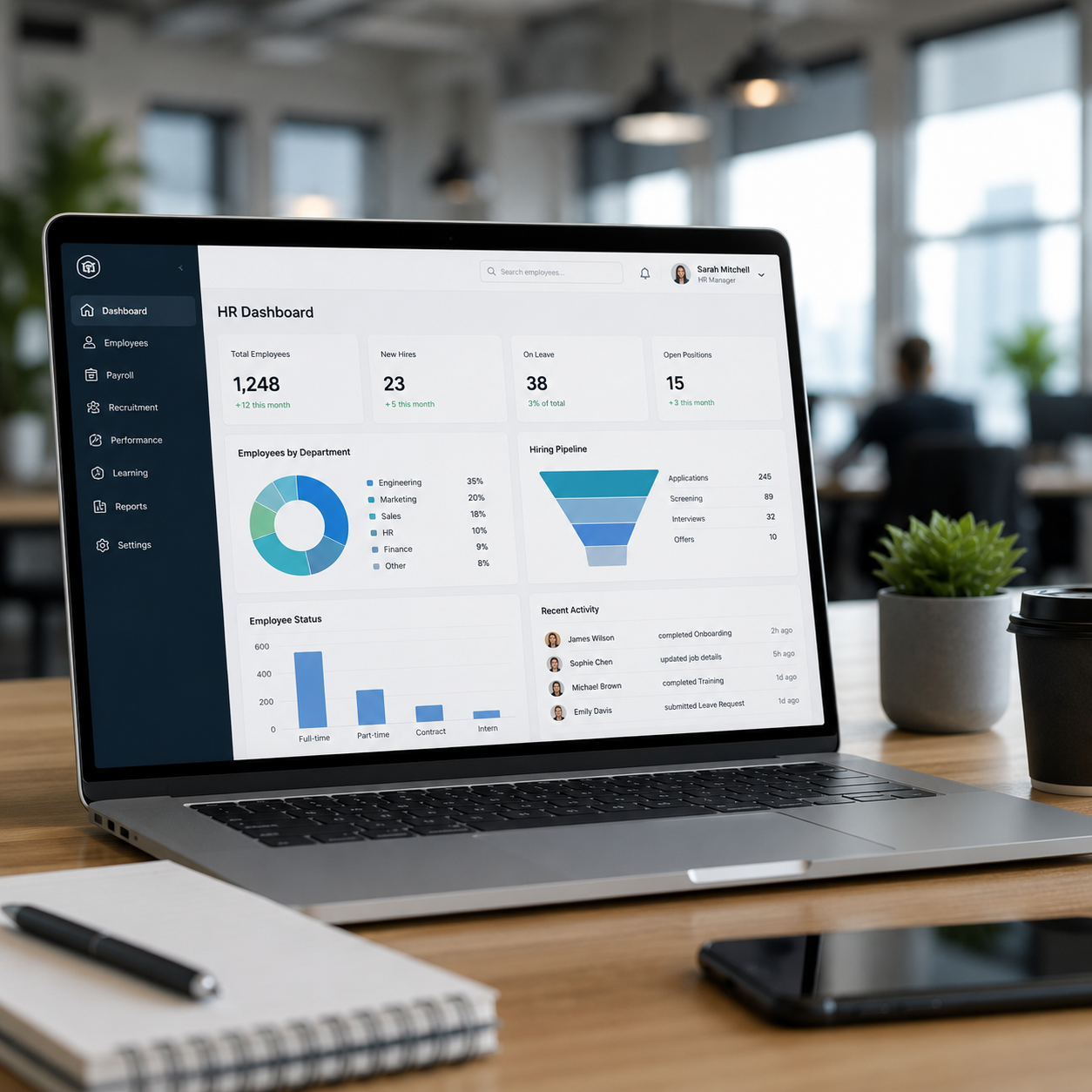
HR software is no longer a single, narrow system for storing employee records. Many of the leading platforms evaluated by organisations in 2026 are broad suites that may combine core HR, recruiting, onboarding, payroll, time and attendance, benefits, performance, learning, compensation, workforce planning, analytics, embedded AI and employee self-service. The category has grown so much that two vendors described as "HR software" can differ enormously in what they actually do, where they operate, and who they are built for.
That breadth makes selection difficult, and harder still for universities. A single HR platform may need to handle permanent academic staff, professional services teams, researchers on fixed-term or grant-funded contracts, adjunct and visiting faculty, hourly and casual workers, student workers, contractors, people holding several appointments at once, multiple pay rates, collective agreements, tenure processes, multi-campus operations and international employees with local payroll and tax obligations. Add strong data protection responsibilities and integration with finance, identity and student systems, and the decision becomes an architecture question rather than a shopping exercise.
The short answer, stated plainly: the strongest HR platform depends on organisation size, payroll complexity, geography, existing enterprise systems and the depth of workforce management required. Workday and Oracle suit broad enterprise transformations; UKG and Dayforce are strong in workforce management and complex payroll; SAP fits wider SAP environments; ADP is payroll-led; and Personio, HiBob, BambooHR and Rippling serve different growing and mid-market needs. There is no universally best platform, and any ranking that claims otherwise should be treated with caution.
One boundary runs through this article, and it is the reason Full Fabric publishes it without appearing in the ranking. HR software manages the employee and workforce lifecycle; student lifecycle software manages prospects, applicants, enrolled students and alumni. These domains are related, and often need to exchange limited information, but they are not the same thing, and conflating them is a common and expensive mistake. Where Full Fabric fits is covered in a dedicated section near the end.
HR software manages employee and workforce information and the processes around it. At its simplest it is a system of record for people: who works at the organisation, in what role, under what terms. In practice, modern HR software reaches well beyond records into the operational work of managing a workforce.
The typical scope of an HR platform may include:
No single product contains every one of these as standard, and many that vendors mention prominently are optional modules, regional add-ons or partner integrations. A platform available in a country does not necessarily process payroll there, and a suite marketing "learning" may mean employee upskilling rather than teaching students. Reading marketing pages as a feature checklist is one of the fastest ways to buy the wrong system.
Buyers encounter three overlapping acronyms constantly, and vendors use them inconsistently. There is no universally enforced definition, but the following is a useful guide.
| Term | Typical scope | Best understood as | Important limitation |
|---|---|---|---|
| HRIS (human resources information system) | Core employee records and foundational HR administration: data, org structures, leave, documents, basic reporting. | The system of record for people data. | On its own, usually lighter on payroll, deep talent and advanced workforce management. |
| HRMS (human resources management system) | HRIS plus broader management functions, which may include payroll, time and attendance, recruiting or performance. | A managed HR operations platform. | The exact functions bundled under "HRMS" vary widely between vendors. |
| HCM (human capital management) | A broader workforce and talent strategy layer covering core HR, payroll, talent, workforce planning and analytics. | An enterprise suite spanning administration and strategy. | Breadth can exceed what smaller organisations need, and modules are often licensed separately. |
These labels indicate rough ambition rather than a precise capability set. Two products both described as "HCM" may differ significantly in payroll depth, country coverage or workforce management maturity. Treat the acronym as a starting point for questions, not an answer.
Four related categories are easy to blur, and keeping them distinct makes selection clearer.
Payroll software calculates and processes employee pay, deductions, taxes and statutory reporting. Payroll is jurisdiction-specific: a platform may run native payroll in some countries, rely on certified partners in others, and integrate with a third-party provider elsewhere. Payroll availability should never be generalised across a vendor's whole geographic footprint.
Workforce management covers scheduling, time and attendance, labour allocation and leave. It matters most where an organisation employs many hourly, shift-based or variable-hours workers, which many universities do.
ERP (enterprise resource planning) covers finance, procurement and often HR, payroll and wider enterprise administration. Some ERPs include HCM; some HCM suites extend toward ERP; and some HR platforms are entirely standalone. Full Fabric covers this in more depth in its guide to ERP systems for higher education.
HR software itself may therefore be a standalone platform, a module inside an ERP, or part of a broader HCM suite. Understanding which of these a vendor is actually offering, and which pieces are included versus optional, is fundamental to comparing like with like.
Institutions vary enormously, and none needs every capability below, but the following requirements recur often enough to form a sensible evaluation frame. Treat each as a question to test, not an assumption to make.
This list matters because generic HR platforms are often built around a conventional corporate workforce of salaried employees, single assignments and straightforward reporting lines. Universities break those assumptions: a researcher may hold two grant-funded part-time appointments, teach hourly and supervise student workers at once. Whether a platform models that natively or only through workarounds is worth verifying during procurement. EDUCAUSE's workforce research is a useful reference for sector context, though not for ranking commercial products.
This is a shortlist and evaluation guide, not a definitive league table.
Each platform was assessed against a consistent set of criteria: breadth of core HR; payroll and country coverage; workforce management; recruiting and onboarding; talent and performance; higher education or public-sector relevance; international capabilities; integrations and APIs; role-based access and governance; analytics; AI governance; scalability; implementation complexity; pricing transparency; and suitability for different organisation sizes.
Three principles apply throughout. No vendor paid for inclusion or placement, and the order reflects overall fit against the criteria. The ranking is not universal: the best choice depends on institutional requirements. And product scope, payroll markets, AI features and certifications change, so capabilities and country availability must be confirmed with the vendor. We have not invented a numerical scoring model, and where public pricing is unavailable we say so rather than estimate.
| Rank | Platform | Best for | Organisation profile | Core strength | Main consideration |
|---|---|---|---|---|---|
| 1 | Workday Human Capital Management | Large universities seeking enterprise HCM, potentially with wider Workday finance and student systems | Large, complex, transformation-ready | Unified people and finance data model; strong planning | Enterprise-scale cost and implementation effort |
| 2 | Oracle Fusion Cloud HCM | Large, international institutions and those already on Oracle Cloud | Large, global, Oracle-aligned | Suite breadth across HR, payroll, talent and analytics | Implementation complexity; breadth can exceed need |
| 3 | UKG Pro | Complex higher education workforces needing HR, payroll, time and scheduling | Mid-to-large, workforce-heavy | Payroll plus deep workforce management for hourly and student workers | Which modules are included versus optional |
| 4 | SAP SuccessFactors HCM | Global institutions and education groups within a wider SAP environment | Large, global, SAP-aligned | Modular talent, learning and analytics; strong ecosystem | Modular scope and integration effort |
| 5 | ADP Workforce Now | Payroll-led HR with strong service and compliance support | US-centric mid-market to lower enterprise | Payroll reliability and tax compliance; large marketplace | Primarily US-focused; product tiering matters |
| 6 | Dayforce | Organisations with complex payroll, time, attendance and scheduling | Mid-to-large, shift-heavy, global payroll needs | Single data model with continuous payroll calculation | Implementation effort; verify non-native payroll depth |
| 7 | Personio | Growing European institutions needing core HR, talent and payroll workflows | European small to mid-market | European core HR and localised payroll in select markets | Payroll is native only in some countries |
| 8 | HiBob | International, distributed, mid-sized organisations prioritising employee experience | Mid-market, multi-entity, global teams | Modern, usable core HR with strong engagement and analytics | Native payroll limited; Payroll Hub connects partners |
| 9 | BambooHR | Smaller and mid-sized institutions prioritising ease of use and core HR | Small to mid-sized, largely US-centric | Clean, easy core HR with built-in applicant tracking | Payroll and benefits largely US-focused |
| 10 | Rippling | Technology-led organisations wanting connected HR, payroll, identity and devices | Mid-market, IT-and-HR consolidation | Unified HR, IT and finance on one employee record | Capabilities span separately licensed modules |
Workday is a cloud human capital and financial management platform unifying HR and finance on one data model with AI embedded throughout. Workday states that more than 650 higher education institutions use one or more Workday applications across areas such as HCM, finance, planning and student administration, and its education messaging emphasises supporting faculty, staff and student workers on a single system.
Large universities that want enterprise-grade HCM and can run a significant transformation programme, particularly those considering a broader Workday finance and student environment.
Workday HCM covers core HR, recruiting, talent and performance, compensation, workforce planning, payroll and analytics, with mobile-first self-service. Reporting and analytics are native and inherit the platform's security model, a real differentiator for cross-domain reporting. Workday's AI layer, Workday Illuminate, adds domain-specific agents across HR and recruiting on a stated human-in-the-loop principle; confirm which Illuminate capabilities are generally available versus announced.
Workday's higher education materials address managing faculty, staff and student workers on one system, and the unified data model suits institutions retiring multiple legacy systems to report from a single dataset. Payroll country coverage should be confirmed per jurisdiction.
Workday offers pre-built connectors, an enterprise integration cloud and a partner marketplace. Workday Student is part of Workday's broader higher education architecture, but it is a student information system, not an HR module, and is not evaluated in this HR ranking; it is noted only because Workday can extend across HR, finance and student systems on a shared platform for institutions that choose it. The complete suite is not required to adopt Workday HCM.
Deep, mature core HR and financial heritage; a unified data model that simplifies cross-domain reporting and planning; strong workforce planning; a large enterprise customer base; embedded, human-in-the-loop AI.
Workday is an enterprise-scale commitment: implementations are substantial change programmes, total cost of ownership sits at the higher end, and pricing is custom. Its breadth means institutions should plan for administrator training, role-specific configuration and structured change management, and evaluate the recruiting module against their needs.
Oracle Fusion Cloud HCM is a comprehensive cloud suite for large and diverse workforces, unifying core HR, talent management, payroll, workforce management, employee experience and analytics on a shared data model. The same foundation extends across Oracle's wider Fusion applications, including finance, to support a single source of truth.
Large, international institutions, especially those already on Oracle Cloud and wanting to consolidate on a single major vendor.
The suite spans core HR, recruiting, onboarding, talent and performance, compensation, succession, workforce management linking time, labour and leave to payroll, employee learning and analytics. Oracle supports global payroll through a combination of native Oracle Payroll, Oracle International Payroll Core and integrations with external providers. Oracle promotes paying employees across more than 60 countries, but institutions should verify which countries use native Oracle payroll and which use international or partner-supported models. Oracle has added embedded AI agents across Fusion HCM spanning recruiting, talent, payroll anomaly detection, service delivery and workforce processes; confirm which are generally available.
Oracle's higher education strength lies in breadth and international reach, and in a single suite for institutions with complex, multi-country operations. Payroll delivery models and module depth should be verified per country.
The shared Fusion foundation is the core of Oracle's pitch: HR, finance, procurement and analytics on one data model. One clarification matters for education buyers: Oracle Learning is an employee learning and development capability, not a university learning management system for delivering teaching to students, and the two should never be conflated.
Comprehensive coverage across HR, payroll, talent and workforce management; strong analytics; extensive global infrastructure; deep integration with Oracle's wider cloud suite; an actively developed AI portfolio.
Breadth can exceed what smaller institutions need, and implementation usually depends on an experienced systems integrator. Oracle frequently draws direct comparisons against competitors; test claims against your own requirements. Pricing is custom.
UKG describes itself as a global platform unifying HR, pay and workforce management. UKG Pro is its HCM suite spanning core HR, payroll, talent, people analytics and employee experience, with UKG Pro Workforce Management handling time, attendance, scheduling and labour compliance as a distinct component. UKG has a strong higher education and public-sector presence, and on 18 February 2026 announced a strategic partnership with Ellucian to combine its workforce platform with Ellucian's higher education ERP and SIS.
Complex higher education workforces needing strong HR, payroll, time, scheduling and workforce management together, particularly those with large hourly and student-worker populations.
UKG Pro covers core HR and payroll, benefits, self-service, talent and people analytics, with workforce management adding time tracking, complex calculations and scheduling. Its higher education materials cover faculty, staff and student workers, including automated handling of multiple roles and fluctuating hours, scheduling for functions such as campus security, and visibility into grant-funded and work-study hours. This workforce management depth is one of UKG's clearest strengths.
UKG's higher education positioning is explicit and mature: payroll plus deep workforce management suits the campus reality of variable-hours, multi-role employment. The Ellucian partnership aims to simplify the workforce-and-student-systems relationship, but does not mean every UKG Pro customer automatically receives an Ellucian integration; verify the exact connector, product and implementation scope.
UKG Pro supports integrations across recruiting, verification, identity, finance, learning and scheduling tools, with published connectors to many third-party systems. Confirm which capabilities are included versus separately licensed, since UKG Pro and UKG Pro Workforce Management are distinct components.
Strong, multi-jurisdiction payroll; deep workforce management for hourly, shift and student workers; explicit higher education and public-sector focus; real-time labour and cost insight.
The platform's breadth means administrators, payroll and reporting users typically need meaningful ramp-up time, so plan for structured configuration and training. Verify which modules are included versus optional before comparing cost. Pricing is quote-based.
SAP SuccessFactors is a modular HCM suite built around Employee Central as its core HR system of record, extending into recruiting, onboarding, performance, learning, succession, compensation and workforce analytics. Through its Joule assistant layer, and at its 2026 Sapphire event, SAP announced Joule Assistants spanning payroll, recruiting, onboarding, HR service and workforce upskilling under an "Autonomous HCM" strategy. Several are recently announced, so confirm which are generally available versus roadmap.
Global institutions and education groups within a wider SAP environment, wanting HR alongside SAP finance and operations.
Employee Central provides core HR, with Employee Central Payroll handling payroll and, in its 2026 releases, adding AI-assisted pay statement explanations across additional countries and languages. Recruiting is delivered through SmartRecruiters for SAP SuccessFactors, SAP's current recruiting platform integrated with SuccessFactors HCM; it is not automatically included in every subscription, legacy Recruiting customers have not all migrated, and connecting it requires implementation work. Performance, learning, succession, compensation and workforce planning round out the suite.
SAP's education positioning is strongest for large, complex institutions already invested in the SAP ecosystem, where the value lies in connecting HR to finance, procurement and research administration. Scope and integration effort should be assessed carefully, and payroll country coverage confirmed per jurisdiction.
The wider SAP ecosystem is both the reason to choose SuccessFactors and the source of its complexity. Integration across Employee Central, SmartRecruiters, learning and the broader SAP estate is central to both the value proposition and the implementation effort. Assess current product scope from SAP's official materials rather than older community pages, which may describe superseded functionality.
Strong modular talent, learning and performance capabilities; mature analytics; deep integration potential within SAP environments; a growing AI portfolio through Joule; global reach.
Modularity means the suite must be scoped and licensed deliberately, and implementation is typically partner-dependent. Institutions should distinguish clearly between generally available functionality and roadmap features. Pricing is custom.
ADP Workforce Now is ADP's all-in-one HR and payroll platform aimed principally at the mid-market, combining payroll, HR, benefits administration, time and attendance, talent and analytics, backed by ADP's long payroll and tax-compliance experience. It is extensible through the ADP Marketplace.
Payroll-led HR where reliability, tax compliance and service support are the priority, including US government and education organisations.
Workforce Now provides payroll with automated tax filing across federal, state and local jurisdictions, time and attendance, benefits administration including ACA and COBRA, onboarding, performance, talent and succession, and embedded analytics. Payroll and tax compliance are the core strength. It includes AI-supported payroll anomaly detection designed to flag potential issues for payroll professionals to review; it does not guarantee error-free payroll.
ADP serves government and education organisations and fits best where payroll accuracy, multi-state US compliance and service support matter most. ADP positions Workforce Now for organisations with 50 or more employees, and offers other products for the smallest and largest organisations, so it is not automatically the right ADP product for every size.
The ADP Marketplace offers a large catalogue of pre-built integrations across recruiting, finance, benefits and IT, and ADP API Central supports custom integration. In 2026 ADP added a curated destination of third-party AI agents in the Marketplace, with partners required to follow responsible-AI principles. Not every ADP product is part of Workforce Now, so confirm exactly what a contract includes.
Strong payroll and tax compliance; a well-developed service and support model; extensive marketplace and integration options; mature benefits administration.
Workforce Now is primarily US-focused, and its payroll and benefits depth may not meet the needs of institutions with significant non-US operations. Pricing is quote-based and depends on organisation size, payroll requirements and selected modules.
Dayforce is a global HCM platform unifying HR, payroll, benefits, talent and workforce management on a single data model, distinguished by continuous payroll calculation that processes pay in real time rather than in frozen batches. Dayforce became a privately held company following the completion of its acquisition by Thoma Bravo in February 2026.
Organisations with complex payroll, time, attendance and workforce management needs, particularly those with large hourly or shift-based populations and multi-country payroll.
Dayforce combines core HR, payroll, workforce management, time and scheduling, benefits, talent and analytics on one system. Its operational strength comes from the single data model spanning payroll, time and workforce management, supporting continuous calculation and on-demand pay more fluidly than many modular suites. Dayforce markets global payroll coverage across more than 200 countries and territories through a combination of products and delivery models; verify the native, managed or partner-supported model in each required country. AI assistants and agents are being added; confirm which are generally available versus roadmap.
Dayforce's payroll and workforce management depth suits institutions with demanding time, scheduling and multi-country pay requirements, and its public-sector materials cover the full employee lifecycle. Validate localisation depth in each payroll country and the total cost of implementation services.
Dayforce provides integration options for finance, benefits and other institutional systems. Its single-application architecture is a genuine advantage for data consistency, reducing the synchronisation issues that arise when payroll and workforce management sit in separate systems.
Real-time continuous payroll calculation; a unified data model; strong workforce management and scheduling; broad payroll reach; on-demand pay.
Implementation requires meaningful effort given the platform's breadth across payroll, workforce management and integrations. Global payroll coverage and delivery models require validation rather than acceptance of headline country counts. Pricing is custom.
Personio is a European HR platform, founded in Munich, combining core HR, recruiting, onboarding, time and absence, performance, compensation and workforce planning, with payroll in selected European markets and strong GDPR alignment and EU data residency. Personio currently positions the platform for organisations with approximately 10 to 5,000 employees.
Growing European institutions needing integrated core HR, talent and payroll workflows with strong European compliance.
Personio covers employee records, absence, documents and reporting in its core tiers, with recruiting and applicant tracking, performance and advanced reporting in higher tiers, and add-ons such as compensation and surveys. It offers Personio Payroll in selected European markets, alongside Preliminary Payroll and integrations with external payroll providers elsewhere. Institutions should verify the delivery model for every country in scope. Personio has also added an AI assistant for natural-language workforce analytics.
Personio suits growing European institutions consolidating fragmented tools into a single system with European labour-law and multi-entity support. Its GDPR alignment, EU-only data hosting and audit trails suit data-protection-conscious buyers, though software alignment does not by itself make an institution compliant.
Personio supports integrations with identity providers such as Okta and Microsoft Entra ID in higher tiers, along with API access and connections to European payroll ecosystems. Multi-entity support for organisations spanning several legal entities is available in higher plans.
Strong European core HR and compliance orientation; native payroll in selected European markets; multi-entity support; a transparent modular structure.
Payroll is native only in some countries, so multi-country institutions must map their markets carefully. Modular pricing means the full platform can cost more than the entry tier, and capabilities outside Europe are more limited.
HiBob is the company; Bob is its platform, and we keep the two separate throughout. Bob is a modern people platform for mid-sized, fast-growing and internationally distributed organisations, spanning core HR, onboarding, time and attendance, performance, compensation, workforce planning, people analytics, engagement and, increasingly, payroll and hiring, with a strong emphasis on usability.
International, distributed, mid-sized organisations prioritising employee experience and flexible, modern HR workflows.
Bob's Core module provides the people, role and skills data layer, workflows, documents and localisation for multi-language, multi-region operations, with Talent, Compensation, Workforce Planning, Hiring and People Analytics around it and strong engagement and survey features. On payroll, Bob offers native payroll products for the United States and United Kingdom, alongside Payroll Hub and payroll integrations elsewhere. Payroll Hub syncs employee and payroll data with third-party providers rather than processing pay natively, so buyers needing fully native, multi-country payroll should map their markets against Bob's actual coverage.
Bob suits mid-sized, internationally distributed organisations that value usability and engagement, with multi-entity and localisation support for groups across several countries. For very large hourly or student-worker populations and complex multi-rate payroll, test the payroll model and workforce management depth carefully.
Bob integrates across HR, payroll, finance and IT, with Payroll Hub as an integration layer that keeps Bob as the system of record while connecting to payroll partners. It supports multi-entity structures and global governance.
A modern, highly usable interface with strong adoption; excellent engagement and analytics tooling; genuine multi-entity and international support; balanced depth for scaling organisations.
Native payroll is limited to the US and UK, with Payroll Hub connecting partners elsewhere, so coverage must be verified. Time and attendance can be a paid add-on, pricing is custom, and implementation timelines depend heavily on legacy data quality and integration scope.
BambooHR is a cloud HR platform for small and mid-sized organisations, centring on a clean, easy-to-use system of record with built-in applicant tracking, onboarding, time-off management, performance and reporting, plus payroll and benefits as add-ons. It prioritises simplicity and high employee adoption over deep enterprise configurability.
Smaller and mid-sized institutions prioritising ease of use and straightforward core HR over complex enterprise workforce management.
BambooHR provides a central employee record, an applicant tracking system included with plan-based limits on job openings, onboarding with e-signatures, time-off tracking, performance management, and customisable reporting with role-based permissions and mobile access. Payroll, benefits and time and attendance are paid add-ons.
BambooHR fits smaller institutions, or discrete departments, moving from spreadsheets to a clean single system of record with light recruiting and onboarding. It is less suited to the complex, multi-rate, multi-assignment payroll and heavy workforce management large universities require, and its centre of gravity is the United States.
BambooHR offers a large integration marketplace across recruiting, payroll, scheduling and communication, connecting to identity and other tools. Its native payroll add-on is primarily for US-based employees, though it has added third-party payroll integrations for some other markets; verify payroll and benefits availability per market.
A clean, approachable interface with strong adoption; built-in applicant tracking; quick onboarding; a solid core HR system of record for smaller organisations; a broad integration marketplace.
Payroll and benefits are largely US-focused, and the platform is less suited to complex or highly customised workflows. BambooHR publishes tiered pricing on its website, with payroll, benefits and other capabilities potentially requiring additional products; confirm the current price and regional availability directly with BambooHR.
Rippling unifies HR, payroll, IT and finance operations on a single employee record, distinctive for extending beyond HR into identity, application provisioning and device management. Organised into HR, IT and Finance clouds on a shared employee data layer, it targets mid-market, particularly technology-led, organisations consolidating HR and IT tooling.
Technology-led organisations wanting connected HR, payroll, identity, permissions and device management on one platform.
Rippling's HR capabilities include an HRIS, recruiting and applicant tracking, onboarding and offboarding, time and attendance, benefits and performance. On payroll, it provides native payroll in selected markets plus broader international hiring, contractor payment and employer-of-record services; these are distinct delivery models rather than one country-coverage figure, so verify the model in each country. Its IT capabilities are the differentiator: identity and access management, single sign-on, multi-factor authentication, automated app provisioning and deprovisioning, and device management including remote configuration, locking and wiping. Rippling introduced natural-language AI across its HR, IT and finance data in 2026.
Rippling fits technology-led organisations that want HR and IT joined up, so hiring, role changes and offboarding drive payroll, access and device provisioning. For universities the identity-and-provisioning angle can be attractive, but be clear about which modules are being bought and how Rippling's identity model would sit alongside existing institutional identity systems.
Rippling acts as an identity provider and connects to a large catalogue of third-party applications, with modules subscribing to a shared employee-and-identity core. This is powerful, but capabilities span separately licensed products rather than a single base subscription.
Rippling's current Trust Center lists certifications including SOC 1, SOC 2, SOC 3, ISO 27001, ISO 27018, ISO 42001 and CSA STAR Level 2. Certification scope and current status should be checked during procurement, and certifications do not by themselves make an institution compliant.
Genuine unification of HR, IT and finance on one employee record; strong onboarding and offboarding automation; native payroll in selected markets plus contractor and employer-of-record options; identity and device management built in.
The HR, IT and finance breadth can obscure which products or modules an institution must actually purchase. Pricing is modular, typically a base platform fee plus per-module, per-employee costs; each cloud and module should be scoped and priced explicitly.
No single platform wins for everyone; the following are sensible starting points, not guarantees of fit. For large universities, Workday and Oracle Fusion Cloud HCM offer enterprise HCM with deep planning and analytics and, potentially, a shared finance or student environment. For complex payroll and workforce management, UKG Pro and Dayforce lead where large hourly, shift-based and student-worker populations, complex scheduling and multi-jurisdiction payroll dominate. Institutions already using SAP or Oracle should weigh SAP SuccessFactors or Oracle Fusion Cloud HCM respectively. Growing European organisations are well served by Personio; smaller institutions by BambooHR; and international, distributed teams by HiBob. For HR and IT workflow alignment, Rippling lets hiring, role changes and offboarding drive payroll, identity, access and device management from one record. ADP Workforce Now sits across several of these where payroll reliability and compliance are decisive, primarily in a US context.
Evaluating your institution's technology architecture? Full Fabric manages the student lifecycle, from first enquiry through to alumni, and integrates with HR, ERP and identity systems through governed, minimal data exchange. Book a free strategy call to see how it fits alongside your workforce platform.
Every platform in this ranking markets AI, and the pace of change in 2026 is significant. Both the use cases and the risks matter.
Across the market, AI is applied to job-description drafting, candidate matching and screening, HR knowledge assistants, workflow recommendations, self-service, skills inference, workforce analytics, scheduling optimisation, summarisation and performance-review support. The clearest 2026 trend is the shift from single-task automation toward "agentic" systems coordinating multi-step workflows. Several vendors emphasise a human-in-the-loop principle, where AI surfaces recommendations but people decide. Confirm which capabilities are generally available rather than announced.
The same capabilities carry real risks: bias from unrepresentative training data; opaque recommendations that are hard to explain or challenge; inappropriate candidate screening; intrusive employee monitoring; AI with excessive access to sensitive personal data; automated high-impact decisions made without adequate human review; and inaccurate outputs presented with unwarranted confidence.
Under the EU AI Act, certain systems used in employment, worker management and access to self-employment can be classified as high-risk, including those used for recruitment, candidate screening, promotion, task allocation, performance evaluation or termination decisions. Following the 2026 AI Omnibus changes, the rules for high-risk use cases listed in Annex III are scheduled to apply from 2 December 2027. Rules for high-risk AI embedded in regulated products are scheduled to apply from 2 August 2028. Separate transparency obligations begin to apply in August 2026. Institutions should assess the intended use of each AI capability and confirm their obligations with qualified legal and data protection professionals. The NIST AI Risk Management Framework is a useful voluntary reference for building governance around these systems. This article does not constitute legal advice.
Whatever the deadline, the practical work is the same. Institutions procuring AI-enabled HR software should insist on human oversight of consequential decisions, impact assessment before deployment, data minimisation, explainability, access controls, bias and accuracy testing, auditability, vendor due diligence, and clear appeal or review processes for anyone affected by an automated recommendation.
HR platforms hold some of the most sensitive personal information an institution controls: salaries, bank details, health and disability information, equality monitoring data, disciplinary records and recruitment histories. Security is a first-order selection criterion, not a footnote.
Institutions should evaluate role-based access and least privilege; single sign-on and multi-factor authentication; audit logs; encryption in transit and at rest; data residency; retention and deletion policies; backups; incident response; the vendor's subprocessors; handling of special-category data such as health information; protection of recruitment records; and the boundaries around any worker-monitoring capability.
Two things must be said plainly. First, a platform's security certifications and features can support an institution's data protection posture, but they do not by themselves make it compliant. Compliance depends on how the institution configures, governs and uses the system, and on its own legal obligations. The UK Information Commissioner's Office publishes guidance on handling employment and recruitment information, and the European Commission sets out the core GDPR principles; neither this article nor any software is a substitute for legal advice. Second, worker monitoring raises significant data protection and ethical questions, and any monitoring capability should be scrutinised carefully before it is enabled.
An HR platform never operates alone. The connections that matter most for institutions typically include:
Two governance principles should shape every connection. First, data should flow only where a specific, agreed workflow requires it, under role-based access and data protection controls, not synchronised wholesale. Second, the HR platform should remain authoritative for employee data within its scope, with connected systems consuming what they need rather than becoming shadow copies of the workforce record. Full Fabric's guidance on the benefits of system integration in higher education, its integrations pages and its broader integration strategy resources explore this further.
HR software implementation is not only an IT project; it is a change programme touching HR, payroll, finance, IT, managers and every employee.
Start with process mapping and a clear view of global and local requirements, since a platform that works cleanly in one country may need significant configuration in another. Plan payroll parallel runs carefully before cutover, because payroll errors erode trust faster than almost anything. Expect data migration to be harder than it looks: legacy data is rarely clean, duplicates are common, and how much history to bring across is a real decision. Scope integrations, identity and permissions early, and invest in testing, change management, manager training and employee adoption, since a deployment people avoid using has failed in practice. Consider the implementation partner and the vendor's upgrade and support model, and plan for exit from the outset: understand how data would be exported at the end of the contract before you sign.
A rigorous procurement conversation is the single best protection against buying the wrong system. This checklist is a starting point.
To be unambiguous: Full Fabric is not HR software and does not appear in this ranking. It is not an HRIS, HRMS, HCM suite, payroll software, workforce management software, an applicant tracking system for employee recruitment, an employee learning platform, an HR analytics system, an ERP, a finance platform or an identity provider, and it does not replace Workday HCM, Oracle HCM, UKG, SAP SuccessFactors, ADP, Dayforce or any other workforce platform.
HR systems manage the employee and workforce lifecycle: staff records, employment contracts, payroll, absence, time, performance, benefits and talent. Full Fabric manages the student lifecycle. It is a purpose-built, composable higher education platform connecting CRM and relationship management, prospective student recruitment, applications, admissions, offers and enrolment, payments where relevant, student information and records, communications, reporting and contextual AI, around one connected record per person from first enquiry to alumni status.
These domains are separate but not isolated. In a well-designed architecture, HR and student lifecycle systems exchange limited, governed information where a workflow requires it: staff identity and roles, faculty access to admissions or student systems, provisioning and deprovisioning, the student-worker relationship and teaching assignments. HR or identity systems may provide staff identity and role information, on which Full Fabric applies access appropriate to student lifecycle workflows; finance and ERP systems remain authoritative for workforce finance and payroll; and student records stay governed within the chosen student information system. Only the data a workflow requires should move between systems, under role-based access and data protection controls, rather than copying complete employee records into Full Fabric. Full Fabric integrates with existing institutional systems rather than duplicating them, a principle explored further in its system integration guidance and campus management resources.
This complementarity is particularly relevant for business schools and public universities, and for the IT leaders and business school CIOs and IT teams who map which system owns which part of the estate: a workforce system of record for staff, a student lifecycle platform for learners, and clean, minimal, governed exchange between them.
There is no single best HR platform for every organisation, and higher education makes that truer than most sectors. The right choice depends on organisation size, workforce complexity, payroll jurisdictions, existing systems, implementation capacity, integration needs, security, governance and AI risk appetite. Workday and Oracle suit broad enterprise transformations; UKG and Dayforce excel at complex workforce management and payroll; SAP fits wider SAP environments; ADP is payroll-led; and Personio, HiBob, BambooHR and Rippling serve different growing and mid-market needs.
Whatever an institution chooses, the enduring principle is clear responsibilities: workforce systems and student lifecycle systems should have distinct, well-understood roles, and exchange only the governed information their shared workflows require. Get those boundaries right, and each system does the job it was built for.
There is no single best HR platform for every organisation. The strongest 2026 options include Workday, Oracle, UKG, SAP, ADP, Dayforce, Personio, HiBob, BambooHR and Rippling. Workday and Oracle suit large enterprise transformations, UKG and Dayforce workforce management and payroll, SAP wider SAP environments, and ADP is payroll-led. The right choice depends on organisation size, payroll complexity, geography, existing systems and the depth of workforce management required.
HRIS refers to core employee records and foundational HR administration. HRMS adds broader functions such as payroll, time, recruiting or performance. HCM describes a wider workforce and talent strategy layer covering core HR, payroll, talent, workforce planning and analytics. Vendors use these terms inconsistently, so treat the labels as a starting point rather than a precise capability set.
It depends on size, workforce complexity and payroll needs. Large universities often evaluate Workday and Oracle; institutions with large hourly and student-worker populations look at UKG Pro and Dayforce; SAP-environment institutions consider SAP SuccessFactors; and smaller or European institutions may prefer Personio, HiBob or BambooHR. Whichever is chosen, workforce complexity such as multiple assignments, grant-funded roles and student workers should be tested explicitly during procurement.
Sometimes, but not always, and availability varies by country. Some platforms run native payroll in certain markets, some rely on certified partners, and some integrate with a third-party provider. Payroll availability should never be generalised across a vendor's whole footprint; confirm native coverage for each country of operation.
Many can, but the depth varies. Higher education workforces often involve multiple employment types, concurrent assignments for one person, multiple pay rates and grant-funded roles, which not every platform models natively. UKG, for example, positions explicitly around faculty, staff and student workers with multiple roles. Verify support for these specific scenarios rather than assuming a general platform handles them out of the box.
It can be, but it does not have to be. Some ERPs include HCM, some HCM suites extend toward ERP, and some HR platforms are standalone. A single suite can simplify integration and reporting, while a best-of-breed platform connected to a separate ERP can offer greater depth. Full Fabric's guide to ERP systems for higher education explores the trade-offs.
Key integrations include ERP and finance, the identity provider, payroll providers, benefits, applicant tracking, employee learning, the data warehouse and business intelligence layer, IT service management and document signing, plus student systems in limited cases. Data should flow only where a specific workflow requires it, and the HR platform should remain authoritative for employee data within its scope.
Assess which AI features are active by default and whether they can be disabled, what data trains or operates them, and how recommendations are reviewed by humans. Certain employment-related AI uses may be high-risk under the EU AI Act, whose high-risk Annex III rules are scheduled to apply from 2 December 2027 following the 2026 AI Omnibus changes, with separate transparency obligations from August 2026. Good practice includes human oversight, impact assessment, data minimisation, explainability, access controls, testing, auditability and clear appeal processes. This is not legal advice; confirm your own obligations.
At minimum, role-based access with least privilege, single sign-on and multi-factor authentication, audit logs, encryption in transit and at rest, data residency options, retention and deletion controls, backups, incident response, transparency about subprocessors, and protection for special-category data such as health information. Certifications support a data protection posture but do not by themselves make an institution compliant.
No. Full Fabric is a student lifecycle platform for higher education, not an HR, payroll or workforce-management platform. It manages CRM, recruitment, admissions, enrolment, student records, communications, payments where relevant, reporting and contextual AI around a single student record, and integrates with HR, ERP, finance and identity systems rather than replacing them.