

Best AI Software for Higher Education Back-Office Operations
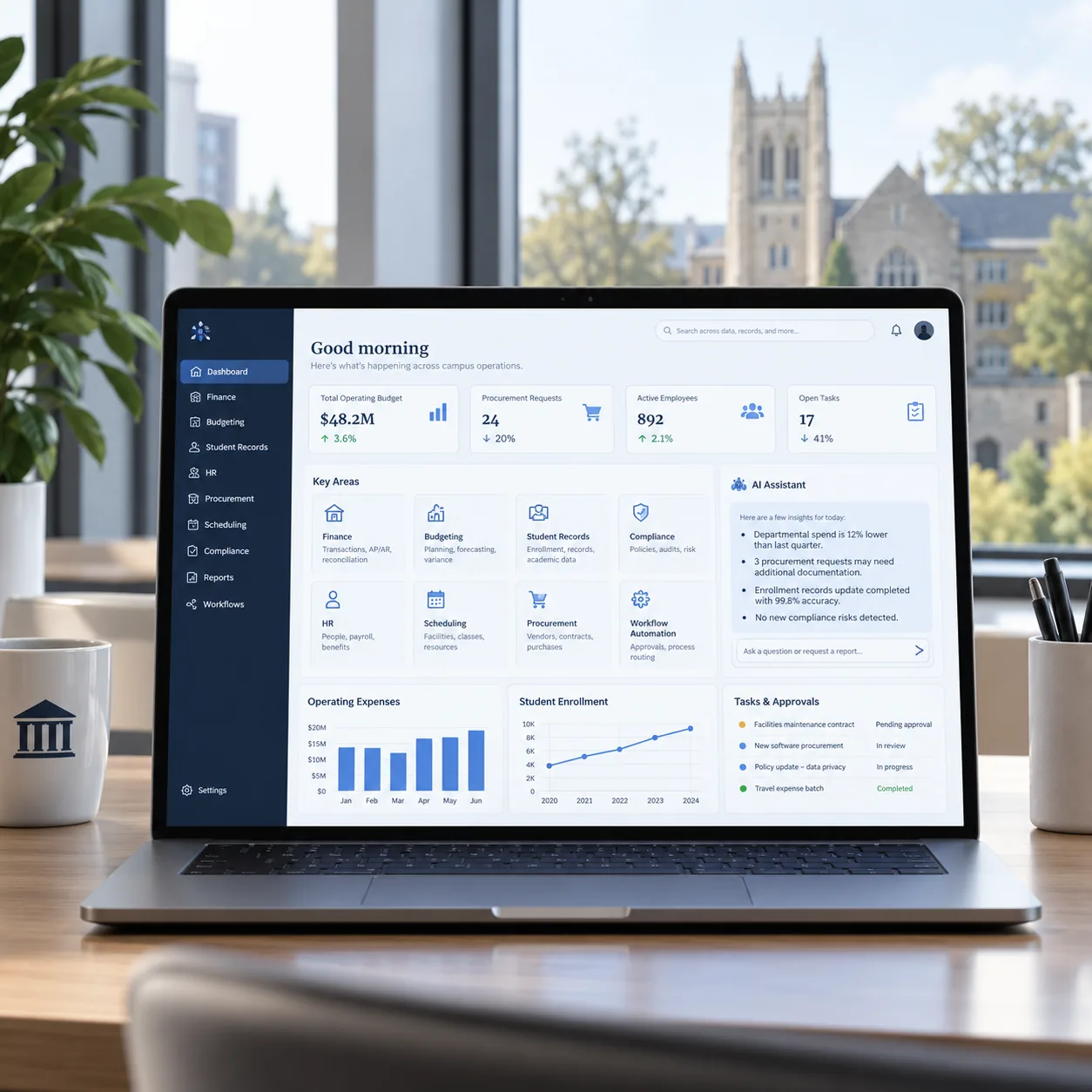
Most published guidance on AI in higher education concentrates on teaching, learning and admissions. Far less attention goes to the work that keeps an institution running: student records and registry, enrolment administration, tuition and payments, institutional finance, procurement, HR, IT and shared services, and the reporting that leadership depends on. That is where a large share of university staff time is actually spent, and it is where AI vendors made most of their significant product moves in 2025 and 2026.
This guide compares the AI platforms most relevant to higher education administrative operations as of September 2026. It is written for CIOs, COOs, CFOs, registrars, student administration leaders, IT and finance directors, and the operations teams of universities and business schools. It is a software selection guide, not a general AI strategy primer. If you need the broader adoption picture, start with our practical guide to navigating AI in higher education instead.
One principle runs through everything below:
The best AI for higher education back-office work is usually the AI closest to the authoritative institutional data and the workflow where the work happens.
A general-purpose assistant can summarise documents and draft emails brilliantly. It cannot, by itself, be the authoritative system for a student's academic status, a tuition balance, a payroll record or a purchase order. Choosing back-office AI is therefore less about choosing the cleverest model and more about deciding which system should own which work.
What is the best AI for higher education back-office operations?
There is no single best platform, because "back office" spans several distinct systems of record. There is, however, a defensible segmented answer based on current product evidence:
- Full Fabric is the strongest option for contextual AI across student-lifecycle operations: registry and student records, enrolment, payments connected to the student record, cohort queries and operational reporting, on one connected applicant-to-student data model. It is not a finance or HR ERP, and does not claim to be.
- Ellucian is the strongest higher-education-native administrative suite. Ellucian Student, launched in April 2026, unifies student, HCM and finance operations on one platform, with agentic AI grounded in Ellucian's Higher Ed Knowledge Graph. Existing Banner and Colleague institutions should verify how Ellucian Student maps onto their current products and modernisation path.
- Workday is the strongest choice for institutions unifying student administration, finance, HCM and planning on one enterprise platform, with a large portfolio of Illuminate AI agents whose availability ranges from generally available to staged 2026 rollout.
- Oracle is strongest for enterprise finance and HR operations with embedded agentic workflows, through Fusion Cloud Applications, Fusion Agentic Applications and AI Agent Studio, with Oracle Student Management connecting student administration to Oracle Financials.
- ServiceNow is the strongest platform for university service operations: IT, HR service delivery, facilities and shared services, with Now Assist and AI agents handling requests, cases, routing and self-service. It is not an SIS or a general ledger.
- Unit4 is a strong people-centric finance, HR and planning ERP for European public sector and higher education institutions, with its Ava virtual agent working across finance, people, procurement and project processes.
- Microsoft 365 Copilot and Copilot Studio are the strongest general productivity and custom agent layer for administrative staff: documents, email, meetings, knowledge search and institution-built agents, governed through the Copilot Control System and Agent 365. Copilot is not a system of record and should not be treated as one.
The sections below explain how each platform earns its place, and how to decide which combination fits your institutional architecture.
What counts as higher education back-office AI?
"Back office" is a useful search phrase but an imprecise one, and it should never be read as implying these teams are less important. In this guide, higher education back-office operations means the administrative functions that keep an institution running:
- student records, registry and enrolment administration
- course and programme administration
- tuition, payments and student finance operations
- institutional finance, accounting, budgeting and procurement
- HR and workforce administration
- IT and enterprise service management, including shared services
- document processing and administrative knowledge work
- institutional reporting, analytics and cross-system workflow coordination
Throughout the article we use terms such as institutional operations, administrative operations and university operations interchangeably with back office.
Higher education back-office AI, then, is AI that helps staff perform or coordinate this administrative work: answering questions over institutional data, summarising records and cases, detecting anomalies, drafting documents, routing requests, and in some architectures executing steps in governed workflows.
Two adjacent categories are deliberately out of scope. Teaching and learning AI (tutoring, assessment, LMS assistants) is a different buying problem. So is admissions and recruitment AI as a standalone category, which we cover in Best AI Software for Higher Education Admissions Teams. This article begins roughly at the applicant-to-student handoff and extends across the administration of the institution.
Seven types of AI used in university administration
Before comparing vendors, it helps to map what AI is actually doing in institutional operations. Most current capability falls into seven categories. Few platforms cover more than two or three of them well, which is precisely why "which AI is best" is the wrong first question and "which AI for which job" is the right one.
1. Student administration and registry AI
AI that works over the student record: enrolment status, course registration, academic history, progression, transcripts, cohort queries and record lookups. The defining requirement is proximity to the authoritative student record and respect for its permissions. Relevant platforms: Full Fabric, Ellucian, Workday Student, Oracle Student Management.
2. Finance, budgeting and procurement AI
AI applied to institutional money: anomaly detection, reconciliation, financial close support, invoice and document processing, forecasting, budgeting and scenario planning, procurement and spend analysis. Relevant platforms: Workday, Oracle, Unit4.
3. HR and workforce AI
Employee self-service, HR case support, policy queries, workforce planning and administrative HR workflows. Relevant platforms: Workday, Oracle, Unit4, and Microsoft for the self-service and knowledge layer. HR belongs in this article as part of institutional operations, but selection of HR-specific AI for hiring or evaluation raises distinct risks addressed later.
4. IT and enterprise service management AI
AI inside the service platform: request and incident summarisation, knowledge search, routing, virtual agents and self-service across IT, facilities and shared services. Relevant platforms: ServiceNow, Microsoft.
5. Reporting, analytics and institutional intelligence
Natural-language questions over governed institutional data, operational dashboards, cross-cohort analysis and leadership queries. Relevant platforms: Full Fabric within the student lifecycle domain; Workday, Ellucian, Oracle and Unit4 within their respective enterprise domains.
6. Document and knowledge work AI
Summarising, drafting, extracting information from documents, meeting notes and policy lookup: the horizontal layer of administrative knowledge work. Relevant platforms: Microsoft 365 Copilot, plus the copilots embedded in each enterprise suite.
7. Workflow AI and agents
AI that completes multi-step tasks: coordinating between records, processing exceptions, escalating, and executing transactions within permission boundaries. Every major vendor now ships or has announced agents here: Ellucian Agents, Workday Illuminate agents, Oracle Fusion Agentic Applications, ServiceNow AI agents, and custom agents built in Microsoft Copilot Studio. This is also where governance requirements rise sharply, because agents that write to systems are categorically different from assistants that read from them.
How we evaluated higher education back-office AI software
Because the title says "best", the selection method should be explicit. Platforms were assessed against current public documentation, product pages, release notes and announcements as of September 2026, on these dimensions:
- Higher education relevance. Purpose-built for institutions, or an enterprise platform with substantial, evidenced higher education adoption.
- Administrative scope. Which institutional functions the platform actually covers as a system of record or service platform.
- AI depth. Whether the AI drafts, searches, analyses, predicts or acts, and how deeply it is embedded in real workflows rather than bolted on.
- System-of-record proximity. Whether the AI operates against authoritative institutional data or against copies and exports.
- Transaction capability and governance. Whether the AI can change records or execute workflow steps, and what permissions, approvals, logging and audit surround that.
- Maturity. Whether capabilities are generally available, in early access or preview, or announced. Where a vendor mixes these, we say so.
- Integration and institutional fit. How the platform coexists with the SIS, ERP, HCM and service-management systems an institution already runs.
No numerical scores or star ratings are used, because they would imply a precision the evidence does not support. Vendor ROI statistics are excluded or explicitly attributed, since vendor pages prove what a vendor claims, not what an institution will achieve.
Best AI software for higher education back-office operations: comparison
| Platform | Strongest back-office area | AI operating model | Core systems it provides | Best fit | Main consideration |
|---|---|---|---|---|---|
| Full Fabric | Student-lifecycle administration and registry | Contextual AI inside the platform (AI Console) | CRM, admissions, enrolment, payments, SIS, reporting | Universities and business schools wanting AI over one connected applicant-to-student record | Not a finance/HR ERP |
| Ellucian | Higher-ed-native student, finance and HCM operations | Agentic AI grounded in a Higher Ed Knowledge Graph | Ellucian Student (student, HCM, finance) | Institutions wanting a higher-ed-specific unified suite | New platform (April 2026); verify migration path from Banner/Colleague and per-agent availability |
| Workday | Unified student, finance, HCM and planning | Illuminate AI agents embedded in the suite | Workday Student, Financials, HCM, Adaptive Planning, Grants | Institutions consolidating on one enterprise platform | Agent availability ranges from GA to staged 2026 rollout; enterprise implementation effort |
| Oracle | Enterprise finance and HR with embedded agents | Fusion Agentic Applications and AI Agent Studio | Fusion ERP, HCM, EPM, Student Management | Institutions on or moving to Oracle Fusion | Many agents are Fusion ERP/HCM capabilities; verify what surfaces in Student Management |
| ServiceNow | IT, HR service delivery and shared services | Now Assist and AI agents on the ServiceNow AI Platform | Service management and workflow platform | Institutions professionalising service operations | Not an SIS or ledger; value depends on service maturity |
| Unit4 | Finance, people, procurement and planning | Ava virtual agent across ERPx processes | Unit4 ERPx (finance, HR, procurement, projects, FP&A) | Mid-market European institutions and public sector | Not a student-records platform |
| Microsoft 365 Copilot / Copilot Studio | Staff knowledge work and custom agents | Productivity copilot plus agent-building platform | None (works over M365 and connected systems) | Institutions already using Microsoft 365 | Not a system of record; agent governance is the institution's job |
Full Fabric
What it is. Full Fabric is a unified higher education platform covering CRM and recruitment, admissions and enrolment, payments, and a full student information system with academic records, grades, transcripts, programme management, reporting and communications. It is built primarily for European institutions, with a single data model in which the record created at first enquiry becomes the enrolled student's record and, eventually, the alumni record.
Where the AI is strongest. Full Fabric's contextual AI operates inside that connected record. Because the platform holds applications, enrolment, academic records, payments status and engagement history in one system, the AI works from a coherent picture rather than fragmented extracts. Its strongest ground is student-lifecycle administrative operations: registry lookups, cohort questions, enrolment administration and operational reporting.
What it actually does. The AI Console, a side panel available across the platform, answers natural-language questions over institutional data ("How many applications are pending?", "Show me all students from the London campus"), uses an open student or applicant profile as context, builds segments, supports events and communication drafting, and produces cohort and intake comparisons that would otherwise require custom report building. Its actions stream visibly into the conversation, so staff can see which data was queried and how an answer was produced.
Which system owns the data and action. Full Fabric itself: the AI operates against the platform's own student, application, programme, payment and engagement records, which are the system of record for those domains at institutions running Full Fabric as their SIS.
How it fits the university stack. Full Fabric covers the student lifecycle and connects outward through documented APIs, enterprise connectors (Salesforce, HubSpot, Microsoft Dynamics, UCAS) and a broader integrations ecosystem, so finance ERPs, LMS platforms and identity providers remain in place. It is a deliberate architectural position: own the student-lifecycle record, integrate with the rest.
Human control and governance. The AI respects each user's existing role and permissions, so it cannot surface records the user could not otherwise access. Administrators can review AI Console activity through audit logs, and the product documentation is explicit that outputs for sensitive decisions should be verified against underlying data. Governance context for IT teams is documented alongside the platform's GDPR and security material.
Best suited to. Universities, public universities and business schools that want contextual AI over a connected applicant-to-student operational record, particularly institutions consolidating fragmented admissions, records and payments systems.
What to verify. Whether your required statutory reporting is covered for your jurisdiction; how the platform integrates with your finance ERP; and the boundary of what the AI can do in your configured environment. Full Fabric is not a general-purpose ERP: for institution-wide payroll, general ledger, procurement or faculty workforce management, it is designed to sit alongside systems such as Workday, Oracle or Unit4, not replace them.
Ellucian
What it is. Ellucian is a major higher-education-specific software vendor, serving approximately 3,000 institutions across 50 countries. In April 2026 it launched Ellucian Student, described by the company as a unified AI-native SaaS platform bringing student information, human capital management and finance onto a single architecture, positioned as a step beyond the traditional SIS model that its Banner and Colleague products defined for decades.
Where the AI is strongest. Ellucian's differentiator is domain specificity. Its AI is built on what it calls the Higher Ed Knowledge Graph, a catalogue of nearly 10,000 higher education workflows, and the company describes the approach as deterministic by design: mapping a request to a defined institutional process with its policies and guardrails, rather than generating a free-form response. Coverage spans student administration, financial aid, academic operations, finance and HCM.
What it actually does. Ellucian Agents are described as automating and standardising work across departments in line with institutional policies and compliance expectations, with every action logged and auditable. Published examples include agents that detect student account holds and initiate clearing actions, and AI-driven workflows across advising, financial aid and enrolment.
Which system owns the data and action. Ellucian Student itself, for institutions that adopt it: student, HCM and finance records on one platform. For the large installed base still running Banner or Colleague, the authoritative record remains in those systems, and how the new platform relates to them is a critical due-diligence question.
How it fits the university stack. As a higher-ed-native suite, Ellucian aims to own the institutional core. Institutions with separate ERP or service-management investments will still need clear integration boundaries.
Human control and governance. Ellucian's published architecture emphasises governed paths from intent to auditable outcome, with actions logged against institutional policies. As with any vendor, statements such as claims that its AI delivers trusted or correct outcomes are marketing language, not independent verification.
Best suited to. Institutions that want a higher-education-specific unified administrative suite from a vendor with deep sector history, particularly existing Ellucian customers evaluating their modernisation path.
What to verify. Which Ellucian Agents are generally available versus announced for your region and configuration; how Ellucian Student maps onto your current Banner or Colleague estate, SaaS modernisation path, data model and commercial roadmap, since Ellucian positions modernisation routes rather than one universal replacement migration; and how the Knowledge Graph's catalogued workflows map to your institution's actual policies. The platform launched in April 2026, so reference deployments are necessarily young.
Workday
What it is. Workday provides an enterprise suite spanning Workday Student, Financial Management, HCM, Adaptive Planning and Grants Management, used by a substantial number of universities alongside its broader enterprise base of more than 11,000 organisations. For institutions willing to consolidate, it offers student administration, finance, HR and planning on one platform and data model.
Where the AI is strongest. Workday Illuminate is the company's AI layer, built on its very large HR and finance transaction dataset. Its strongest current ground is finance and HR operations: contract intelligence, self-service, document-driven accounting and financial process support, extended in September 2025 with announced agents for financial close, cost and profitability, and financial testing, plus HR agents for case handling, performance and workforce processes.
What it actually does. For higher education specifically, Workday announced two Illuminate for Industry agents at Workday Rising in September 2025: an Academic Requirements Agent, which automates the creation of academic requirements to reduce implementation effort, and a Student Administration Agent, which automates repetitive administrative student tasks across the lifecycle. Both were announced for 2026 availability. Current public documentation reviewed for this article does not establish GA status for either as clearly as it does for several broader Workday agents, so institutions should verify availability in their tenant and release before treating either as shipped capability. Availability across the wider portfolio is genuinely mixed: the Contract Intelligence, Contract Negotiation and Self-Service agents are generally available, several finance and document agents moved through early access towards general availability in 2026, and the September 2025 wave was announced on 2026 timelines. Workday also introduced Flex Credits, a consumption-based commercial model for its AI capabilities.
Which system owns the data and action. Workday itself, across student, finance, HCM and planning domains, which is exactly why its agents can act with transaction context and native permissions.
How it fits the university stack. As a consolidation play. Institutions adopting Workday Student typically do so as part of replacing legacy administrative systems, which is a multi-year enterprise programme rather than a point purchase.
Human control and governance. Agents operate within Workday's security and business-process framework, and the company has integrated its agent registry with Microsoft Entra Agent ID for cross-platform agent identity and governance.
Best suited to. Institutions pursuing one enterprise platform for student, finance, HR and planning, with the budget and programme capacity that entails.
What to verify. The current GA status of each specific agent you are buying, in your region, at contract time. Workday's announcements legitimately mix generally available, early access and planned capabilities, and a 2026 availability statement is not a deployment date. Also verify Flex Credit consumption economics under realistic usage.
Oracle
What it is. Oracle Fusion Cloud Applications span ERP, HCM, EPM, supply chain and customer experience, with Oracle Student Management providing Fusion-based student administration that connects to Oracle Financials. Oracle's higher education footprint also includes the long-standing PeopleSoft Campus Solutions installed base, for which Fusion is the strategic direction.
Where the AI is strongest. Enterprise finance and HR operations. In March 2026 Oracle announced Fusion Agentic Applications, a class of applications powered by coordinated teams of AI agents that are native to the transactional system: they can make and execute decisions within business processes by accessing enterprise data, workflows, policies, approval hierarchies, permissions and transactional context directly, rather than through an external integration layer. These are supported by Oracle AI Agent Studio, which added an Agentic Applications Builder in 2026. AI Agent Studio is included with applicable Fusion Cloud subscriptions and provides Oracle-built agents and templates, with minor changes such as editing prompts or uploading documents, without a separate Agent Studio charge. More substantial custom-agent development, third-party or marketplace agents and premium model usage can require additional licensing, so read Oracle's current AI licensing documentation before scoping.
What it actually does. Published Fusion capabilities include finance agents for areas such as cash and document-driven processing, HCM agents for hiring support, manager coaching and workforce management, and workspace-style agentic applications that monitor operations and recommend or execute prioritised actions, with built-in observability and safety controls.
Which system owns the data and action. Oracle Fusion, for the domains it runs. This is the important nuance for universities: most of Oracle's published agent capability belongs to Fusion ERP, HCM and CX. A university running Oracle Fusion ERP and HCM alongside Oracle Student Management gets a powerful administrative AI environment, but that is not the same as every enterprise agent being student-administration-specific. Verify which AI capabilities surface inside Student Management itself versus in the surrounding Fusion suite.
How it fits the university stack. Best where Oracle is already, or is becoming, the enterprise finance and HR platform. Student Management adds the student administration layer within the same cloud.
Human control and governance. Oracle emphasises that native runtime agents inherit Fusion's identity, data access, approvals, audit trails and lifecycle management rather than requiring those to be rebuilt around an external AI layer.
Best suited to. Institutions committed to Oracle Fusion for finance and HR, and PeopleSoft institutions planning their forward path.
What to verify. Per-agent availability by release and region (Oracle ships quarterly 26A/26B/26C waves, and roadmap items are not shipped items); the maturity of Student Management for your programme models and jurisdictional reporting; and, per the licensing distinction above, which of your planned agent uses stay within the included templates versus requiring a Custom AI Agent subscription.
ServiceNow
What it is. ServiceNow is a service-management and workflow platform, now marketed as the ServiceNow AI Platform, spanning IT service management, HR service delivery, customer and constituent service, knowledge management and workflow automation. In universities it typically runs IT, shared services, HR requests, facilities and increasingly student service desks. It is not an SIS and not a general ledger, and its value lies precisely in orchestrating service work around those systems.
Where the AI is strongest. Service operations. Now Assist embeds generative AI across ITSM, CSM, HR service delivery and the platform's builder tools: summarising cases and incidents, drafting resolutions and knowledge articles, powering AI search and virtual agents, and routing requests. ServiceNow has since layered autonomous AI agents and an AI control tower for governing agents across the enterprise on top of this foundation.
What it actually does in higher education. ServiceNow's role in higher education service operations is well evidenced through university deployments, while the maturity of Now Assist adoption varies by institution. Griffith University's published customer story describes ServiceNow as the platform powering its service-excellence programme; Western Sydney University has publicly documented plans and identified use cases for Now Assist across CSM and ITSM rather than measured production outcomes; and the Internet2 NET+ ServiceNow community, whose 2026 higher education summit featured Yale, Northern Arizona University and Western Governors University, focuses on how institutions are extracting value from Now Assist. Distinguish deployed capability from published plans when weighing any customer story.
Which system owns the data and action. ServiceNow owns the service record: the request, the incident, the case and its resolution history. Student, finance and HR records remain in their own systems, which ServiceNow reads from and writes to through integrations.
How it fits the university stack. As the front door and coordination layer for requests that touch many systems: a strong pattern is authoritative records in SIS, ERP and HCM, with ServiceNow handling intake, routing, self-service and case management across them.
Human control and governance. Platform-level roles, workflow approvals and audit apply to AI actions, and ServiceNow's AI governance tooling addresses agent oversight. The practical governance burden sits in how integrations are scoped: what the platform is permitted to read and write in the systems behind it.
Best suited to. Institutions with high shared-services and request volumes, or existing ServiceNow estates, seeking to reduce repetitive case handling and improve self-service.
What to verify. Which Now Assist skills and AI agents are licensed in your SKU; the language coverage you need; and the integration and data-access design for any workflow that reaches into student or finance systems.
Unit4
What it is. Unit4 ERPx is a cloud ERP for people-centric, service organisations, with higher education, public sector, nonprofits and professional services as its core verticals and a strong European footprint. It covers financial management, HR and people, procurement, project management and FP&A. It does not provide student records, and should not be evaluated as if it did.
Where the AI is strongest. Finance, people and planning workflows in the mid-market. Unit4's positioning stresses that governance is built into the architecture, with AI actions constrained by a policy, threshold and delegation engine, and per-tenant, in-jurisdiction models rather than public model training.
What it actually does. Ava, Unit4's Advanced Virtual Agent launched in 2025, is the conversational interface to ERPx, including inside Microsoft Teams. It responds to natural-language requests, brings tasks, guidance and insights to users, and orchestrates agents across finance, projects and people processes. Unit4 highlights pattern-recognition use cases such as surfacing grant underspend and payroll anomalies. In July 2026 the company launched "AI for Your World", a commitment-free programme letting ERPx customers trial its AI capabilities, including Ava, until August 2027 before deciding on a subscription, which is a low-risk way for institutions to evaluate real behaviour against real data.
Which system owns the data and action. Unit4 ERPx, for finance, HR, procurement and project records.
How it fits the university stack. As the finance and people ERP alongside a separate SIS. A higher education SIS such as Full Fabric can sit alongside Unit4 ERPx, with the SIS owning the student lifecycle and Unit4 owning institutional finance and workforce processes, provided the integration and system-of-record boundaries are clearly designed.
Human control and governance. Policy, threshold and delegation controls on AI actions; auditability is a stated design principle. Treat forward-looking webinar and campaign statements as intent, and confirm shipped capability in product documentation.
Best suited to. Mid-sized European universities, business schools and public institutions looking for a people-centric finance, HR and planning ERP with a strong European and public-sector orientation.
What to verify. Exactly what Ava can answer, recommend and execute in the modules you license today; localisation for your jurisdictions; and how the trial-period capabilities map to the eventual subscription.
Microsoft 365 Copilot and Copilot Studio
What it is. Microsoft 365 Copilot embeds AI across Outlook, Teams, Word, Excel, PowerPoint and SharePoint; Copilot Studio is the platform for building custom agents that use institutional data, connect to external systems and take actions. Together they form a horizontal productivity and agent-infrastructure layer for institutions that already use Microsoft 365. This is deliberately a different category from an SIS or ERP.
Where the AI is strongest. Administrative knowledge work: drafting correspondence and reports, meeting summaries and follow-ups, policy and document search across SharePoint with permissions respected, and spreadsheet analysis. A registry office, finance team or dean's office can capture significant value here without changing any system of record.
What it actually does. Beyond the productivity copilot, Copilot Studio lets institutions build agents for specific workflows, with connectors, workflow orchestration and Model Context Protocol (MCP) tool integration supported in current product experiences, with availability and implementation details varying by agent and runtime experience. Governance has matured markedly through 2026. The Copilot Control System covers security, management and measurement. New Copilot Studio agents now receive Microsoft Entra Agent IDs automatically, bringing agent access into the same identity and governance framework used elsewhere in the institution. Older agents created before the Agent ID rollout may still use legacy app registrations during the migration period and can be migrated using Microsoft's supported migration mechanisms. Microsoft Agent 365, generally available since 1 May 2026, provides a centralised control plane for agent inventory, permissions, behaviour and activity across Microsoft and partner ecosystems.
Which system owns the data and action. Not Copilot. Microsoft 365 owns documents, mail and collaboration content; student, finance and HR records remain in the SIS, ERP and HCM. A Copilot Studio agent can read from or act on those systems only through the integrations an institution builds and permissions, and that boundary should be designed, not assumed.
How it fits the university stack. As the horizontal layer over everything else. A useful rule of thumb: general AI helps staff work with information; operational AI works inside or against the systems that own institutional transactions and records. Copilot Studio agents can bridge the two, but the bridge inherits the integration, identity and write-access questions covered later in this article.
Human control and governance. Enterprise data protection, tenant-level controls, agent lifecycle management and usage measurement are well documented, but the institution owns agent governance: who may build agents, what they may connect to, and how their actions are reviewed.
Best suited to. Institutions already using Microsoft 365 that want a broad productivity layer, and institutions with capable IT teams that want to build targeted custom agents.
What to verify. The Microsoft 365 Copilot, Agent 365 and security and governance licences required for your intended deployment: Agent 365 is included in Microsoft 365 E7 and is also available separately, while specific Entra, Purview, Defender and agent-security capabilities depend on the underlying Microsoft licensing. Also verify metered agent consumption, data-boundary and residency settings, and your internal governance model before opening agent building broadly.
A note on other candidates. SAP and Salesforce both offer credible AI capabilities (SAP in finance and HR ERP, Salesforce through Agentforce and Education Cloud), and higher-education-specific point tools exist for document processing and student service. They are omitted here not for lack of merit but because the seven platforms above already represent every distinct architectural model an institutional buyer needs to understand, and adding vendors for brand recognition would dilute rather than improve the comparison. Institutions deeply invested in SAP or Salesforce should evaluate those vendors' AI within the same frameworks this article applies.
Which AI is best for each university administrative task?
The most reliable way to buy back-office AI is to start from the administrative problem, define the capability it requires, and only then shortlist vendors.
| Administrative problem | AI capability to look for | Strong current options |
|---|---|---|
| Registry staff spend too much time finding and re-checking student information | Contextual AI over authoritative student records; natural-language queries; permission-aware access | Full Fabric; Ellucian; Workday Student or Oracle Student Management where those are the SIS |
| Finance loses days to reconciliation and exception handling | Transaction-aware AI; anomaly detection; document-driven accounting; connected approval workflows | Workday; Oracle; Unit4 |
| Staff cannot find institutional policies and knowledge | Grounded, permissions-aware enterprise search with sources | Microsoft 365 Copilot; ServiceNow AI search; suite copilots |
| Shared services are overwhelmed by repetitive requests | Case summarisation; virtual agents; routing; self-service; escalation | ServiceNow; Copilot Studio agents; ERP service assistants |
| Leadership waits weeks for custom reports | Natural-language analytics over governed, live institutional data | Full Fabric (student lifecycle); Workday, Ellucian, Oracle, Unit4 (their domains) |
| Processes cross multiple systems manually | Orchestration and agents with clear identity, permissions and exception handling; or, often, better integration | ServiceNow; Copilot Studio; suite-native agents; sometimes integration work rather than AI |
The last row deserves emphasis. When staff manually move data between systems, the honest evaluation sometimes concludes that the answer is cleaner integration, fewer systems or deterministic automation rather than an AI agent papering over an architectural gap. Our article on campus management software covers that consolidation question in depth.
AI inside the system of record vs AI layered across systems
Almost every credible option in this market fits one of four architectures, and the choice between them matters more than any feature comparison.
A. AI inside the system of record. Ellucian Agents inside Ellucian Student, Workday Illuminate inside Workday, Oracle's Fusion Agentic Applications inside Fusion, Now Assist inside ServiceNow. The advantages are structural: transaction context, native permissions, workflow state, direct action capability and fewer integration boundaries. The trade-offs are platform dependency and scope limited to what that system owns.
B. A unified institutional platform with contextual AI. Full Fabric fits here for the student-lifecycle operational domain: one connected record from applicant to alumnus, with AI working across admissions, enrolment, records, payments and reporting within it. The advantage is continuity and context across processes that are usually fragmented. The explicit trade-off is scope: it is not a university-wide finance, HR or procurement ERP, and institutions still need one.
C. An AI layer over several systems. ServiceNow workflows spanning back-end systems, Copilot Studio agents calling institutional APIs, or custom orchestration. The advantage is cross-system reach without replacing systems of record. The trade-offs are exactly the hard parts: integration, identity, permissions across boundaries, error and exception handling, write-access governance, and clear technical ownership of the layer itself.
D. General productivity AI. Microsoft 365 Copilot and similar governed enterprise assistants. Broad value across drafting, meetings, documents and knowledge, with wide staff adoption, but it does not by itself become the SIS, ERP, HCM or service platform.
Most institutions will rationally run a combination: A or B for their core domains, D for everyone, and C sparingly, where a cross-system workflow genuinely justifies the governance overhead.
The system-of-record question
A single procurement test cuts through most vendor ambiguity:
If the AI gives the answer or takes the action, which system remains authoritative?
Student status and academic results belong to the SIS. Invoices belong to the ERP. Payroll belongs to the HCM or payroll system. Service requests belong to the service-management platform. Institutional policy belongs to a governed knowledge source. If a proposed AI tool cannot give a clean answer, or the honest answer is that the AI itself would hold the current version, you are looking at a parallel, ungoverned source of institutional truth: a knowledge bot contradicting official policy, a cached view of a student's status diverging from the registry, finance outputs copied into uncontrolled stores. Back-office AI should work inside, against or through governed institutional systems, never beside them.
Read-only AI vs transactional AI
Back-office AI changes character the moment it can alter records, and evaluation should split accordingly.
Read-only and assistive AI searches, summarises, analyses, drafts and recommends. Risks are real but bounded: wrong answers, stale data, permission leakage. Governance centres on data access, grounding and verifiability.
Transactional and action AI changes student statuses, creates or updates records, approves or rejects workflow steps, posts accounting transactions, triggers payments, modifies HR information or resolves service requests. This demands materially stronger controls: enforced permissions no broader than the invoking user's, segregation of duties, human approval on defined action classes, complete action logs, rollback and correction paths, and designed exception handling.
Do not assume autonomous execution is the goal. For many processes, an AI that prepares the action for human approval delivers most of the efficiency with a fraction of the risk.
AI for student records and registry
Registry and student administration deserve particular attention because they combine high query volume with high stakes: the academic record is the institution's most legally and reputationally sensitive administrative asset.
The productive uses of AI here are consistent across platforms: finding information quickly, summarising a student's record and history, answering cohort questions ("how many students in this programme have outstanding conditions?"), identifying exceptions and missing items, reducing manual lookups, and supporting staff who handle student service requests. What matters is that the AI operates against authoritative programme structures, enrolment, registration, academic status, grades, progression, transcripts, awards and payment status, within the SIS's own permission model, and that its use is logged. Full Fabric's SIS product and contextual AI are built around exactly this pattern; Ellucian, Workday and Oracle offer equivalents within their student platforms.
One boundary should be non-negotiable: no autonomous AI alteration of grades, academic outcomes, progression decisions or awards.
AI for finance, HR and shared services
Finance. AI is genuinely good at the pattern-heavy parts of institutional finance: matching transactions, flagging anomalies, extracting data from invoices and documents, and preparing reconciliations and close tasks. Evaluation should focus on separation of duties, approval thresholds, transaction logs, rollback, and access boundaries around bank and payment data. Keep one distinction sharp: an agent that identifies an exception and prepares a reconciliation is a different risk class from one that executes a payment. Finance leaders can find the Full Fabric perspective on connected student-finance data on the CFO and finance solutions page.
HR. Employee self-service, policy queries, document administration, scheduling and workforce analysis are comparatively low-risk and often high-value. Hiring selection, promotion, performance evaluation and termination are different: for European institutions, certain AI systems used in employment fall under Annex III of the EU AI Act, subject to the Article 6 classification rules. Following the 2026 Digital Omnibus amendments (Regulation (EU) 2026/1744), the compliance deadline for standalone Annex III high-risk systems is 2 December 2027. That does not make routine administrative HR assistants high-risk, and it does not make finance assistants, knowledge bots or reporting copilots high-risk either; classification depends on the specific use. Keep legal analysis proportionate, involve counsel for employment-decision use cases, and note that this article is not legal advice.
Shared services. The economics here are about volume: summarising, routing and self-serving thousands of repetitive requests. This is ServiceNow's home ground, with Copilot Studio agents a lighter-weight alternative for narrower scopes, and the payoff compounds when the service layer is integrated with, rather than duplicating, the underlying systems of record.
When conventional automation is better than AI
A credible AI strategy includes knowing when not to use AI. Conventional automation executes a known rule: when X happens, perform Y. AI interprets, generates, predicts or selects tools under uncertainty. Many back-office processes are better served by the former: updating a registration status after a payment clears, scheduled reminders, standard approval chains, document routing and notification rules. Deterministic workflow is cheaper, fully predictable and easier to audit. Calling routine automation "AI" to make a programme sound modern helps nobody, and vendors who blur the line in their marketing deserve sharper questions in procurement. The best implementations combine the two deliberately: deterministic automation for the known rules, AI for the interpretation, summarisation and exception handling around them.
Why data quality matters more than the model
AI does not solve fragmented institutional data simply because it can query it. If student IDs do not reconcile across systems, programme structures conflict, finance and the SIS disagree, permissions are messy or data ownership is unclear, AI will expose those problems faster and more publicly than a quarterly report ever did, but it cannot make the source data authoritative.
AI readiness is therefore partly data and systems readiness. Practically, that means: agreed systems of record per domain; reconciled identifiers for students, staff and programmes; a permission model that reflects real roles; and known data owners. Institutions with connected platforms and clean integrations start from a structurally better position than those layering AI over a decade of unreconciled exports. Reporting is where this shows first: natural-language access to governed, live data (with permissions and current status) is a different proposition from exporting institutional data into a spreadsheet and asking a general model about it, which adds export, security, freshness and reconciliation problems of its own. Full Fabric's dashboards and reporting sit on the former model within the student lifecycle; Workday, Ellucian, Oracle and Unit4 provide the equivalent in their enterprise domains.
What to ask a higher education AI vendor
A concrete procurement checklist, usable in RFPs and demos:
- Which specific administrative workflow are we trying to improve, and how is it measured today?
- Which system is authoritative for the data involved?
- Does the AI operate inside that system, or through an integration? Who owns the integration?
- Is the AI read-only, or can it write records and execute transactions?
- Exactly which records and fields can it change?
- Which action classes require human approval, and can we configure that?
- How are segregation-of-duties rules enforced on AI-initiated actions?
- Can the AI ever operate beyond the invoking user's own permissions?
- Is every AI query and action logged, and can we review the logs?
- How is an incorrect action reversed, and who is alerted?
- How are exceptions and failures handled mid-workflow?
- What happens when two systems disagree about a value?
- Is each capability we are buying GA, preview, early access or roadmap, in our region?
- Does our institutional data train vendor or third-party models?
- Where is data processed and retained, and does that meet our GDPR and residency requirements?
- Can we disable individual tools, skills or actions without disabling the whole assistant?
- What happens operationally if the AI service is unavailable?
- Who at our institution owns configuration and ongoing monitoring?
- How will value be measured after six and twelve months?
- Are we solving an AI problem, or an integration, automation or data-quality problem?
Question 20 is the cheapest one to ask and the most expensive one to skip.
Where AI should not act without human approval
Operational governance for back-office AI reduces to a short list of standing controls: least-privilege access, segregation of duties, approval chains, data minimisation, audit logs and transactional traceability, human override and rollback, source-of-truth integrity, and data residency and GDPR compliance where applicable.
Within that, some actions should always require explicit human approval, whatever the vendor's autonomy story: changes to grades, academic outcomes, progression and awards; movement of institutional funds and payment execution; payroll changes; hiring, promotion, disciplinary and termination decisions; and irreversible record deletions. An AI that prepares these actions well is valuable. An AI that executes them unsupervised is a liability.
Frequently asked questions
What is the best AI for higher education back-office operations?
There is no single best platform. Based on current evidence: Full Fabric for contextual AI over student-lifecycle operations; Ellucian for a higher-ed-native student, finance and HCM suite; Workday for unified enterprise student, finance and HR with Illuminate agents; Oracle for enterprise finance and HR with embedded agentic applications; ServiceNow for service operations and shared services; Unit4 for mid-market finance, people and planning; and Microsoft 365 Copilot for general staff knowledge work and custom agents.
What university administrative tasks can AI automate or assist today?
Record and cohort lookups, applicant and student summaries, report and segment building, invoice and document data extraction, reconciliation preparation, anomaly detection, case summarisation and routing, self-service request handling, policy search, and drafting of routine correspondence. Higher-stakes transactional steps are increasingly possible but should sit behind human approval.
What is the best AI for student administration and registry?
AI that operates inside the SIS holding the authoritative record, with permission-aware natural-language queries and audit logging. Full Fabric provides this within its connected student-lifecycle platform; Ellucian, Workday Student and Oracle Student Management provide it within theirs.
What is the best AI for university finance teams?
ERP-embedded AI: Workday Illuminate finance agents, Oracle Fusion finance agents and agentic applications, and Unit4's Ava, focused on reconciliation, anomaly detection, document processing and close support. Verify per-capability availability, and keep payment execution behind human approval.
Can AI update student records automatically?
Technically, agentic platforms increasingly can, within configured permissions. Whether they should is a governance decision. Low-risk administrative updates behind approval workflows are reasonable; autonomous changes to grades, academic outcomes or awards are not.
What is the difference between AI and workflow automation in university administration?
Automation executes known rules deterministically (when X, do Y). AI interprets, generates, predicts or chooses actions under uncertainty. Many administrative processes need reliable automation more than they need AI, and mature platforms combine both.
Is Microsoft Copilot enough for university back-office AI?
It is enough for the knowledge-work layer: documents, email, meetings, policy search and analysis. It is not a system of record, so it cannot replace AI that operates inside the SIS, ERP, HCM or service platform. Most institutions will want Copilot plus operational AI in their core systems.
Should universities use AI agents for finance and HR?
Selectively. Agents that detect, prepare and recommend are lower-risk and widely useful. Agents that execute financial transactions or employment decisions require segregation of duties, approvals, logging and, for certain HR uses in the EU, attention to AI Act obligations that apply to standalone Annex III high-risk systems from 2 December 2027.
How should universities govern AI that can change institutional records?
Through the same discipline applied to human users, made explicit for machines: least-privilege access, action-level permissions, approval chains, complete audit logs, rollback paths, exception handling and a named institutional owner for configuration and monitoring. The system-of-record question ("which system remains authoritative?") should be asked of every proposed capability.
What back-office AI capabilities does Full Fabric provide?
Contextual AI across a connected student-lifecycle platform: natural-language questions over applications, students, cohorts and institutional data; profile-aware record summaries; segmentation; event and communication support; and reporting and analysis, all within user permissions, with visible steps and administrator audit logs. It complements, rather than replaces, an institution's finance and HR systems.
Does a university need one AI platform for every department?
No, and it should be sceptical of any vendor implying otherwise. The winning architecture is usually a small number of well-governed systems of record, each with useful AI, connected through clear integrations and identity and permission controls, plus one general productivity layer for all staff.
Related Full Fabric reading
- Contextual AI for Higher Education
- Student Information System (SIS) for Higher Education
- Navigating AI in Higher Education: A Practical Guide
- Best AI Software for Higher Education Admissions Teams
- Campus Management Software: What Universities Need
- Full Fabric Integrations Ecosystem
Further reading and sources
Platform documentation
- Full Fabric: Contextual AI, Student Information System, SIS product, Integrations
- Ellucian: Ellucian Student launch announcement, April 2026, Ellucian AI and the Higher Ed Knowledge Graph
- Workday: Workday Illuminate expansion announcement, September 2025, covering the Academic Requirements Agent and Student Administration Agent announced for 2026 availability, and the May 2025 Illuminate agents announcement documenting generally available agents
- Oracle: Fusion Agentic Applications announcement, March 2026, Oracle AI for Fusion Applications and Oracle's documentation on when a Custom AI Agent subscription is required for AI Agent Studio
- ServiceNow: education solutions, the Griffith University customer story, the Now Assist launch announcement naming Western Sydney University's planned use cases and the Internet2 NET+ ServiceNow higher education community
- Unit4: AI-native ERP, ERPx and the "AI for Your World" announcement, July 2026
- Microsoft: Microsoft 365 Copilot in Education, Copilot Studio agent identity documentation, What's new in Copilot Studio covering MCP tool integration, and the Agent 365 general availability announcement, May 2026 covering Microsoft 365 E7 and standalone availability
Governance and regulation
- Regulation (EU) 2024/1689 (EU AI Act) and the Digital Omnibus on AI, Regulation (EU) 2026/1744, deferring standalone Annex III high-risk obligations to 2 December 2027 (Official Journal of the European Union; European Commission AI regulatory framework pages; law-firm analyses by Gibson Dunn and Morgan Lewis, 2026)
- Full Fabric: Security and GDPR documentation and Trust Centre
Product names, availability statements and regulatory timelines in this article reflect public vendor documentation and announcements as of September 2026 and may change. Vendor-published claims are attributed as such. This article is not legal advice.

