

Direct Admissions in Colleges: What It Is & How It Works
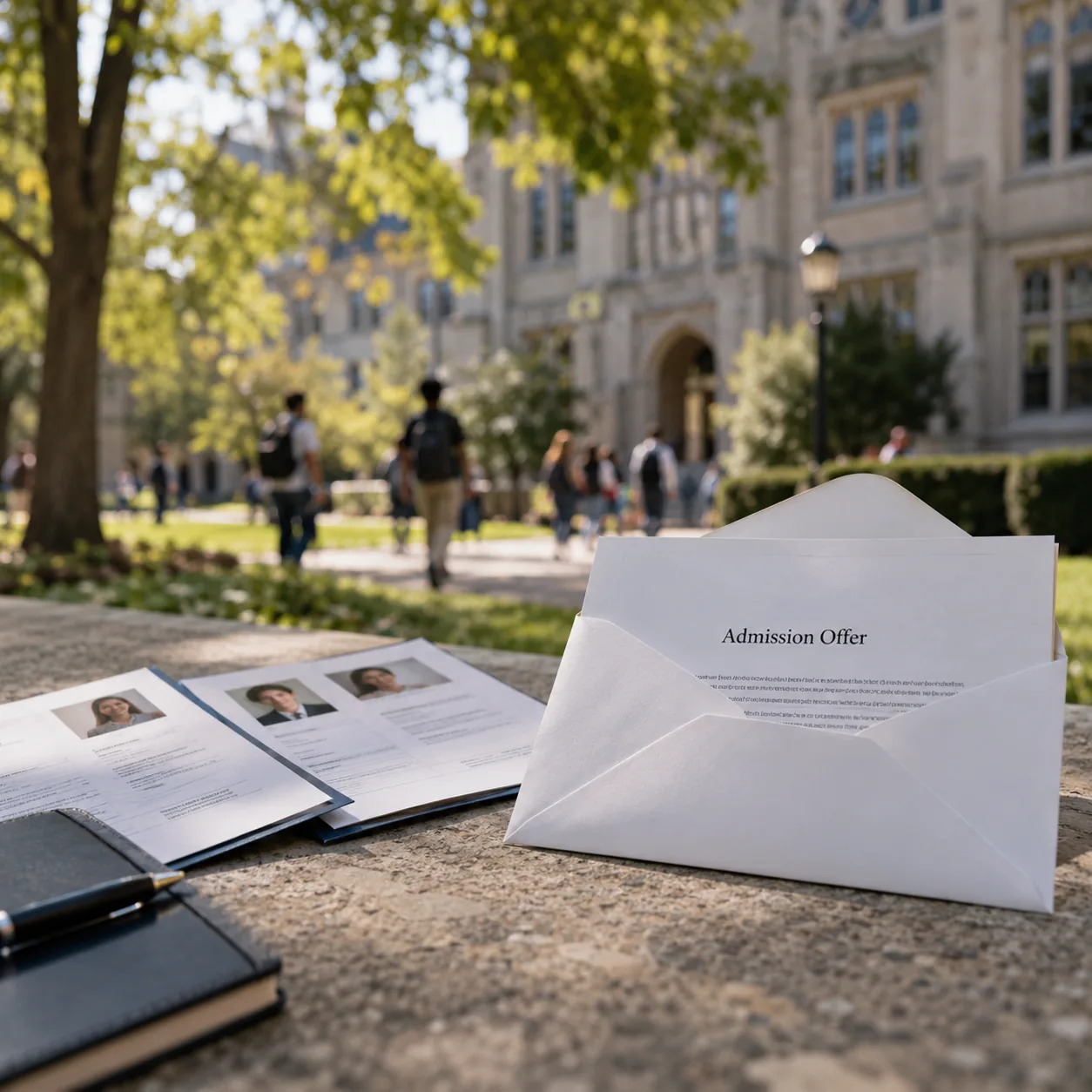
A growing number of American students now open their email in the autumn of senior year, or earlier, and find a college admission offer they never applied for. In the 2026-27 cycle, 234 colleges are sending proactive offers through Common App's Direct Admissions programme, Niche reports that more than 1.19 million students received at least one acceptance and scholarship offer through its platform for Fall 2026 entry, and 17 US states operate direct admissions policies or programmes of their own.
This article explains what direct admissions in colleges actually is, how the main programmes work, how it differs from automatic, rolling, early and open admissions, what the independent evidence says about applications and enrolment, and what it changes operationally for admissions teams. It is written primarily for higher education professionals, but it also answers the questions students and families ask when an unexpected offer arrives.
What is direct admissions in college?
Direct admissions is an admissions model in which a college proactively identifies students who meet predetermined criteria, using data that already exists, and offers or guarantees them admission before they complete the traditional application process.
The Education Commission of the States defines direct admissions as policies that proactively notify or admit students to one or more public postsecondary institutions based on predetermined criteria. The same logic applies to platform programmes run by Common App and Niche and to institutions running their own schemes.
Most direct admissions programmes share a common set of components:
- Predetermined eligibility criteria: typically GPA, sometimes coursework, class rank, residency or geography.
- Existing student data: a platform profile, a school record or a state data system, rather than a new application.
- Proactive identification: the institution or programme finds the student, not the other way around.
- An admission offer or guarantee, communicated before the student has applied in the traditional sense.
- Reduced application friction: usually waived fees, often waived essays and recommendations.
- Subsequent verification and enrolment steps, because an offer based on preliminary data still needs confirming before a student registers.
What direct admissions is not: it is not simply "easier admissions", and it is not one universal process. The phrase describes who initiates the admission decision and when; the workflow that follows the offer varies substantially from programme to programme.
How does direct admissions work?
Traditional admissions puts the burden of initiation on the student: research, application, documents, fee or waiver, submission, then waiting while the college reviews and decides. Direct admissions reverses that sequence. In general terms:
- The institution or programme has access to qualifying information about students, from a platform profile, participating high schools or a state data system.
- It applies predetermined eligibility criteria, most commonly a GPA threshold, sometimes combined with coursework, residency or programme rules.
- Eligible students are identified, often on a rolling or weekly basis.
- The student receives a proactive offer of admission, typically by email and through a platform dashboard or letter.
- The student decides whether to engage.
- Information is verified and any remaining steps are completed: a simplified application, a claim form or a final transcript, depending on the programme.
- The student accepts, pays any deposit, and enrols.
The exact steps vary by programme, and that variation matters. The table below summarises both sides of the process.
How a direct admissions offer moves from eligibility to enrolment
| Stage | Student experience | College operation |
|---|---|---|
| Eligibility | Provides or authorises data (profile, GPA, school records) | Defines criteria: GPA, coursework, geography, programmes |
| Match | Nothing to do; matching is automatic | Runs rule-based matching against the data source |
| Offer | Receives offer by email, dashboard or letter | Issues offer with terms, conditions, perks and deadlines |
| Engagement | Researches the institution, weighs options | Runs post-offer communications and information campaigns |
| Verification | Submits application or claim form, transcript, documents | Verifies self-reported data against official records |
| Enrolment | Accepts, arranges aid, deposits, registers | Confirms admission, tracks acceptance, deposit and melt |
Do students still have to apply?
This is the most misunderstood aspect of direct admissions. "Get into college without applying" is an attractive summary, but incomplete. Direct admission describes the proactive admissions decision, not one universal application workflow; what follows the offer depends entirely on the programme. Three current models illustrate the range:
Niche Direct Admissions issues acceptances based on the student's Niche Profile. Each participating college sets its own acceptance and scholarship criteria, Niche matches profiles against them, and qualifying students see offers on their dashboard without submitting a traditional application first. Students then complete the college's next steps and receive official acceptance details before enrolling.
Common App Direct Admissions works differently. Students complete key education and family information in Common App, including GPA, citizenship, fee-waiver eligibility and parental education, and participating colleges use eligible profile information to determine whether the student meets their stated direct-admissions criteria. If a student wants to act on an offer, they still submit their Common App to that institution: the fee is waived, the application is non-binding, and the college verifies the information against official documents such as transcripts before confirming the admission.
Direct Admit Wisconsin, a state-system programme, genuinely removes the traditional application. Participating high schools provide academic records, the Universities of Wisconsin review them at the end of junior year, and eligible students receive offers without submitting the standard application. Students complete a short Direct Admit form to connect with the universities that admitted them, and offers remain conditional on graduating, completing required coursework and submitting a final transcript.
So the honest answer to "do I still have to apply?" is: sometimes yes, in a simplified form; sometimes no, but the offer must still be claimed and the record verified. Students should read the instructions attached to their specific offer.
Direct admissions vs traditional college admissions
The clearest way to see the difference is as a reversal of who moves first. In traditional admissions, the admission decision is the last step in a student-initiated process: research, application, fee or waiver, review, decision. In direct admissions, the institution applies its criteria to existing data and sends an offer before any application exists, so the student's first decision is not "should I apply?" but "should I engage with this offer?".
That reversal changes the psychology as much as the process. A traditional applicant has invested hours in research and forms by the time a decision arrives; a direct-admit student may know almost nothing about the institution that has just admitted them. Both facts matter later in this article.
Direct admissions vs automatic, rolling and early admissions
Direct admissions overlaps in everyday language with several other admissions terms, but the distinctions are real and practically important.
Direct admissions vs automatic or guaranteed admission
Under a guaranteed or automatic admission policy, any student who satisfies published criteria is assured admission, but typically still has to apply, submit documentation and meet deadlines. The institution promises the outcome; the student still initiates the process.
Wisconsin runs both models side by side. Under The Wisconsin Guarantee, students in the top 5% of their class are guaranteed admission to UW-Madison, and students in the top 10% to other Universities of Wisconsin, but they must still complete a traditional application. Direct Admit Wisconsin, by contrast, proactively sends offers based on junior-year records and removes the traditional application entirely. Same state system, two different mechanisms, never to be conflated.
Direct admissions vs rolling admission
Rolling admission means the college reviews completed applications continuously as they arrive rather than against a fixed decision date; the student still applies first. Direct admissions means the institution initiates the offer before any normal application review. A college can operate both at once: rolling review for traditional applicants and proactive offers for a direct-admit population.
Direct admissions vs early action
In early action, the student applies by an early deadline and a non-binding decision arrives early; the sequence is still student-initiated. In direct admissions, the institution identifies the student first, and no traditional application may be required before the initial offer.
Direct admissions vs early decision
Early decision is student-initiated, early, and binding, subject to the institution's stated financial and other terms. Direct admissions offers are generally institution-initiated and non-binding: Common App explicitly describes its offers as non-binding, and students are not required to enrol if they apply. Programmes differ, so students should verify the terms of each individual offer rather than assume every scheme is legally identical.
Direct admissions vs open admission
Open admission means an institution admits most or all applicants who meet basic requirements, but the student still generally initiates the application. Selectivity and application initiation are different dimensions: an open-access college can run direct admissions, and so can a moderately selective one.
Direct admissions vs likely letters
A likely letter tells a candidate who has already applied that formal admission is highly probable. A direct admission offer represents an actual or conditional admission pathway based on predetermined criteria, usually before any application. The precise administrative status of each depends on the programme.
Direct admissions vs conditional admission
Conditional admission can exist inside or outside direct admissions. Many direct admissions offers are genuine admission subject to clearly stated conditions: completing high school, maintaining grades, submitting a final transcript, meeting programme prerequisites or, for some populations, an English-language requirement. A direct admission offer is best read as real admission with stated verification steps, not necessarily unconditional admission.
Direct admissions vs other college admissions pathways
| Admissions pathway | Who initiates? | Application required? | Decision timing | Binding? |
|---|---|---|---|---|
| Direct admissions | Institution or programme | Varies: none, simplified, or claim form | Before the student applies | Generally no; check the offer terms |
| Traditional admissions | Student | Yes | After review of a full application | No |
| Rolling admissions | Student | Yes | Continuous, as applications complete | No |
| Early action | Student | Yes, by early deadline | Early in the cycle | No |
| Early decision | Student | Yes, by early deadline | Early in the cycle | Yes, subject to stated terms |
| Open admissions | Student | Yes, usually minimal | Quick, criteria-based | No |
| Automatic/guaranteed admission | Student, with a published guarantee | Usually yes | After the student applies | No |
Who qualifies for direct admissions?
Eligibility is defined by each institution, programme or statute, and it is where programmes differ most. Colleges in Common App Direct Admissions establish their own GPA requirements, programme eligibility, geographic criteria where applicable, offer periods, perks and conditions, and Common App additionally targets first-generation and low- and middle-income students. Niche partners each configure their own acceptance and scholarship criteria. State programmes set thresholds in statute or policy: Illinois' One Click College Admit admits on GPA alone, while Direct Admit Wisconsin reviews GPA and required coursework.
The data mechanism behind direct admissions
Direct admissions only works if the institution or programme has enough reliable information to determine eligibility before the traditional application. Depending on the scheme, that data may include platform profiles, self-reported GPA, coursework, class rank, residency and geography, school-provided records, state education records, fee-waiver eligibility, first-generation indicators or programme interests. Different schemes use different fields; no programme uses all of them.
The data source shapes the programme. Common App matches against self-reported profile information; Direct Admit Wisconsin relies on records provided by participating high schools. Connecticut's CAAP originally required counsellor-calculated class rank, which proved a serious bottleneck; when eligibility moved to self-reported GPA, the number of students receiving offers rose from 2,706 to 19,393 in a single year, according to Common App's evaluation. Eligibility design and data plumbing determine reach.
Why offers still need verification
An offer generated from self-reported or preliminary data is real, but it is not the end of the record-keeping. Before final enrolment, institutions typically still need an official transcript, confirmation of graduation, identity and residency checks, programme prerequisites, financial documentation and, where relevant, English proficiency. Common App is explicit that colleges verify application information against official documents before confirming admission, and that self-reported information should match the school record.
Direct admissions removes unnecessary uncertainty and application friction. It does not remove the institution's need for accurate records. Weak data quality at the offer stage simply becomes a verification problem at the enrolment stage.
Direct admissions is not autonomous AI admissions
It is worth stating plainly, because the two ideas are increasingly discussed in the same breath: direct admissions is not an AI decision model. Most programmes are built from predetermined eligibility criteria applied to existing data through automated matching. A rule such as "GPA at or above threshold, in an eligible geography, for an eligible programme, generates an offer" is deterministic: it can be written, audited and reproduced without machine learning. A platform may use AI elsewhere in recruitment or communications, but the admission decision itself does not require AI, and describing rule-based matching as AI muddies both governance and vendor evaluation.
Examples of direct admissions programmes
Common App Direct Admissions
Common App's programme extends proactive admission offers from participating member institutions to first-generation and low- and middle-income students, based on information students have entered into their Common App. For 2026-27, 234 institutions across 42 states and Washington, DC are participating, with offers beginning in mid-September. In the completed 2025-26 admissions year, Common App reports that 240 participating colleges offered admission to more than 800,000 students. After receiving an offer, 25% of students applied to at least one college they had not already been considering, up from 17% the year before, and 32% applied to at least one institution that sent them an offer. All of these figures are Common App programme data.
The student flow is consistent: complete the key profile questions (education, family information, GPA, citizenship, fee-waiver eligibility and parental education); offers appear in the Direct Admissions section of the account and by email; if interested, the student submits their Common App to that college by its deadline with the fee waived; the college verifies the information and confirms the admission. Offers are non-binding, and participating colleges may add perks such as waived essays, waived recommendations or guaranteed financial aid, which vary by institution and should never be assumed.
Niche Direct Admissions
Niche Direct Admissions allows high school seniors to receive real-time acceptance and scholarship offers based on their Niche Profile. Each participating institution sets its own criteria, Niche matches profiles against them, and qualifying students see offers immediately on their dashboard. The colleges, not Niche, make the acceptance.
For the 2026-27 admissions cycle, its sixth, Niche reports that more than 160 colleges across 36 states and Washington, DC are using Niche Direct Admissions. For students seeking Fall 2026 entry, Niche reports that more than 1.19 million students received at least one acceptance and scholarship offer, with an average annual scholarship of approximately $17,500. Niche also reports that the median partner sourced 14% of first-year deposits through the programme, and estimates that the programme sourced approximately $254 million in first-year net tuition revenue across 152 participating partners for Fall 2026.
Treat all of these as Niche-reported programme and partner metrics, not independent evidence. In particular: 1.19 million students received offers, which is not 1.19 million enrolments; $17,500 is an average scholarship offer figure, not actual aid accepted, not net price, and not an average scholarship across US colleges; 14% is a median share of first-year deposits, not of all enrolments or applicants; and $254 million is Niche's estimate of first-year net tuition revenue, not an audited figure.
Statewide direct admissions
Direct admissions is no longer only a platform product. According to the Education Commission of the States' April 2026 50-State Comparison of statewide admissions policies, 17 states have direct admissions policies or programmes for high school students who meet defined criteria, established in statute, board or system policy, or through agency-led statewide initiatives. Designs vary: Idaho pioneered the model in 2015 by proactively admitting high school graduates to a set of public institutions, and Illinois launched One Click College Admit in 2025, admitting students to participating public universities on GPA alone.
Some states build their programmes on third-party infrastructure. The Connecticut Automatic Admission Program (CAAP) is delivered in partnership with Common App: eligible Connecticut seniors with a 2.75 unweighted or 3.0 weighted GPA receive offers from participating institutions through their Common App account, and Illinois likewise uses Common App as the delivery channel. A state or system can own the policy while a platform provides the pipes.
Direct Admit Wisconsin
Direct Admit Wisconsin is one of the clearest examples of a genuine no-traditional-application model. Participating high schools and the Universities of Wisconsin use junior-year course and GPA records for opted-in students to identify who is eligible, and eligible students receive proactive offers without submitting the standard admission application. Students complete a Direct Admit form to indicate interest and connect with the universities that admitted them, and offers are conditional on completing required coursework, maintaining the required GPA, graduating and submitting a final transcript.
For the high school Class of 2027, 10 of the 13 Universities of Wisconsin participate; UW-Madison, UW-La Crosse and UW-Eau Claire do not, and UW-Eau Claire joins for the Class of 2028. Neither Direct Admit Wisconsin nor The Wisconsin Guarantee guarantees admission to a specific major or programme within a university.
Why colleges are adopting direct admissions
The policy rationale starts from a simple observation: the traditional admissions process contains friction that suppresses applications from students who would qualify. Students may underestimate whether they would get in; fees discourage multiple applications; essays and recommendations create work; students may not know which colleges are relevant to them; and uncertainty weighs most heavily on first-generation and lower-income applicants, who have the least insider knowledge of the process.
A direct admission offer changes the starting point: it tells an eligible student, in effect, you already meet our criteria and you are wanted. Common App deliberately targets its programme at first-generation and low- and middle-income students, and its Connecticut evaluation found those students were twice as likely to respond to an offer as their peers. That is a rationale and an engagement signal, not a guaranteed outcome, and not every programme has an explicit equity target.
For institutions, there is a second, equally honest motive: recruitment. Direct admissions is simultaneously an admissions pathway, because it changes how eligibility and admission occur, and an acquisition channel, because it puts the institution in front of students who were not already considering it. Common App's 2025-26 data supports the channel framing: 25% of offer recipients applied to at least one college they had not previously been considering, while 32% applied to at least one institution that sent them an offer. Both are Common App programme metrics, not independent causal evidence. What matters is evaluating the channel honestly, which is the subject of the next section.
Does direct admissions actually increase enrolment?
Growth in offers and participating institutions is not the same as enrolment impact. To evaluate direct admissions properly, keep applications, engagement, yield and actual enrolment separate. The independent evidence is more nuanced than the programme marketing.
What the experimental research shows
The strongest causal evidence comes from Taylor Odle (University of Wisconsin-Madison) and Jennifer Delaney (University of Illinois), who ran a large randomised experiment with Common App and six universities across four states, covering nearly 32,000 students. Students assigned to receive a direct admissions offer, with tailored information, a simplified application and an automatic fee waiver, were 2.7 percentage points more likely to submit a college application, a roughly 12% relative increase, with larger effects among racially minoritised, first-generation and low-income students. They were not, however, more likely to ultimately enrol: the study found no statistically significant increase in eventual college enrolment.
The authors' conclusion is the one every enrolment leader should internalise: these low-cost, low-touch interventions can move the needle on college-going behaviours but are insufficient alone to increase enrolment, given other barriers including the ability to pay. Direct admissions removes application friction; an offer alone does not solve affordability, institutional fit, communication or yield.
The Idaho evidence
Statewide results can look different. Odle and Delaney's earlier study of Idaho, the first state to adopt direct admissions in 2015, found early evidence that the policy increased first-time undergraduate enrolments by 4-8% (roughly 50-100 students per campus) and in-state enrolment by approximately 8-15%, with gains concentrated among two-year, open-access institutions, but minimal-to-no impact on the enrolment of Pell-eligible students, which the authors relate to the programme offering admission without accompanying financial aid.
Idaho shows that design and context matter: a statewide, universal scheme feeding open-access institutions produced measurable enrolment gains in particular sectors, while affordability remained a barrier for the lowest-income students. Its results should not be generalised to every programme or state.
The Connecticut evidence and the denominator problem
Common App's December 2025 evaluation of CAAP adds an operational layer. Among the 19,393 Connecticut students who received a CAAP offer in 2024-25, 46% applied to at least one offering institution. Common App notes that it does not systematically observe where students ultimately enrol, but CSCU data indicated that, for the four participating public institutions, approximately 13% of applications from CAAP offer recipients resulted in enrolment the following fall. Common App members also anecdotally report lower average enrolment rates for direct admissions applicants than for traditional applicants.
A lower yield percentage is not evidence that direct admissions fails. It reflects a denominator problem: proactive offers dramatically expand the pool of admitted students, including many who had never seriously considered the institution. Some of those students engage, apply and enrol, each potentially an incremental enrolment the institution would not otherwise have won, so percentage yield can fall even if the programme generates additional enrolled students. An institution sending 100,000 proactive offers should not judge the channel by the yield expectations of 5,000 self-selected applicants.
Why application gains do not automatically become enrolment gains
Across the evidence reviewed here, direct admissions can meaningfully increase application and engagement behaviour, particularly among first-generation and lower-income students, though effects vary by programme design and context. Converting those gains into enrolment depends on what happens after the offer: affordability, familiarity with the institution, communication quality, verification friction and distance. Common App's Connecticut data illustrates the levers: students within 15 miles of an offering institution applied in response to 14% of offers, against 5% beyond 60 miles, and October offers drew an 8% response against 3% for May. Proximity, timing and follow-through move outcomes; the offer alone does not.
The balanced conclusion: direct admissions should be evaluated as an admissions and recruitment intervention, with its own funnel and its own economics, not treated as an automatic enrolment-growth mechanism.
The new direct admissions funnel
Direct admissions reshapes the funnel itself. The traditional sequence runs prospect, applicant, admit, enrol; a direct admissions channel runs eligible student, admit, engage, verify, accept, enrol. Admission moves from near the end of the funnel to near the beginning, and everything the institution used to learn about a student during the application now has to happen after the offer.
That means the channel needs its own measurement, not borrowed benchmarks. Relevant metrics include offers issued, offers engaged with, next steps taken, applications or claim forms completed where required, verification completion, acceptances, deposits, enrolments, incremental enrolment attributable to the channel, net tuition revenue where appropriate, cost per enrolled direct-admit student, programme fit and melt. There are no established sector benchmarks for most of these yet, so measure honestly for a cycle and set baselines from real data rather than inventing targets.
What direct admissions changes for admissions teams
The post-offer information gap
Receiving an offer is only the start. A traditional applicant has usually researched the college, chosen a programme and invested hours in an application; a direct-admit student may know very little about the institution that has just admitted them. Common App's Connecticut evaluation surfaced exactly this: students reported being unfamiliar with direct admissions, confused by the ensuing process, and daunted by researching institutions they did not know, while some who applied heard little from the institution afterwards.
The post-offer journey therefore has to answer, quickly and clearly: Why this institution? Why this programme? What will it cost, and what aid is available? What are the next steps, which documents are needed, and by when? Can I visit or speak to someone? What happens after I accept? Institutions that treat the offer as the finish line will admit thousands and enrol few.
Friction moves downstream
Removing the application does not remove all friction; it relocates it. Effort that used to sit in application completion reappears in offer engagement, verification, financial aid, transcript collection, programme selection, deposits and registration. The design task is the whole direct-admit journey, not the offer-generation step, and one principle is worth applying ruthlessly at the verification stage: ask only for what is still required. If a direct-admitted student must complete a 40-question conventional application, upload irrelevant materials and re-enter data the institution already holds, much of the benefit of direct admission has been destroyed.
Affordability can remain a binding constraint
Affordability can remain one of the deciding factors after admission uncertainty is removed, and the experimental evidence shows why application gains do not necessarily become enrolment gains. Some Niche offers include scholarships and some Common App institutions guarantee aid, but many offers include no aid at all. A scholarship headline is not a net price, FAFSA and/or institutional financial-aid processes may still be required depending on the student and institution, and students need total cost of attendance, not a single number. Direct admissions does not solve college affordability, and admissions and financial aid must not operate as disconnected processes for this population.
The risks and trade-offs
A balanced assessment should weigh the following, none of which is an argument for or against direct admissions universally:
- Lower apparent yield. The offer pool is broader and less self-selected, so percentage yield can be lower even when the programme generates additional enrolled students. Report the channel separately.
- Weak student awareness. Offers arrive from institutions students may not know, so conversion depends on post-offer communication.
- Offer fatigue. Students can receive many proactive offers across platforms and states; an undifferentiated offer is easy to ignore.
- Data quality. Incorrect or incomplete profile data creates verification failures and support workload later.
- Programme exclusions. Institutional admission does not necessarily include nursing, engineering, honours or other capacity-limited programmes; communicate this clearly.
- Capacity control. Where capacity is constrained, model offer volumes against what can be operationally supported.
- Financial-aid coordination. An admitted student without an affordability answer is unlikely to enrol.
- Communication workload. Large, initially low-intent offer populations overwhelm teams unless follow-up is automated and segmented.
How colleges can design a direct admissions workflow
Whether an institution joins Common App or Niche, joins a state programme or designs its own scheme, the operational stages are broadly the same.
1. Define eligibility
Set the criteria: GPA, coursework, geography, residency, student segments, and which programmes are included or excluded. Simpler criteria reach more students, as Connecticut's shift from class rank to self-reported GPA showed.
2. Define the offer
Specify exactly what is being offered: admission status, programme eligibility, any scholarship or aid, the conditions attached, and the deadline. Ambiguity here becomes distrust later.
3. Define the source data
Decide where eligibility data comes from, whether platform profiles, school records, state systems or the institution's own CRM data, and how accuracy will be handled.
4. Match eligible students
Matching rules must be transparent, reproducible and auditable. Deterministic rules are easier to defend to students, counsellors and regulators than opaque scoring.
5. Deliver the offer
Choose channels: Common App, Niche, a state portal, school systems, the institution's own CRM, or a combination. Timing also matters: in Common App's Connecticut evaluation, October offers generated a higher application response than May offers, although that should not be interpreted as a universal enrolment-conversion benchmark.
6. Verify
Collect and verify transcripts, graduation, programme requirements and remaining documentation, requesting only what has not already been provided.
7. Convert
Run the post-offer campaign: segmented communications, aid explanation, programme and campus content, counselling access, events and reminders, tuned to a population that mostly does not yet know the institution.
8. Enrol
Track acceptance, deposit, registration, melt and final enrolment, and feed the results into next cycle's eligibility, offer and communication design.
What happens after a direct admissions offer?
For students, a direct admission offer is usually genuine, but it deserves a careful read. Sensible checks: Is this a real admission offer or an invitation to apply? Is it conditional, and on what? Which programme does it cover, and which does it exclude? Is a scholarship actually guaranteed, and what is the realistic net cost? Do I still need to submit an application or claim form, and by when? Which documents still need verification? Is the offer binding? What happens if my final grades change?
Students should verify any unexpected offer through official channels, such as their Common App or Niche account, the official state programme site, or the institution's admissions office, rather than links in an unsolicited message; that habit both confirms genuine offers and protects against scams. For institutions, the mirror-image obligation is to make the post-offer path effortless to understand: what the offer means, what remains to be done, what it costs, and who to talk to.
How technology supports direct admissions after the offer
A mature direct admissions workflow usually spans several systems: a student-data source, a matching platform, a CRM, admissions management, an application or verification portal, communications, financial aid, payments, an SIS and analytics. The biggest operational risk is allowing direct-admit students to become a disconnected parallel population, managed in spreadsheets alongside the platform that generated the offers. Once a student engages with an offer, they should enter the institution's normal lifecycle: one record, one communication history, one view of outstanding requirements, one funnel report.
How Full Fabric fits into a direct admissions workflow
Full Fabric does not run a direct admissions marketplace. It does not power Common App or Niche Direct Admissions, does not hold national high-school transcript datasets, and does not autonomously admit students. Offer generation happens on those platforms or through state systems, under criteria each institution configures.
Full Fabric becomes relevant at the point a direct-admit prospect enters the institution's own operational workflow, because direct admissions changes who initiates the relationship, not what the institution must do next. Once a student engages with an offer, the institution still needs the same operational backbone: one connected record, verification, communications, offer management, financial steps, enrolment and reporting. That downstream lifecycle is what Full Fabric, a purpose-built higher education admissions and enrolment platform, is designed to support:
- One connected record. Enquiries, applications, documents, communications, decisions and payments sit against a single person record, so an engaged direct-admit student is not managed in a side spreadsheet.
- Configurable, programme-specific forms. Application forms in the online application portal are built with a no-code editor, and candidates can be sent straight to the relevant form through custom URLs, so institutions can configure a shorter, programme-specific application or verification journey where their process permits it, asking only for what is still required.
- Admissions workflows and automation. Status changes, notifications, document chasing, reminders and communications can be automated, which matters when the offer population is large and initially low-intent.
- Offers, conditions and payments. Offer letters can be generated from applicant data, acceptance workflows configured, files uploaded against conditions, and application fees, deposits and payment plans handled in the same system.
- Enrolment continuity and reporting. Admissions connects through to enrolment and the student record, and because reporting can segment the lifecycle using captured applicant and source data, institutions that identify direct-admit students through an appropriate source, tag, route or configured field can keep their offer, acceptance and enrolment performance visible rather than hidden in a blended yield figure.
The honest boundary: Full Fabric supports the operational journey from engaged offer to enrolled student. It does not generate the proactive offers, and no software guarantees more applications, higher yield or more enrolments; those depend on programme design, aid and follow-through.
Frequently asked questions
What is direct admission in college?
Direct admission is when a college proactively identifies students who meet predetermined criteria, such as a GPA threshold, using existing data, and offers them admission before they complete the traditional application process.
How does direct admission work?
The institution or programme sets eligibility criteria, matches them against existing data such as a platform profile or school records, and sends offers to qualifying students by email, dashboard or letter. The student engages with the offer, completes any remaining steps, has their information verified, and can accept and enrol.
Do you have to apply if you receive direct admission?
It depends on the programme. Common App still requires a submitted application with the fee waived; Niche issues acceptances before a traditional application, with next steps afterwards; Direct Admit Wisconsin removes the traditional application but requires a short Direct Admit form and a final transcript. Read the instructions attached to the specific offer.
Is direct admission guaranteed?
Often yes, subject to the programme's stated verification and conditions, such as graduating, maintaining the qualifying GPA and submitting a final transcript. Students should read the specific offer and confirm the terms in their official account or with the institution.
Is direct admission binding?
Generally no. Common App explicitly describes its offers as non-binding, Niche offers do not require commitment, and state programmes leave students free to consider other options, but students should still check the terms of the individual programme and institution.
Is direct admission the same as automatic or guaranteed admission?
Not quite. Guaranteed admission promises an outcome to students who meet published criteria but usually still requires them to apply; direct admission means the institution proactively contacts or admits the student, often with no traditional application. The Wisconsin Guarantee and Direct Admit Wisconsin illustrate the difference within one system.
Is direct admission the same as rolling admission?
No. Rolling admission is continuous review of student-initiated applications. Direct admission is an institution-initiated offer made before a normal application review. A college can operate both.
Do direct admission offers include scholarships?
Sometimes. Niche offers pair acceptance with a scholarship figure, and some Common App institutions guarantee aid or other perks, but many offers include no aid. A scholarship headline is not a net price, and aid applications such as the FAFSA may still be required, depending on the student and institution.
Can you still apply to other colleges after receiving direct admission?
Yes. Offers are generally non-binding, so students can keep applying elsewhere and compare options, costs and aid before deciding.
Does direct admission guarantee admission to a specific major?
Not necessarily. Direct Admit Wisconsin, for example, provides admission to the university, not to a specific major, and competitive programmes such as nursing or engineering may be excluded or subject to separate requirements at many institutions. Check programme eligibility in the offer.
Does direct admissions increase college enrolment?
The evidence is mixed. A randomised experiment by Odle and Delaney found offers increased applications by 2.7 percentage points (about 12%) with no statistically significant increase in enrolment, while Idaho's statewide programme was associated with 4-8% growth in first-time undergraduate enrolment, concentrated at open-access institutions. Outcomes depend on design, affordability and post-offer follow-through.
Related Full Fabric reading
- Enrollment Yield: What It Is & How to Improve It
- 10 Strategies to Maximise the Effectiveness of the Admissions Funnel
- 10 Best Student Enrollment Management Systems
- Admissions and Enrolments Software
- Enrollment Management Software for Higher Education
Further reading and sources
Direct admissions programmes
- Common App, Direct admissions expands in 2026-27 with 234 participating institutions (August 2026)
- Common App, Common App Direct Admissions (student overview)
- Common App, Understanding Common App Direct Admissions (student resource)
- Niche, How Niche Direct Admissions really works: six things enrolment leaders should know (August 2026)
- Niche, Direct Admissions overview and FAQ
- Education Commission of the States, 50-State Comparison: Statewide Admissions Policies (April 2026)
- Universities of Wisconsin, Direct Admit Wisconsin
Research and evidence
- Odle, T. and Delaney, J., Experimental Evidence on "Direct Admissions" from Four States, EdWorkingPaper 23-834, Annenberg Institute at Brown University (2025)
- Odle, T. and Delaney, J., You are Admitted! Early Evidence on Enrollment from Idaho's Direct Admissions System, Research in Higher Education 63, 899-932 (2022)
- Common App, Expanding postsecondary access through statewide direct admissions (CAAP report) (December 2025)

