

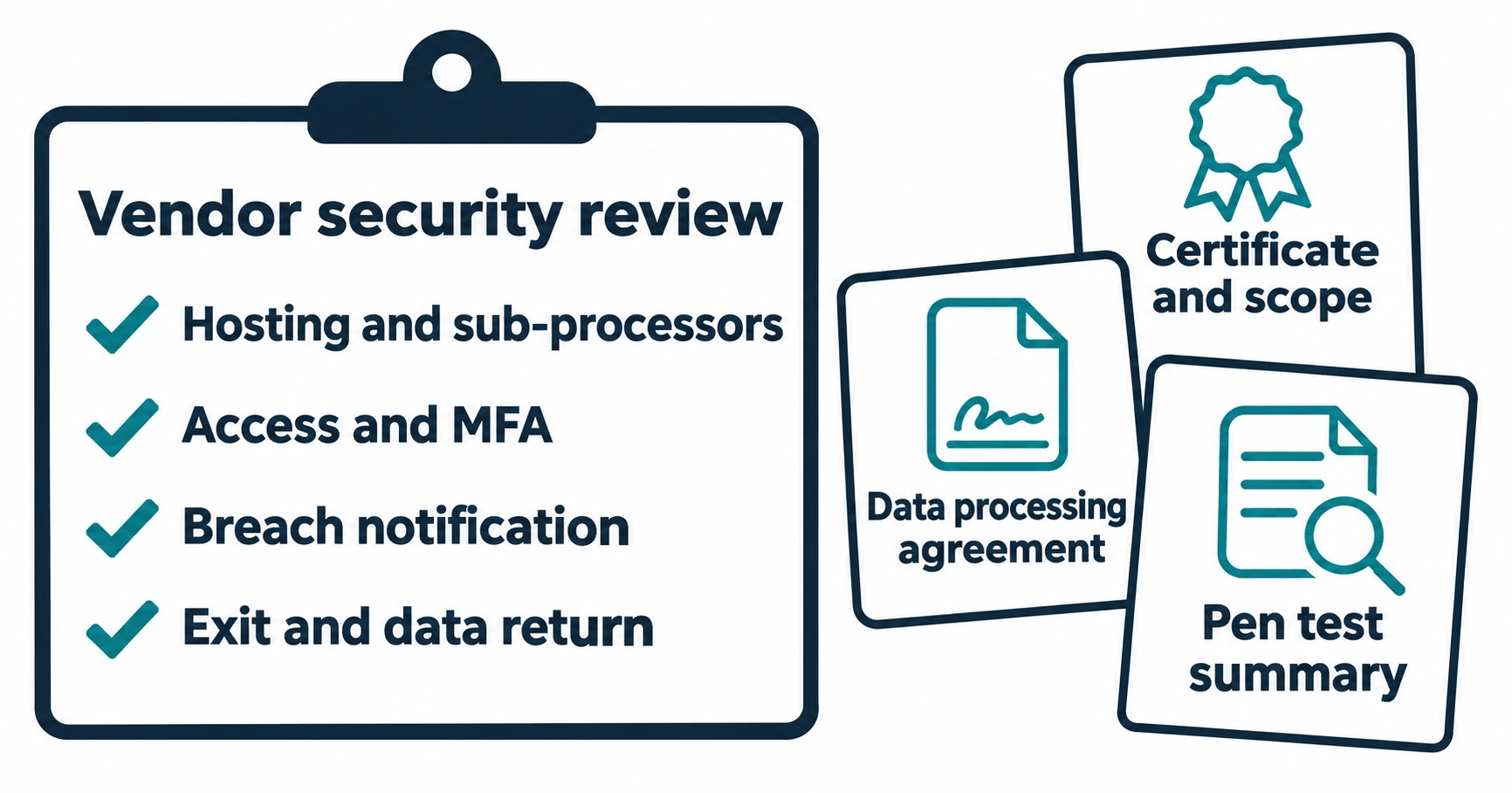
In a security review of an admissions software vendor, a university IT team should ask questions in ten areas and request evidence for each answer: certifications and their scope; hosting, international transfers and sub-processors; the data processing contract; identity and access; encryption and customer separation; testing and vulnerability handling; logging and audit; incident notification; resilience during admissions peaks; and AI features and exit. The questions are the easy part. The value of the review lies in the evidence you ask for, in checking that a certificate actually covers the service you are buying, and in testing what happens at the moments that matter most for admissions: a deadline day, a breach, and the end of the contract.
Transparency note: Full Fabric sells admissions, CRM and student records software and publishes this article. The checklist is vendor-neutral and built on UK and EU guidance from the NCSC, UK GDPR and the EU AI Act. The section on how Full Fabric answers these questions uses only what Full Fabric has published on its security pages and changelog as of November 2026. Where we do not publish something, we say so.
Admissions software is often reviewed as "just another SaaS tool". It is not, for four reasons.
None of this needs a different method from any other supplier review. It changes where you look hardest.
The UK National Cyber Security Centre's supplier assurance questions and its 14 cloud security principles are the best starting points for UK institutions, and the areas below map onto them. For each area we give the questions, the evidence that should back the answer, and the red flags.
Ask:
Evidence: the certificate itself and its scope statement, not a logo on a web page.
Red flags: a certificate whose scope covers only a head office, a data centre provider or a different product; a certificate under ISO/IEC 27001:2013, as the transition to the 2022 edition ended on 31 October 2025.
The NCSC's questions ask directly whether the scope of a certification covers the parts of the service you will be using. That question does more work than any other in the review. Note also the difference between the two Cyber Essentials levels: the NCSC describes Cyber Essentials Plus as the same protections with independent, hands-on technical testing, which the basic level does not include. If a vendor is US-based, it may offer a SOC 2 report instead of ISO certification; ask what period it covers and which services, in the same way.
Ask:
Evidence: the sub-processor list (usually an annex to the DPA) and the hosting locations in writing.
Red flags: "hosted in the EU" with no list of sub-processors; support or AI services outside the UK or EU that are not disclosed.
A transfer of personal data outside the UK is a restricted transfer under UK GDPR. It needs UK adequacy regulations, an appropriate safeguard or an exception (Chapter V and Article 46). The safeguards differ by regime: for UK GDPR transfers, the UK's standard clauses are the International Data Transfer Agreement (IDTA) and the UK Addendum to the European Commission's Standard Contractual Clauses; the EU SCCs on their own cover EU GDPR transfers. Ask the vendor to document, for each sub-processor outside the UK or EU, which regime applies and which mechanism it relies on. "Our data stays in the EU" is rarely the whole story for a modern SaaS product: email delivery, support tooling and AI models are often provided from elsewhere.
Ask:
Evidence: the vendor's standard DPA, compared against Article 28 of UK GDPR.
Article 28(3) requires, among other things, that the processor acts only on documented instructions, keeps staff bound by confidentiality, applies appropriate security, uses sub-processors only with your authorisation, helps you meet data subject rights and your security, breach and DPIA obligations, deletes or returns the data at the end of the service, and makes information available for audits. A DPA that is silent on any of these is a negotiation point, not a formality. Since 30 September 2026, the UK regulator that enforces these rules has been the Information Commission, which took over the functions of the Information Commissioner's Office (ICO).
Ask:
Evidence: a demonstration in a test environment, the permission model, and the admin settings for MFA and session expiry.
Red flags: MFA that cannot be enforced; shared admin accounts; API keys tied to an individual user's account; no way to restrict what an integration can reach.
This maps to NCSC principles 9 and 10 (secure user management, identity and authentication). For admissions, the applicant side deserves its own question: a compromised applicant account can expose identity documents just as a staff account can.
Ask:
Evidence: architecture documentation and the relevant controls in the certification scope.
NCSC principle 3 (separation between customers) is the one most often answered with a slogan. Ask how separation is enforced and tested, not whether it exists.
Ask:
Evidence: a redacted penetration test summary, a vulnerability management policy and a public security contact.
Red flags: no independent testing; testing that excludes the public portal; no published way to report a vulnerability.
The OWASP Application Security Verification Standard (version 5.0, released May 2025) is a useful reference if your team wants to ask about specific application controls.
Ask:
Evidence: sample audit entries from a test environment.
NCSC principle 13 is "audit information and alerting for customers". Its point is that logs you cannot reach are of little use to you during an investigation.
Ask:
Evidence: the incident clause in the DPA and the incident response policy.
Under Article 33 of UK GDPR, a processor must notify the controller without undue delay after becoming aware of a personal data breach. The controller must notify the regulator without undue delay and, where feasible, within 72 hours of becoming aware of it, unless the breach is unlikely to result in a risk to people's rights and freedoms. The university's clock starts at its own awareness, not the vendor's, but prompt notice from the vendor is what gives the university time to assess the breach and respond. Push for a specific notification commitment in the DPA.
Ask:
Evidence: the SLA in the contract (not marketing copy), the business continuity and disaster recovery plans, and the date of the last restore test.
Red flags: availability figures that appear on the website but not in the contract; no tested restore.
Ask about AI:
Ask about exit:
Evidence: the AI section of the DPA and sub-processor list, and the exit or data portability terms.
Not every scoring or recommendation feature is high-risk under the EU AI Act. Classification depends on the system's intended purpose and the Article 6 criteria, and a feature that profiles applicants is always treated as high-risk. Ask the vendor how it has classified each AI feature and why, and if the Act may apply to your institution, review both the vendor's documentation and your own use before 2 December 2027.
Asking for documents first turns the meeting into a discussion of gaps rather than a reading of slides.
| Document | What it answers | What to check |
|---|---|---|
| Certificates (ISO/IEC 27001, Cyber Essentials Plus or equivalent) | Is there independent assurance? | Scope, issuer, expiry, edition |
| Data processing agreement | Are Article 28 terms covered? | Instructions, sub-processors, breach notice, deletion, audit |
| Sub-processor list and hosting locations | Where does data go? | Every country, every purpose, transfer mechanism |
| Penetration test executive summary | Is the service tested independently? | Date, scope (portal, app, API), open findings |
| Incident response policy | Will you hear about a breach in time? | Notification time, named contact |
| Business continuity and disaster recovery plans | Will admissions survive an outage? | RTO, RPO, date of last test |
| Contractual SLA | What is actually promised? | Availability figure, exclusions, credits |
| Completed security questionnaire | Consistent answers across all areas | Answers that contradict the documents |
| Exit and data portability terms | Can you leave with your data? | Access period, formats, cost, deletion confirmation |
Start from a standard questionnaire, then add admissions-specific questions. Many institutions use HECVAT, the Higher Education Community Vendor Assessment Toolkit maintained by EDUCAUSE. HECVAT 4, launched in February 2025, rolls the former Full, Lite and On-Prem versions into one file and adds new and updated privacy and AI questions. EDUCAUSE says vendors need to complete it only once a year and can share it with any institution, so ask whether a current one is available. UK institutions may prefer to build on the NCSC supplier assurance questions instead; the two overlap heavily.
Run a DPIA alongside it, not after it. Under Article 35 of UK GDPR, a data protection impact assessment is required before processing that is likely to result in a high risk. An admissions platform holding large volumes of applicant data, possibly including special category data, will often meet that test, and the vendor's answers are inputs to it.
Involve the right people. Information security owns the technical controls. The data protection officer owns the DPA, transfers and DPIA. Enterprise architecture owns identity and integrations. Admissions should explain peak periods and the outside parties who need access. Procurement and legal make sure the answers end up in the contract, because a promise in a questionnaire that is not in the contract is not a commitment.
Proportion the effort to the risk. Not every question carries the same weight. For an admissions platform, the questions that most often decide the outcome are certification scope, sub-processors and transfers, access control for staff and applicants, breach notification and exit.
For the functional side of data protection, such as consent, retention rules and subject access requests inside the CRM, see what a GDPR-compliant admissions CRM must do.
This section is Full Fabric describing itself, using only what it has published.
Certification. Full Fabric's information security management system is certified to ISO/IEC 27001:2022, covering the development, operation and provision of the Full Fabric platform. A copy of the certificate is available on request from compliance@fullfabric.com. Full Fabric does not publish a SOC 2 report.
Hosting and sub-processors. Customer data is hosted in the European Union on Amazon Web Services (AWS EMEA SARL), in Ireland and Germany, with backup storage in Sweden. A small number of sub-processors are based outside the EU, each with a transfer safeguard set out in the Data Processing Agreement; for example, Anthropic in the USA provides the AI models behind the optional AI features. Full Fabric acts as processor for the institution, and the DPA, including the list of sub-processors and hosting locations, is available to customers on request. The details are on Full Fabric's security and certifications page.
Access and authentication.
The dated entries are on the Full Fabric changelog.
Encryption, testing and development. Sensitive information is encrypted in transit with TLS 1.2 or higher, and data is encrypted at rest. Full Fabric works with third-party security experts and runs regular penetration tests and vulnerability assessments, and code changes go through automated and manual review before deployment. Vulnerabilities can be reported to compliance@fullfabric.com.
AI. AI features are disabled by default. Each institution decides whether to enable them and can restrict them to specific users through role-based permissions. Customer data is not used to train or improve AI models, and the AI provider keeps data sent for processing for up to 30 days, except where a longer period is required by law or to investigate misuse.
Exit. After the contract ends, the account remains available read-only for 30 days, with the API active, so the institution can export its data in CSV, JSON and ZIP formats at no additional charge for standard exports. What happens to production data and backups afterwards is set out on the GDPR, data hosting and data exit page.
What we have not published. Contractual availability terms, recovery objectives, penetration test summaries and completed security questionnaires are not on our website. Ask for them during procurement, and judge us on the answers as you would any other vendor. For how Full Fabric fits into an institution's architecture and integrations more broadly, see Full Fabric for higher education IT teams.
Ask about ten areas: certifications and their scope, hosting and sub-processors, the data processing agreement, authentication and access, encryption and customer separation, vulnerability testing, logging, breach notification, resilience during admissions peaks, and AI and exit. For each, request evidence rather than accepting a yes, and make sure the important commitments end up in the contract.
Well-run vendors test their service independently on a regular basis, fix findings to timescales set by severity, and publish a contact for reporting vulnerabilities. In a review, ask for the date and scope of the last penetration test, a summary of its findings and their status, the remediation timescales, and where a researcher would report a flaw. A vendor without a published reporting route is a warning sign.
No certificate is enough on its own. ISO/IEC 27001 shows that the vendor runs an audited information security management system, but you still need to check that its scope covers the service you are buying, and to review the areas a certificate does not settle for you: your DPA terms, sub-processors, breach notification time, availability commitments and exit.
Often, yes. UK GDPR requires a data protection impact assessment before processing that is likely to result in a high risk to individuals. Large-scale applicant data, possible special category data and any automated scoring all point that way. Your data protection officer makes the call; the vendor's security answers feed into it.
Either works as a base, and they overlap. HECVAT is common in higher education and many vendors have a completed copy ready. The NCSC questions fit UK public sector practice. Whichever you use, add questions specific to admissions: applicant account security, outside parties such as agents and referees, peak-period resilience and AI used on applications.
UK GDPR requires a processor to notify the controller without undue delay after becoming aware of a personal data breach. The controller must then notify the regulator without undue delay and, where feasible, within 72 hours of its own awareness, unless the breach is unlikely to result in a risk to individuals. Prompt notice from the vendor is what makes that window workable, so agree a specific notification time in the DPA rather than relying on the legal wording alone.
If you are preparing a security review of admissions software and want to put these questions to Full Fabric, we will work through them with your IT, security and data protection teams. Book a demo.

