Most colleges treat enrolment shortfalls as a marketing problem. Spend more on paid search, refresh the website, run another open day, buy another list. Sometimes that is the issue. More often, it is not.
The students were there. The enquiries came in. The applications opened. Somewhere between the first form fill and the start of term, a meaningful share of them quietly fell away — not because they chose a competitor, but because the process in front of them was slow, unclear, or hard to act on. A reminder that never went out. A document request buried in an inbox. A deposit page that broke on mobile. An offer letter that took eleven days to reach the candidate while a faster institution closed the deal in three.
This is the reality enrolment teams live with, and it is why enrollment management has emerged as a discipline in its own right. It is the work of coordinating recruitment, admissions, payments, enrolment, reporting, and student records into a single lifecycle — so that the institution knows where every applicant is, what they need next, and which interventions will actually protect yield. It is part strategy, part operations, and largely invisible to applicants when it is done well.
This guide is for the teams responsible for that work: heads of admissions, enrolment leaders, marketing and recruitment, operations, registrars, and the institutional leadership that depends on the numbers they produce.
Demand generation and enrollment management are often discussed as if they were the same job. They are not. Demand generation creates volume at the top of the funnel — awareness, enquiries, event registrations, application starts. Enrollment management is what happens to that volume once it arrives.
The distinction matters because more enquiries do not automatically translate into more enrolled students. A college that doubles its lead volume but cannot follow up within a working day, cannot tell applicants what to do next, and cannot move offers through committee in under a week will see most of that additional volume evaporate. The funnel is not leaking because the leads are bad. It is leaking because the operational layer underneath it cannot absorb them.
Conversion, speed, clarity, and coordination are the levers that turn demand into enrolled students. Each one is largely a function of process and systems rather than spend.
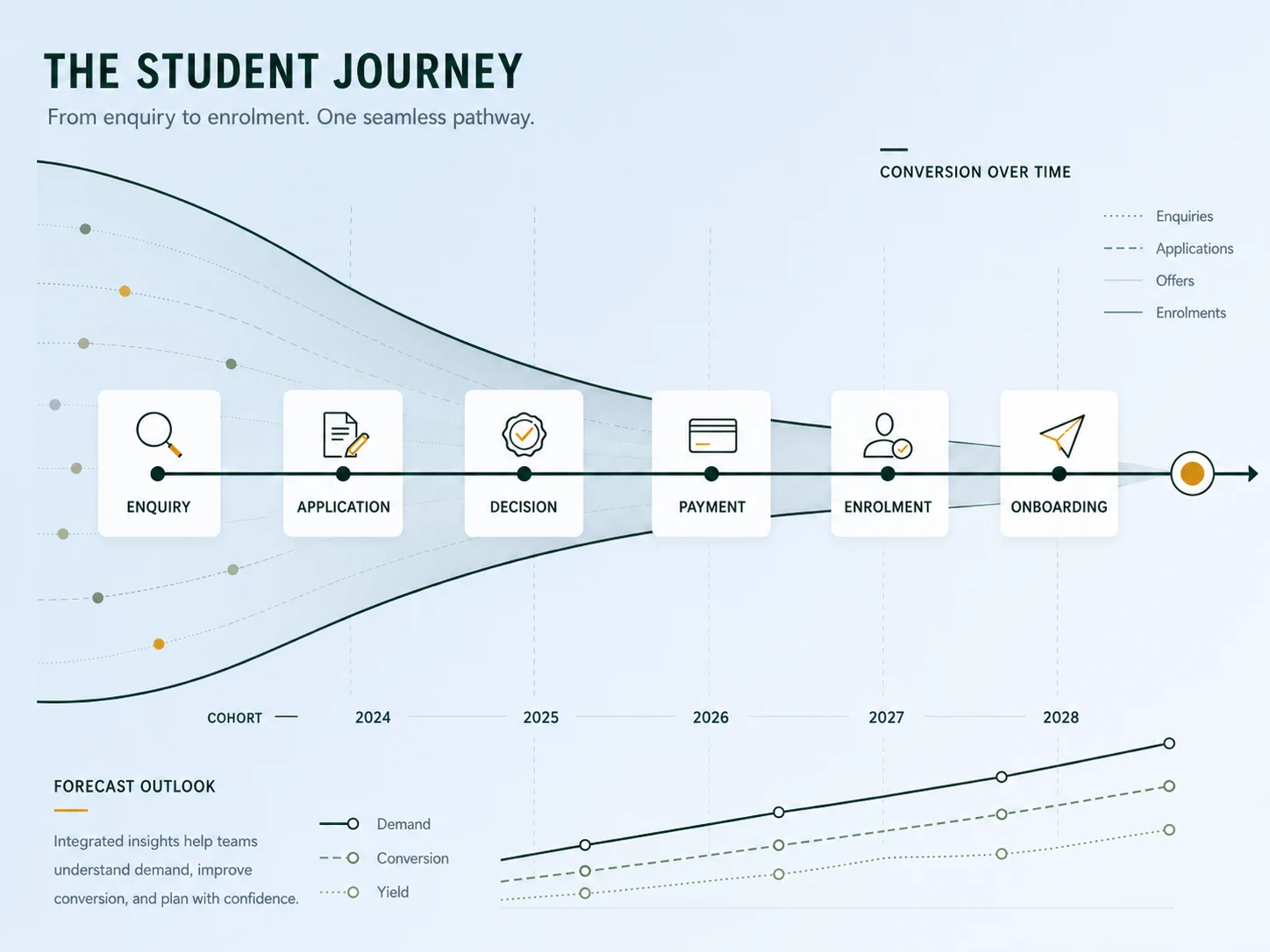
From the applicant's perspective, the journey is continuous. They enquire, they apply, they receive a decision, they accept, they pay a deposit, they enrol, they onboard, and at some point they become a student record in the system that will follow them through to graduation and beyond.
From the institution's perspective, that same journey is frequently split across four or five disconnected tools. The marketing CRM owns enquiry data. A separate application portal owns application data. Finance owns payment data in a different system again. The SIS owns the student record. Each handoff between these stages is a moment where data has to be re-entered, reconciled, or assumed — and each handoff is where things break.
A prospective student who attended an open day in March, applied in May, was offered a place in June, and paid a deposit in July may appear as four different entities across four different systems. Nobody on the team can answer a simple question — where are we with this candidate? — without opening multiple tabs and cross-referencing manually. That is the operational cost of fragmentation, and it scales badly. A team can manage it across 200 candidates. They cannot manage it across 2,000.
Most leakage clusters around a small number of recurring failure points. They are worth naming explicitly, because they are rarely dramatic — they are the kind of friction that compounds quietly across a cycle.
Slow follow-up after enquiry. Response times still matter. Candidates who hear back within hours convert measurably better than those who hear back within days, and the gap widens for international and executive learners who are evaluating several institutions in parallel.
Unclear next steps. Many applicants do not abandon out of disinterest. They abandon because the next action is not obvious. A confirmation email that does not specify what to do next is functionally a dead end.
Missing documents. Transcripts, references, English language certificates, and identity documents are the most common reason applications stall. Without an automated chase sequence, the burden falls on individual admissions officers to remember who owes what — and the queue grows.
Weak application reminders. A started application that goes quiet for two weeks is significantly less likely to be submitted. Most colleges have no systematic way to nudge it back to life.
Delayed decisions. Every day between application complete and decision issued is a day a competitor can move faster. Internal review processes that involve PDFs, email threads, and shared drives are usually where this time disappears.
Payment and deposit confusion. A confirmed offer that does not turn into a paid deposit is one of the most expensive forms of leakage, because the candidate has already chosen the institution. Broken payment flows, unclear deadlines, and finance teams operating in a separate system from admissions are the usual culprits.
Poor handoff from admissions to enrolment. A candidate who has paid is not yet enrolled. Course selection, document checks, visa support, induction scheduling, and SIS record creation all need to happen — and if they happen in disconnected systems with disconnected teams, candidates fall through the gap.
Lack of visibility into at-risk applicants. Teams cannot intervene on what they cannot see. Without a clear signal that a specific candidate has stalled, the intervention never happens.
The teams that manage enrolment well tend to share one trait: they can answer questions about the current cycle without opening a spreadsheet.
Funnel reporting, yield by programme, conversion by source, cohort forecasting, payment status, and progress against enrolment targets are not optional dashboards. They are the operational instruments by which the cycle is steered. When they require manual reconciliation across multiple systems, two things happen. First, the reports arrive too late to act on — last week's leakage is already last week's lost revenue. Second, the people producing them stop trusting the numbers, because every export disagrees slightly with every other export.
Leadership visibility suffers in the same way. A vice-principal who cannot see, in real time, how the current intake is tracking against target is a vice-principal making decisions on lagging information. That is a difficult position from which to defend yield, justify resource, or plan the next cycle.
The shift worth making is from periodic reporting to continuous visibility. Funnel performance should be live. Yield projections should update as offers are issued and deposits are paid. Payment status should be visible to admissions, not just finance. None of this is exotic — but it requires that the underlying data live in one place, or at least move cleanly between places.
Enrolment outcomes are influenced by admissions, marketing, finance, IT, operations, and academic teams. None of them owns the result on their own.
This is where many colleges struggle. Marketing is measured on enquiries. Admissions is measured on offers issued. Finance is measured on deposits collected. The registrar is measured on enrolled student records. Each team hits its own target while the institution misses its enrolment number, because the metrics do not connect and the handoffs are not anyone's specific responsibility.
A shared view of the student is the practical antidote. When everyone is looking at the same record — the same candidate, the same stage, the same outstanding actions — coordination becomes a matter of operational habit rather than escalation. Ownership can be defined by stage rather than by team, and the question of who is responsible for moving this candidate forward this week? becomes answerable.
Enrollment management, framed properly, is a cross-functional discipline. It belongs partly to every team that touches the journey and wholly to none of them.
The technology layer is not the whole answer, but it sets the ceiling for what process and team alignment can achieve. When the underlying enrollment management software is fragmented or limited, even well-designed processes inherit its constraints.
A few criteria are worth weighing carefully:
The market for student enrollment management software has matured considerably. There are several credible options, each with different strengths, and the right choice depends on the institution's size, programme mix, and operational maturity. A comparative view of the available platforms is more useful than evaluating any single product in isolation.
Software changes are not the only way forward, and they are rarely the fastest. Most colleges can recover meaningful yield by working on the process layer first.
Start by mapping the full student journey end to end — every stage, every system, every team involved, every communication. This is usually the first time anyone in the institution has seen the journey on a single page, and the bottlenecks become visible quickly.
Identify the handoff points. These are where most leakage occurs. For each one, define what data moves, who is responsible, and what the candidate experiences during the transition.
Remove duplicated data entry wherever it appears. Re-keying is both a cost and a source of errors that compound downstream.
Automate reminders and follow-up for the predictable, repetitive moments — incomplete applications, missing documents, unpaid deposits, induction confirmations. Admissions officers should be spending their time on judgement calls and relationship moments, not chase emails.
Define ownership by stage. Every stage of the funnel should have a named owner who is accountable for movement through it. This is more useful than defining ownership by team.
Align reporting definitions across teams. If marketing's converted enquiry is different from admissions' converted enquiry, the numbers will never agree and nobody will trust them.
Consolidate systems where consolidation is realistic. Not every tool needs to live in one platform, but the further the data lives apart, the more reconciliation work the team carries.
Review conversion and yield weekly during active cycles. Monthly is too slow. Quarterly is post-mortem.
Process improvements only go so far when the underlying systems are pulling against the team. There is usually a point at which the cost of stitching tools together outweighs the cost of consolidating them, and the signals are recognisable.
Reporting that requires manual reconciliation every week is a signal. So is a team duplicating work because the CRM and the application system do not share a record. Leadership without live funnel visibility is another. An applicant experience that feels disjointed — different logins, different branding, conflicting communications — is a fourth. When these accumulate, the institution is paying for fragmentation in time, in yield, and in candidate trust.
This is the point at which a unified approach becomes worth evaluating. The argument is not that any single platform is universally right, but that the operational case for consolidation is real and quantifiable when fragmentation is genuinely costing the institution. For teams beginning that evaluation, a comparative view of the best admissions and enrollment software platforms is a more useful starting point than a single vendor conversation.
Colleges do not only lose students because demand is weak. They lose them because the process between interested and enrolled is slow, unclear, fragmented, or hard to act on. Most of that is fixable, and most of it does not require more budget — it requires visibility, coordination, and the operational discipline to treat the student journey as one lifecycle rather than a series of disconnected stages.
Enrollment management, done well, is largely invisible. Candidates feel that the institution is organised, that decisions are timely, that next steps are obvious, and that someone knows who they are at every point. Teams feel that the cycle is steerable rather than reactive. Leadership sees the numbers they need, when they need them, without asking three people to produce them.
That is the work. It is unglamorous, mostly operational, and it protects more yield than another campaign usually can.
The development and maintenance of an in-house system is a complex and time-consuming task. Full Fabric lets you turn your full attention to maximizing growth and performance.