For most of the past two decades, the Student Information System has been treated as plumbing — quietly recording who is enrolled, on which programme, with which grades, paying which fees. Few people outside the registrar's office think about it. Fewer still consider it part of the educational experience.
That framing is increasingly out of step with how higher education actually operates. Programmes have become more varied. Student journeys are less linear. Reporting demands have intensified. Staff are stretched thinner. In this environment, the system that holds the institution's record of its students is no longer a back-office concern — it shapes what staff can do, what students experience, and what leaders can see.
This article is about how a modern SIS enhances education in practice: not by teaching, but by removing the friction that gets in the way of teaching, supporting, and deciding well.
The old view of the SIS as a database of student records is technically accurate and operationally misleading. Records are the artefact; they are not the point.
A student information system is the system that anchors academic, operational, and lifecycle data for every student the institution serves. It is the source of truth that admissions, finance, academic affairs, student services, and leadership all rely on — usually without realising how often they are relying on it. When that anchor is coherent, the institution behaves coherently. When it is fragmented across departmental tools, spreadsheets, and unreconciled exports, the institution behaves fragmentedly, regardless of how capable individual staff are.
This is why the SIS conversation has shifted. It is no longer about storage. It is about whether the institution can function as one organisation rather than a federation of disconnected processes.
Ask any student who has navigated a university admissions process, an enrolment cycle, and a fees query in the same year, and you will hear a familiar pattern: they have repeated themselves. Often many times. To admissions, then to the registry, then to student services, then to finance. Each conversation begins again from scratch.
This is not a service culture problem. It is a systems problem. When the people supporting students cannot see what has already happened — the previous enquiries, the documents submitted, the offer terms, the payment status, the academic progression to date — they cannot help quickly, and they cannot help with confidence.
A coherent SIS gives staff the right context at the right time. The admissions officer can see what stage the applicant has reached. The programme administrator can see which modules the student is registered for and what is outstanding. The finance team can see the fee schedule attached to the offer the student actually accepted. None of this is glamorous, but it is the difference between an institution that feels organised and one that feels like a maze.
Students notice. Trust accumulates in small moments — a phone call that does not require them to re-explain their situation, a portal that reflects what they were told yesterday, a deadline reminder that knows they have already submitted the document. These moments are produced by infrastructure.
Behind every cohort sits a small mountain of operational decisions: programme structures, module registration, attendance rules, assessment schedules, progression criteria, transcript generation, academic calendars. None of these are individually exotic. The difficulty is that they are interdependent, and they evolve every year.
When the SIS holds these structures natively — and applies them consistently to every student — the operational work is largely procedural. When it does not, it falls to people. Spreadsheets are maintained alongside the system. Module changes are tracked manually. Progression rules are interpreted case by case. Transcripts are assembled from multiple sources and reconciled at the end.
The cost of fragmentation here is not only the time it consumes. It is the error rate. Mistakes in academic operations — a missing grade, an incorrect module registration, an overlooked progression rule — affect students directly, and they are difficult to undo. A SIS that can express the institution's actual academic rules, rather than approximate them, removes a large category of preventable harm.
In many institutions, admissions and enrolment are run as separate operations, with separate tools, separate teams, and separate working assumptions. This is historically understandable. Admissions is a marketing-shaped problem; enrolment is a registry-shaped problem. They have different rhythms.
But the student does not experience two separate worlds. They experience one journey, in which they applied, were offered a place, accepted, and are now expected to register, pay, and begin studying. The moment between "applicant" and "student" is one of the most common places for institutional data to be lost — or, more often, re-entered.
A well-designed SIS preserves continuity across that handoff. The applicant record becomes the student record. The documents collected during admissions remain accessible. The offer terms, scholarships, and fee arrangements carry through. The programme and intake the student was admitted to is the programme and intake they are enrolled in, without anyone having to translate between systems.
This continuity has operational consequences beyond convenience. Onboarding becomes faster. Reporting on conversion and yield becomes trustworthy because admissions and enrolment data share a single definition. Leadership can finally answer questions that span the boundary — how many of last year's offer holders are now in good academic standing? — without commissioning a special exercise.
Leadership teams, regulators, and accreditation bodies all need reliable data. The reliability is not optional and the deadlines are not flexible. Yet in many institutions, producing a clean enrolment figure, a clean retention figure, or a clean diversity figure requires days of reconciliation work, because the data lives in several systems that do not agree.
This is rarely because anyone is careless. It is because each system was built around its own operational purpose, and the definitions diverged. The CRM counts an applicant differently from the SIS. The finance system counts a registered student differently again. The academic records system has its own view. When leadership asks how many students are currently enrolled on a given programme, the honest answer is often: it depends who you ask.
A modern SIS does not eliminate all reporting complexity. But by holding the canonical record — and by integrating cleanly with the systems that surround it — it removes the reconciliation tax. Reports stop being investigative exercises and start being routine outputs. Decisions get made on the same numbers across the institution, which is a quiet but significant change in how an institution governs itself.
There is a category of work in higher education that is rarely named but consumes enormous staff time: the work of making fragmented systems behave as if they were one. Manual exports between tools. Duplicate records cleaned up after the fact. Status chasing across email threads. Spreadsheets shared as the de facto source of truth because no system holds the answer. Cross-departmental coordination conducted entirely through meetings.
This work is invisible because it is distributed. No single person spends their week on it; everyone spends a slice of their week on it. Across an institution, the cumulative cost is substantial — not only in salaries, but in the support, advising, and academic work that does not happen because staff are reconciling instead.
A SIS that reduces this friction does not just save time. It changes what staff can do. Admissions officers can have longer conversations with prospective students. Programme administrators can spot a struggling student earlier. Student services teams can pre-empt problems rather than react to them. The connection to education is indirect but real: the quality of student support is partly a function of how much administrative noise the institution forces its staff to absorb.
Higher education is no longer organised solely around the traditional undergraduate or master's degree. Most institutions now run a mix of modular learning, executive education, short courses, stackable credentials, international cohorts, online and hybrid delivery, and partnerships of various shapes. Some of these are growing faster than the core degree portfolio.
Older SIS architectures were not built for this. They assumed annual intakes, fixed programme structures, and a relatively uniform student type. When an institution tries to run a six-week executive programme, a stackable certificate, or a cohort split across two countries through a system designed for three-year undergraduate degrees, the workarounds accumulate quickly — and the cost of launching new programmes rises.
This matters because programme innovation is one of the few genuine growth levers institutions have. If launching a new format requires months of operational engineering, it will not happen often, and the formats that do launch will be shaped by what the system can tolerate rather than by what the market needs. A modern SIS that handles varied programme structures natively does not, by itself, produce new programmes. But it removes the structural constraint that often kills them before they begin.
Selecting a SIS is a decision institutions live with for a long time. Replacements are disruptive and expensive, which means most procurement choices are made under the implicit assumption that this one will last. The criteria that matter are less about feature lists and more about the institutional behaviour the system enables.
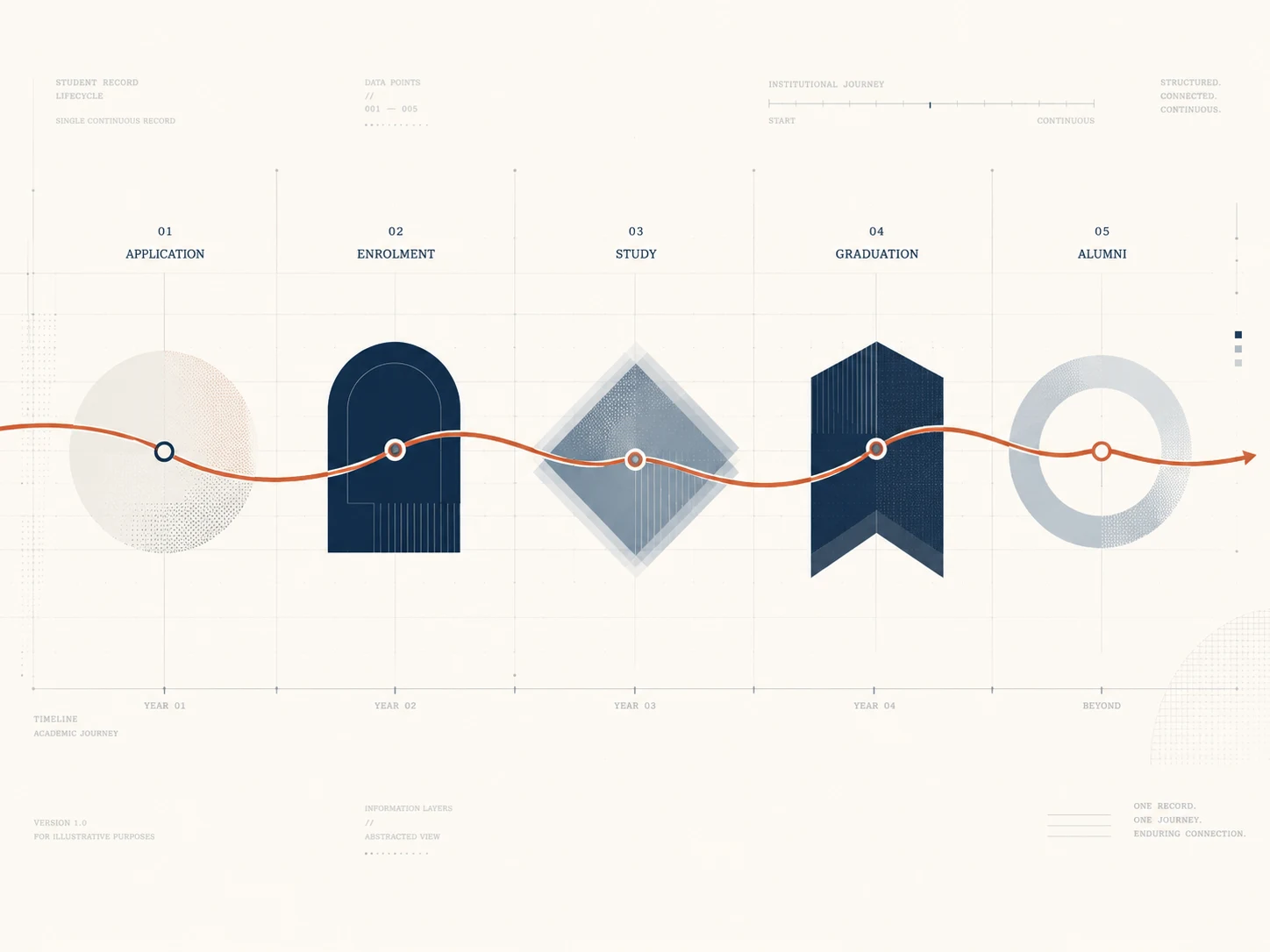
A single student record. One record that holds the entire lifecycle — enquiry, application, enrolment, study, graduation, alumni — rather than fragments distributed across departmental tools that have to be stitched back together later.
Admissions-to-enrolment continuity. The applicant record should become the student record without re-keying, reconciliation, or translation between systems. Offer terms, documents, fee arrangements, and intake details should carry through automatically.
Programme and module flexibility. The system should be able to express the institution's actual academic structures — including modular learning, executive education, short courses, and stackable credentials — rather than forcing every programme into a single template.
Reporting and compliance. Trustworthy figures should be a routine output, not a special exercise. The SIS should produce data leadership, regulators, and accreditation bodies can act on, without weeks of preparation each cycle.
Role-based access and audit trails. Internal governance and external regulators both depend on knowing who saw what, who changed what, and when. This should be built in, not retrofitted.
Clean integration with the surrounding stack. Finance, the LMS, the CRM, and admissions tools should connect through proper integrations, not ad hoc exports or manual reconciliation jobs maintained by one person who knows the spreadsheet.
Configurability for operational teams. The people closest to the work — registrars, programme administrators, admissions officers — should be able to adjust the system to reflect how the institution actually runs, without depending on a vendor or central IT for every change.
Lifecycle visibility. Leadership should be able to see students as whole journeys, not departmental snapshots. The same record should answer questions across admissions, enrolment, academic progression, and beyond.
Institutions weighing these criteria in detail may find it useful to compare the best student information systems for higher education against their own operational reality, rather than against a generic feature matrix. The systems that look strongest on paper are not always the ones that hold up under the actual texture of academic operations.
A Student Information System does not teach students. It does not advise them, mentor them, mark their work, or write their references. It is easy, on those grounds, to treat it as peripheral to the educational mission.
But education does not happen in isolation from the institution that hosts it. It happens in the context of admissions decisions, enrolment processes, programme structures, fee arrangements, academic progression rules, support services, and the dozens of small operational moments where a student encounters their university as an organisation. When those moments are clear and well-supported, education is easier — for students, for staff, and for leaders trying to make decisions about where to invest next.
This is the indirect logic of the SIS. Its value does not come from any single feature, but from the friction it removes at the points where friction matters most: the handoff from applicant to student, the coordination across departments, the reporting cycles, the launch of new programmes. Reduce that friction, and the consequences compound. Student support gets sharper, because staff are not buried in reconciliation. Decisions get better, because leaders are working from the same record as everyone else. Operations scale, because new programmes and cohorts do not require new workarounds.
A SIS, used well, makes the institution more coherent. Coherence is not the most exciting word in higher education. But it is one of the conditions under which good education becomes possible at scale.
The development and maintenance of an in-house system is a complex and time-consuming task. Full Fabric lets you turn your full attention to maximizing growth and performance.